



The experience of using Google Maps is different in certain locations. While you may get turn-by-turn driving instructions and street-level views with the tap of your finger in several countries, other locations may look blurry and are difficult to navigate by road. A user’s Google Maps experience is often linked to regulations in particular countries that curtail the use of satellite imaging and geographic surveys. This raises a set of questions about security and transparency.
Which countries resist being mapped, and why?
Several countries that have hostile relations with their neighbours or militant groups tend to resist being clearly mapped on Google’s navigation system. They fear that making detailed satellite imagery of their land easily available to users could lead to the targeting of critical infrastructure, or planning for potential attacks.
Countries like India, Israel, and South Korea have, over time, changed their tone on mapping. And these changes date back to a couple of decades earlier.
For instance, in 2007, BBC reported that India had asked Google to lower the level of detail in some Google Earth images, for security reasons. Nearly a decade later, in 2016, India resisted Google’s ask for ground-level photographs for its Street View offering. Street View only returned to the country in 2022. But, in late 2025, Google announced that it was boosting its Maps service with Gemini AI, allowing people to get personalised travel advice and ask questions. The company noted then that it had data for about 35 million places in India.
Israel is another country that poses a quandary to Google Maps users. Zoom lightly into multiple parts of Israel and you are likely to be met by extremely blurry houses and out-of-focus manmade structures, or blurred out areas adjoined to far more discernible zones. Near Gaza, however, users can zoom in to clearly see the devastating aftermath of Israel’s military action, such as the detailed rubble of the ruined Jabalia refugee camp market.
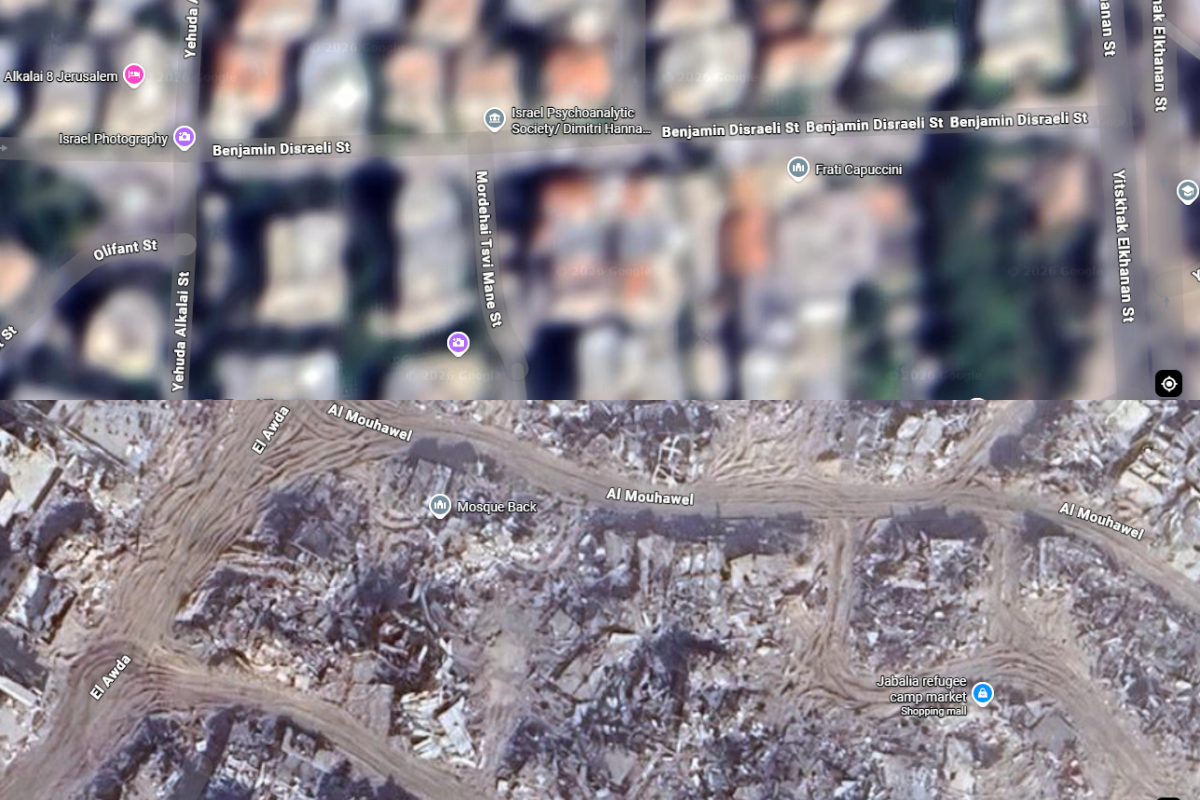
A comparison showing how locations on Google Maps can have different levels of clarity, featuring a blurry neighbourhood in Israel, pictured above, and a clearer image of Gaza, pictured below
| Photo Credit:
Map data ©2026 Google
Israel’s blurriness in Google Maps was previously due to a U.S. law known as the Kyl-Bingaman Amendment, which restricted the clarity of satellite images that show Israel and areas surrounding it. Enforced in 1997, it stipulated a resolution limit of two metres in Ground Sampling Distance (GSD), which measures how on-screen pixels translate to actual distances on the ground. In other words, a higher GSD value yields a less detailed and more blurry map, because less data is captured.
In July 2020, however, the U.S. Commerce Department published a Federal Register notice acknowledging that satellite imagery of Israel was available through other sources at a better resolution.
“The Department has therefore changed the existing resolution limit of 2.0 m GSD to 0.4 m GSD for U.S.-licensed satellite imaging of Israel,” stated the notice. In essence, this meant more detailed data for satellite imagery—and a clearer look at Israel on the map.
Amnon Harari, who was the head of space programmes at Israel’s Defence Ministry, was quoted by Reuters that month as saying that it was “always preferable to be seen blurred, rather than precisely.”
Despite the change in regulations, multiple locations in Israel are still blurred on Google Maps, though not necessarily on other mapping/navigation platforms.
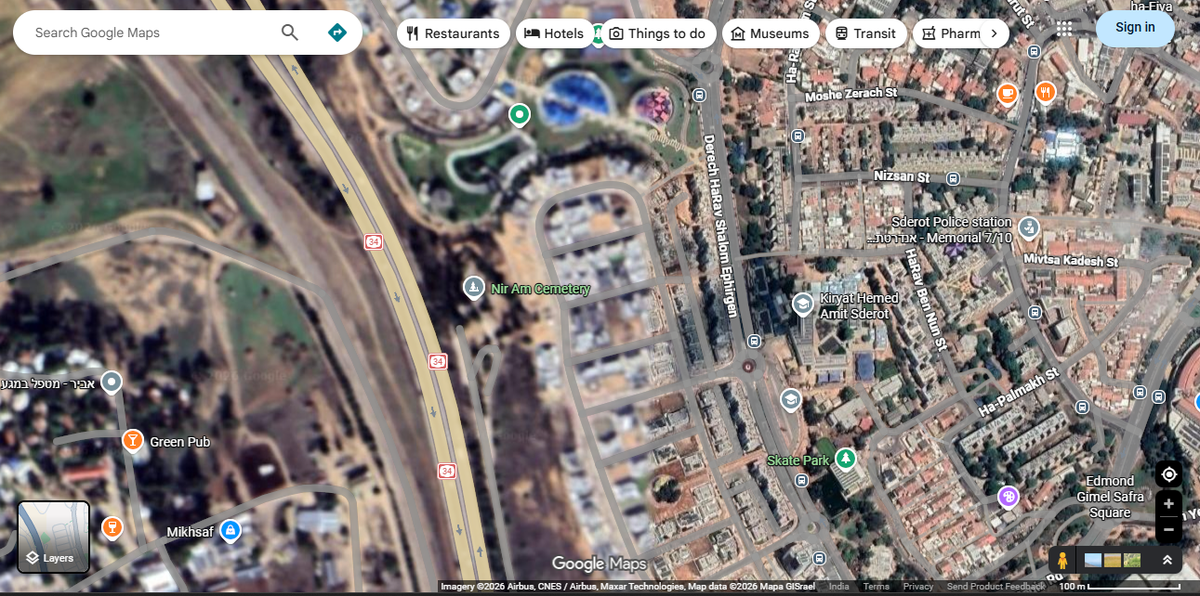
A screengrab of a section of Israel on Google Maps shows how both blurred and visible locations can be seen close to each other, even after regulations were changed
| Photo Credit:
Map data ©2026 Google
Several other countries have blurred out specific areas or particular landmarks on Google Maps, largely for security reasons, such as Interpol in France. On the other hand, entire patches of central Greenland and Antarctica are also difficult to explore in detail on Google Maps, with reasons for this including their climate.
South Korea, meanwhile, has pushed back against Google’s requests for better map data. In a translated statement from last year, the company noted that international tourists faced “great inconvenience upon entering the country,” claiming that the directions function of Google Maps was not available in Korea. Travellers instead use a local offering like Naver, which is restricted to showing South/North Korea, and parts of their neighbouring countries. However, Google claimed that it was only requesting “safe” data, or a “ ‘national basic map’ on a scale of 1:5000.”
Finally, after years of dialogue and negotiations, Google claimed its victory. In late February, it was announced that the internet giant would be allowed to export high-precision map data to servers located overseas.
Google’s Vice President Cris Turner said the company looked forward to bringing a ”fully functioning Google Maps to Korea,” per media statements. However, Korea’s government expects Google to fulfil its security conditions, such as blurring sensitive facilities, and not fully revealing the longitude and latitude coordinates for South Korean territory, reported Reuters. This easing of restrictions was a condition that the Trump administration had reportedly pushed for, per media outlets.
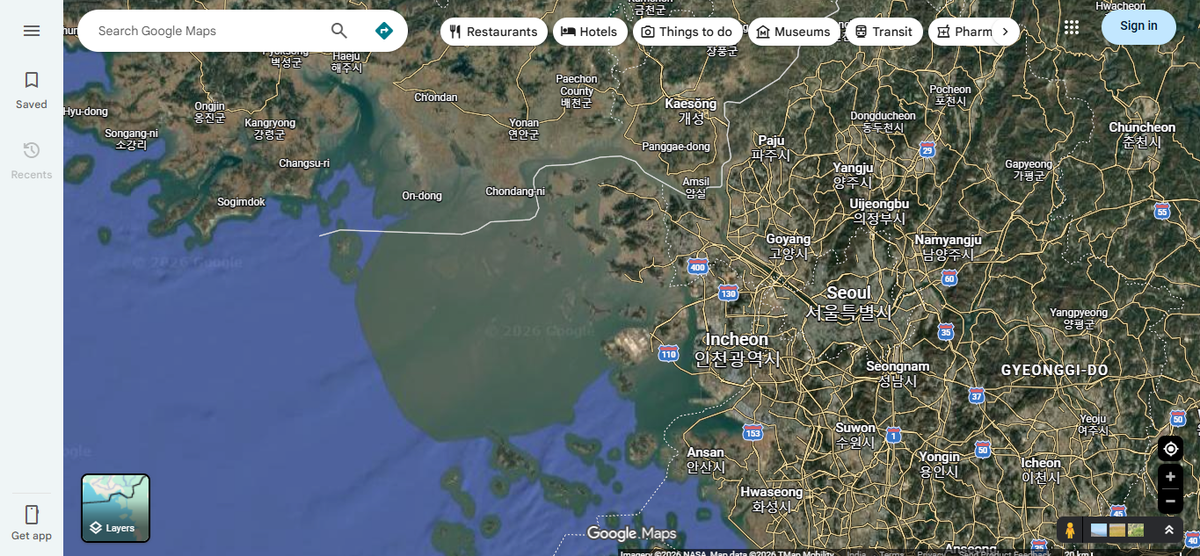
A screengrab from Google Maps showing the border between North and South Korea
| Photo Credit:
Map data ©2026 Google
How does greater mapping freedom affect Google and its users?
Google has explained that it uses techniques including photogrammetry to create its satellite-view of Maps, or a process where it puts together (satellite) imagery sourced from external providers. These include state agencies, geological survey organisations and commercial imagery providers, according to a Google blogpost from 2020.
From the company’s perspective, better quality data of popular, frequently visited places — such as South Korea — make navigation easier and safer for those using Google Maps in such locations.
Accurate satellite data also plays a crucial role in journalism and activism; images of Gaza rubble from multiple platforms were used to raise international awareness about Israel’s widespread bombing of civilian homes, even as the country insisted that it was targeting Hamas with precision.

Widening access to high-quality, verifiable satellite imagery is also helpful when detecting falsified images. Take the case of a satellite image published by Tehran Times, which claimed to show a destroyed U.S. base in Qatar, during the U.S.-Iran war this month. However, researchers soon identified this as an AI-edited fake image.
When Google Maps can obtain better satellite/mapping data, there is a definite benefit for its business as well. Once key cities and international hubs are mapped out in detail, this can ease the way for Google parent Alphabet to potentially deploy its Waymo robotaxis there while using its own navigational data, rather than depending on a third-party navigation company’s technology.
However, some South Korean experts have raised antitrust concerns, noting that Google’s enhanced access to Korea’s map data could make it harder for local companies like Naver to compete and hold their own against an international giant.
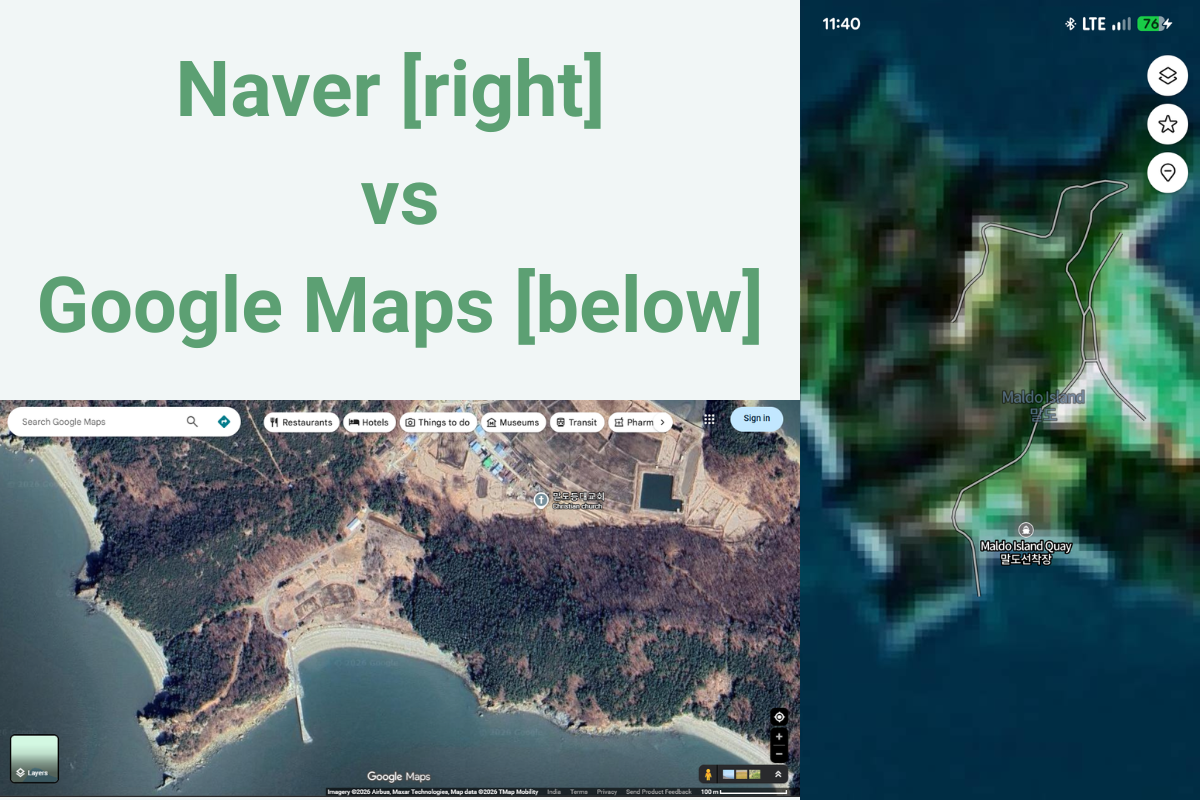
Visuals of the same island via Google Maps and Naver
| Photo Credit:
Map data ©2026 Google and Map data ©2026 Naver
As Google continues to juggle the navigational needs of billions of users with the security requests of their governments, the integrity of satellite images on Maps is not just a technology challenge, but an urgent geopolitical issue.
Published – March 13, 2026 04:47 pm IST