




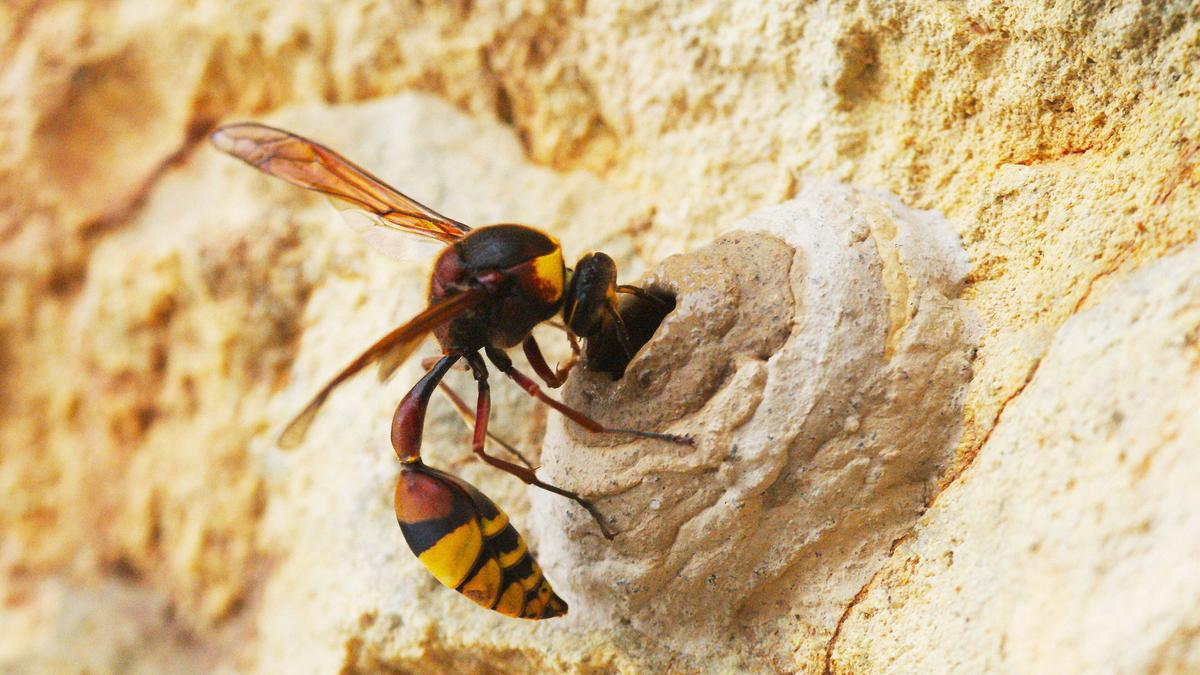
In many animals, sex is decided by obvious physical differences in the chromosomes. But in ants, bees, and wasps, sex is often decided in a more unusual way: by whether an embryo carries two different versions of a specific DNA region or two matching ones.
Two studies, one in Science Advances in 2024 and the other in Proceedings of the National Academy of Sciences in January 2026, have shown that this rule is controlled by a stretch of DNA that doesn’t even make a protein — and that the same basic setup has persisted across an unusually large span of evolutionary time.
The finding could be used to more closely monitor the diversity of these insects.
Genetic switch
The 2024 study focused on the Argentine ant (Linepithema humile), an invasive species. The researchers were motivated by a gap in what biologists know about sex determination in most insects: they understand some famous examples, like fruit flies, but many economically and ecologically important insects, including the 1.2 lakh species of ants, bees, and wasps, use methods whose core molecular triggers have been hard to pin down.
In these insects, females usually develop from fertilised eggs and have two chromosome sets while males usually develop from unfertilised eggs and have one. Sometimes, however, fertilised eggs produce diploid males, males with two chromosome sets, and they’re typically sterile. This is bad news for colonies and for species that are bred commercially or are trying to survive in the wild.
To find the genetic switch behind this method, the 2024 team compared DNA patterns in female ants and diploid males produced by inbreeding. They found a single small region in the genome where females were consistently ‘mixed’, i.e. carried two different versions, while diploid males were consistently ‘matched’, carrying two copies of the same version. In other words: being ‘mixed’ at this spot reliably predicted female development and being ‘matched’ predicted male development.
Remarkable findings
When the researchers looked closely at this sex-determining region, they made two remarkable observations. First, the region was extremely diverse. In the invasive European populations they sampled, the team could distinguish seven different versions, or alleles, of the region and the diversity around it was the highest they detected anywhere in the genome.
Second, and more surprising, the region didn’t contain any protein-coding gene that could work like a classic master switch. Instead the main gene overlapping the region produced a long noncoding RNA, which is an RNA molecule that is made from DNA but which isn’t translated into a protein.
The team called this gene ANTSR. The evidence suggested the main issue wasn’t which protein ANTSR makes — it makes none — but how strongly ANTSR is turned on. In embryos that were ‘mixed’ at the sex locus, ANTSR expression was higher. In embryos that were ‘matched’, ANTSR expression was lower.
Then the team connected ANTSR to a well-known downstream part of insect sex development, a gene called tra, which helps steer development towards male or female forms.
Argentine ants are not easy to genetically engineer, so the researchers used a technique called RNA interference. They injected embryos with double-stranded RNA designed to knock down ANTSR, lowering its activity. When they did this in embryos that were genetically destined to be female, about 10% switched to showing the male-type tra splicing pattern while the control embryos did not. In the paper’s wording, the knockdown results supported the idea that ANTSR sits upstream of tra and helps instruct female development.
So the 2024 conclusion was both specific and broad. In Argentine ants, the main readout of the sex locus seems to be whether ANTSR is strongly expressed and that ANTSR helps push the embryo into the female developmental pathway. More broadly, the study suggested a new kind of regulatory logic: instead of different protein keys fitting different protein locks, the signal may actually come from how two noncoding alleles interact to boost or fail to boost gene activity.

Conserved block
The second and more recent study, published on January 5, started from a bigger evolutionary mystery raised by the first. The 2024 paper found that ANTSR itself changes quickly at the sequence level. Yet the genomic neighbourhood around ANTSR looked similar across ants, bees, and stinging wasps.
Specifically, ANTSR sits in a conserved block between two protein-coding genes called CRELD2 and THUMPD3. The 2026 team checked if this was a coincidence by combining two approaches.
First, the researchers performed comparative genomics across dozens of bee, wasp, and ant genomes looking for matching gene order. This test would show whether CRELD2 and THUMPD3 flank an ‘empty’ interval where a noncoding locus could sit.
Second, they genetically mapped two lineages far from ants: bumblebees and hornets. The logic was that if a complementary sex-determining locus was operating, females should be ‘mixed’ at that locus while diploid males should be ‘matched’.
A similar pattern
In bumblebees (Bombus terrestris), the researchers had brothers and sisters mate and collected the early males. Genome sequencing showed that most of these early males were diploid. When the team compared their genomes, they found a single region that was consistently heterozygous in females and homozygous in diploid males. And that region included the candidate ANTSR locus.
They found a similar pattern in hornets: a single interval was consistently heterozygous in females but homozygous in diploid males, again overlapping the candidate ANTSR region.
They also looked for a distinctive genomic signature that such loci should leave behind. Complementary sex determination tends to maintain many alleles in a population because ‘matching’ at the locus produces sterile diploid males, which evolution doesn’t like to perpetuate.
This means in a species using such a system, that locus should be unusually diverse. The 2026 team reported that, across resequencing data from females of 17 species, most showed a sharp heterozygosity peak in the interval between CRELD2 and THUMPD3, consistent with a shared, rather than diverse, complementary sex-determining locus.

Practical implications
The findings challenge the standard expectation that insect sex-determining master switches turn over rapidly. The ANTSR locus looks like an exception: an ancient primary signal conserved for more than 150 million years, but in function and position rather than in its sequence. In other words, evolution may preserve what a DNA region does even when changing what it looks like.
The studies also have practical implications. Diploid male production is a real problem for many hymenopterans, including important pollinators and biological control insects. If the same genomic region can be tracked across many species, breeders and conservation biologists could measure how much diversity exists at the sex locus and manage matings or populations to reduce the chances of producing sterile males. The 2026 paper explicitly pointed to this use to monitor diversity of insects of the order Aculeata.
The studies together also offer a broader lesson about genomes: biologists often search for conserved biology by searching for conserved sequences. But the studies revealed not a conserved protein-coding gene but a conserved genomic slot.
D.P. Kasbekar is a retired scientist.
Published – February 24, 2026 05:30 am IST