Skip to content
  • Facebook
  • X
  • Linkedin
  • WhatsApp
  • Associate Journalism
  • About Us
  • Privacy Policy
  • 033-46046046
  • editor@artifex.news
Artifex.News

Artifex.News

Stay Connected. Stay Informed.

  • Breaking News
  • World
  • Nation
  • Sports
  • Business
  • Science
  • Entertainment
  • Lifestyle
  • Toggle search form
  • Israeli Strikes Kill Nine People In Gaza As Truce Talks Resume In Qatar
    Israeli Strikes Kill Nine People In Gaza As Truce Talks Resume In Qatar World
  • Mohammed Shami’s Legs Bandaged, Smoothness Lacking: Pacer To Miss 2nd T20I vs England Too?
    Mohammed Shami’s Legs Bandaged, Smoothness Lacking: Pacer To Miss 2nd T20I vs England Too? Sports
  • The Global South’s stand on Israel’s war in Gaza | Explained
    The Global South’s stand on Israel’s war in Gaza | Explained World
  • IndiGo Places Firm Order For 30 A350-900 Planes, Says Airbus
    IndiGo Places Firm Order For 30 A350-900 Planes, Says Airbus Nation
  • Sri Lanka to save over LKR1,000 million annually by slashing security of former Presidents
    Sri Lanka to save over LKR1,000 million annually by slashing security of former Presidents World
  • Access Denied World
  • New Year’s Eve LIVE: Celebrations begin as Kiribati rings in 2026
    New Year’s Eve LIVE: Celebrations begin as Kiribati rings in 2026 World
  • US Extends Greetings To India On 76th Republic Day
    US Extends Greetings To India On 76th Republic Day World
A turning point for nuclear deterrence

A turning point for nuclear deterrence

Posted on February 4, 2026 By admin


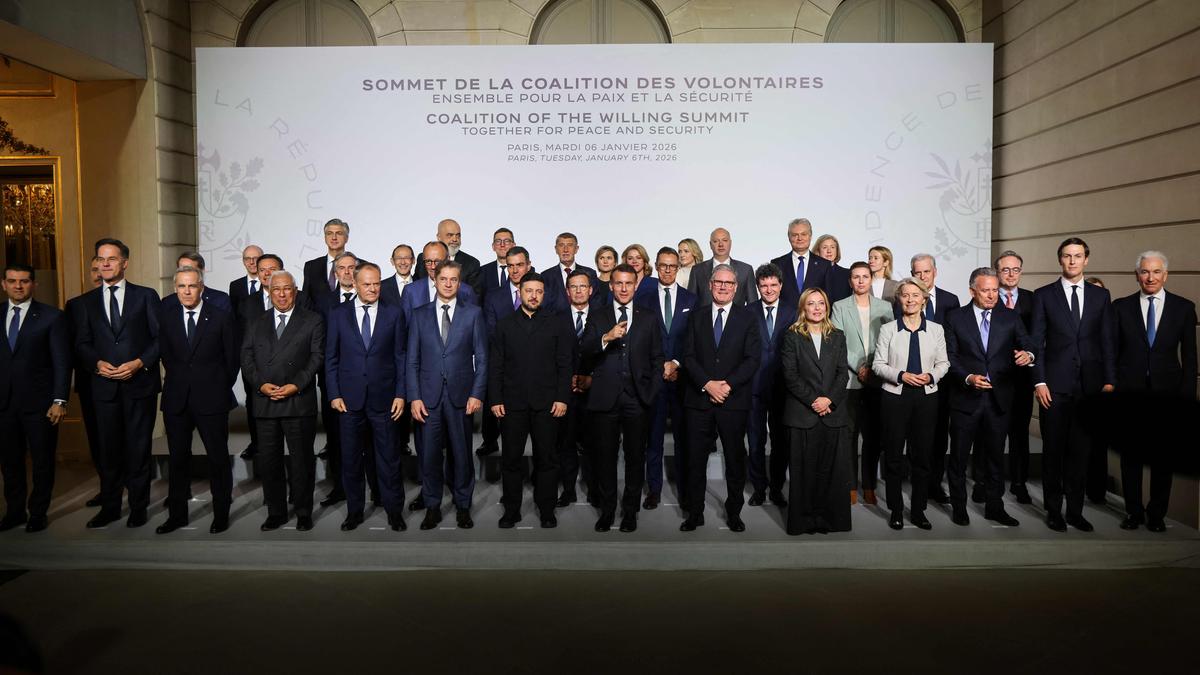
The Coalition of the Willing summit on security guarantees for Ukraine on January 6, 2026.
| Photo Credit: AFP

The rupture between Europe and Donald Trump’s U.S. over Greenland may be papered over in time, but Europe’s trust in the U.S. as a reliable North Atlantic Treaty Organization (NATO) ally has been irreparably broken. As the last remaining arms control treaty limiting Russia’s nuclear arsenal comes to an end, conversations about defending Europe are acquiring a sharper edge.

NATO came together in 1949 as a defensive nuclear alliance against the Soviet Union with the U.S. as its primus inter pares— the ultimate guarantor of the security of its western European members. Now, the hegemon has turned on its own alliance, over Mr. Trump’s desire to acquire Greenland, a sovereign territory under the jurisdiction of NATO member Denmark. Mr. Trump’s bullying and economic warfare has broken trust, and without trust NATO as a nuclear alliance is hollowed out. How Europe responds to this rupture will shape not only the future of the continent’s security, but also the future of conversations about nuclear deterrence. Depending on whether the new security architecture of Europe privileges nuclear deterrence, thinking about nuclear weapons will either be updated to reflect the lessons of the 80 years since a nuclear weapon was last detonated, or continue to echo conversations that took place when the Nuclear Non-Proliferation Treaty (NPT) separated the world into nuclear haves and have-nots.

The nuclear conversation

The intervening years since the NPT restrained horizontal proliferation have seen threats to world security shift from nuclear rivalry to terrorism and extremism; climate change; economic stress; inequality; and regional rivalries. While none of these is easily addressed by nuclear weapons, conversations about nuclear possession and use continue to privilege nukes as the ultimate guarantor of peace and security even as great power rivalry returns to the global stage.

Moreover, discussions about ‘what deters’ appear to have ossified. At the dawn of the nuclear age, when possessors were still building their arsenals, there was a debate on whether deterrence rested on certainty or uncertainty. Some believed that uncertainty was enough; that allowing an adversary to not be certain that any adventurism would not be countered with a nuclear response was enough for deterrence to work. A form of this deterrence arguably operated between India and Pakistan between the 1980s and 1998. Israel, with its opaque nuclear status, also relies on this uncertainty. For the rest of the nuclear possessors, a complex interplay of great power politics led to growing stockpiles and an emphasis on the certainty of a nuclear response. Testing demonstrated intent and number of weapons indicated resolve.

Yet, even as nuclear states were racing to stockpile warheads, a taboo on nuclear use was gaining strength. A nuclear weapon has not been deployed since 1945. While nuclear threats have been issued, and states have developed ever smaller and more ‘useable’ weapons (tactical or battlefield nukes), nuclear use, to the best of our knowledge, has never been seriously contemplated.

Arms control agreements between the U.S. and the Soviet Union/Russia, along with the global non-proliferation architecture may have contributed to sparing the world another Hiroshima, but thinking on nuclear deterrence remains essentially unchanged. And now, after a sharp reduction in nuclear stockpiles between the U.S. and Russia, the pendulum may be swinging back. 


Editorial | Neo-colonial shadows: on Trump, Greenland and his Davos talk

China, Russia and the U.S. are ambitiously modernising their nuclear stockpiles. China has reportedly added 100 warheads a year since 2023 to reach a total of 600. In 2015, the U.K. reversed a 2006 decision to reduce its stockpile and is at 225 warheads. The last remaining arms control agreement between Russia and the U.S. —New START — expires on February 5, and if both states start increasing their stockpiles from the current 5,459 and 5,277, respectively, it will send a clear message of moving back to Cold War ideas of deterrence. 

Lessons from Ukraine

The war in Ukraine should have led to a more serious debate about what deters. Russian President Vladimir Putin had made nuclear threats before his invasion and then again in October 2022. Yet those threats were countered not by the certainty of a nuclear response, but by the certainty of a robust response that left the nuclear element unclear. It is worth remembering that Ukraine — a non-nuclear country — has been able to defend itself against a nuclear adversary. Yes, it has had help and yes, it has lost territory, but Ukraine has not yet been defeated by its nuclear neighbour. 

Therefore, what happens in the next few months as Europe comes up with a security architecture that does not rely on the U.S could reshape nuclear thinking. 

Apart from some tepid discussion about how France and the U.K. might extend their nuclear umbrella to cover Europe, most of the previous debate appeared to return to hugging the U.S. ever closer. In the meantime, an ad hoc grouping of mainly European states, called the Coalition of the Willing, has come together to guarantee Ukraine’s security. Ukraine now has experience in defending itself against a nuclear state. Against this backdrop, whether Europe chooses to base its new security architecture on some sort of replacement nuclear alliance, or on a defensive alliance that may have a nuclear element, will shape future discussions about nuclear weapons and deterrence. 

Priyanjali Malik writes on nuclear politics and security.

Published – February 05, 2026 01:37 am IST



Source link

World Tags:Donald Trump quest for Greenland, NATO-U.S. ties over Greenland, Nuclear deterrence

Post navigation

Previous Post: Access Denied

Related Posts

  • Access Denied World
  • GenZ Indian-American running for Georgia State Senate raises over 0K
    GenZ Indian-American running for Georgia State Senate raises over $280K World
  • Airbus A320 software switch: Flight delays, cancellations likely; over 200 planes impacted
    Airbus A320 software switch: Flight delays, cancellations likely; over 200 planes impacted World
  • US Sanctions 4 Firms Aiding Pakistan’s Ballistic Missile Program
    US Sanctions 4 Firms Aiding Pakistan’s Ballistic Missile Program World
  • Access Denied World
  • Grenfell Tower was a ‘death trap’ due to failures by U.K. government and industry, inquiry finds
    Grenfell Tower was a ‘death trap’ due to failures by U.K. government and industry, inquiry finds World

More Related Articles

Scotland’s Yousaf set to resign as First Minister, U.K. media say Scotland’s Yousaf set to resign as First Minister, U.K. media say World
Access Denied World
Access Denied World
Access Denied World
Access Denied World
US Woman Sent 3-Year-Old Son Away To “Learn To Be A Man”. He Is Now Missing US Woman Sent 3-Year-Old Son Away To “Learn To Be A Man”. He Is Now Missing World
SiteLock

Archives

  • February 2026
  • January 2026
  • December 2025
  • November 2025
  • October 2025
  • September 2025
  • August 2025
  • July 2025
  • June 2025
  • May 2025
  • April 2025
  • March 2025
  • February 2025
  • January 2025
  • December 2024
  • November 2024
  • October 2024
  • September 2024
  • August 2024
  • July 2024
  • June 2024
  • May 2024
  • April 2024
  • March 2024
  • February 2024
  • January 2024
  • December 2023
  • November 2023
  • October 2023
  • September 2023
  • August 2023
  • July 2023
  • June 2023
  • May 2023
  • April 2023
  • March 2023
  • February 2023
  • January 2023
  • December 2022
  • November 2022
  • October 2022
  • September 2022
  • August 2022
  • July 2022
  • June 2022
  • May 2022

Categories

  • Business
  • Nation
  • Science
  • Sports
  • World

Recent Posts

  • A turning point for nuclear deterrence
  • Access Denied
  • Access Denied
  • Access Denied
  • Access Denied

Recent Comments

  1. DennisEpist on UP Teacher Who Asked Students To Slap Muslim Classmate
  2. CraigPaync on UP Teacher Who Asked Students To Slap Muslim Classmate
  3. DennisEpist on UP Teacher Who Asked Students To Slap Muslim Classmate
  4. Josephfeemy on UP Teacher Who Asked Students To Slap Muslim Classmate
  5. Zacheryfut on UP Teacher Who Asked Students To Slap Muslim Classmate
  • Access Denied World
  • Access Denied World
  • US Sends Back Illegal Indian Immigrants On Chartered Flight Ahead Of Polls
    US Sends Back Illegal Indian Immigrants On Chartered Flight Ahead Of Polls Nation
  • Access Denied Sports
  • At G7, Blinken seeks European support for pressure on China
    At G7, Blinken seeks European support for pressure on China World
  • WikiLeaks’ Julian Assange pleads guilty in deal with U.S. that secures his freedom: Watch Video
    WikiLeaks’ Julian Assange pleads guilty in deal with U.S. that secures his freedom: Watch Video World
  • IMF Confirms That Cash-Strapped Pakistan Is Seeking 24th Bailout
    IMF Confirms That Cash-Strapped Pakistan Is Seeking 24th Bailout World
  • The Science Quiz: The evolutionary edge to human survival
    The Science Quiz: The evolutionary edge to human survival Science

Editor-in-Chief:
Mohammad Ariff,
MSW, MAJMC, BSW, DTL, CTS, CNM, CCR, CAL, RSL, ASOC.
editor@artifex.news

Associate Editors:
1. Zenellis R. Tuba,
zenelis@artifex.news
2. Haris Daniyel
daniyel@artifex.news

Photograher:
Rohan Das
rohan@artifex.news

Artifex.News offers Online Paid Internships to college students from India and Abroad. Interns will get a PRESS CARD and other online offers.
Send your CV (Subjectline: Paid Internship) to internship@artifex.news

Links:
Associate Journalism
About Us
Privacy Policy

News Links:
Breaking News
World
Nation
Sports
Business
Entertainment
Lifestyle

Registered Office:
72/A, Elliot Road, Kolkata - 700016
Tel: 033-22277777, 033-22172217
Email: office@artifex.news

Editorial Office / News Desk:
No. 13, Mezzanine Floor, Esplanade Metro Rail Station,
12 J. L. Nehru Road, Kolkata - 700069.
(Entry from Gate No. 5)
Tel: 033-46011099, 033-46046046
Email: editor@artifex.news

Copyright © 2023 Artifex.News Newsportal designed by Artifex Infotech.