
Skip to content
  • Facebook
  • X
  • Linkedin
  • WhatsApp
  • YouTube
  • Associate Journalism
  • About Us
  • Privacy Policy
  • 033-46046046
  • editor@artifex.news
Artifex.News

Artifex.News

Stay Connected. Stay Informed.

  • Breaking News
  • World
  • Nation
  • Sports
  • Business
  • Science
  • Entertainment
  • Lifestyle
  • Toggle search form
  • Premier League: Manchester United Sink Everton To Boost Top Four Bid
    Premier League: Manchester United Sink Everton To Boost Top Four Bid Sports
  • NZ vs SA third T20I: Tom Latham shines as New Zealand beats South Africa to lead series 2-1
    NZ vs SA third T20I: Tom Latham shines as New Zealand beats South Africa to lead series 2-1 Sports
  • Ukrainian strike on college in Russian-occupied town kills 18: officials
    Ukrainian strike on college in Russian-occupied town kills 18: officials World
  • Britain’s Defence Ministry Hit By Cyberattack, Ex-Minister Targets China
    Britain’s Defence Ministry Hit By Cyberattack, Ex-Minister Targets China World
  • Rahul Gandhi To Students In US University of Texas at Dallas
    Rahul Gandhi To Students In US University of Texas at Dallas Nation
  • New Frog Species Named After Hollywood Actor Leonardo DiCaprio
    New Frog Species Named After Hollywood Actor Leonardo DiCaprio World
  • Access Denied
    Access Denied Nation
  • Senior Himachal Officer, 7 Cops Convicted In Custodial Death Of Rape-Murder Accused
    Senior Himachal Officer, 7 Cops Convicted In Custodial Death Of Rape-Murder Accused Nation
Trump’s oil blockade pushes Cuba to the brink

Trump’s oil blockade pushes Cuba to the brink

Posted on February 4, 2026 By admin


In what is potentially an existential crisis for the socialist nation, Cuba is left with just 15 to 20 days of oil at current levels of demand and domestic production, according to the data analytics firm Kpler. The crisis was triggered by the U.S. military operations in Venezuela that abducted President Nicolás Maduro.

The attack followed a naval blockade that led to the U.S. illegally interdicting ships transporting oil from Venezuela to countries, including Cuba. It has been exacerbated by an executive order signed by U.S. President Donald Trump on January 29, which threatens punitive tariffs on any country selling oil to Cuba.

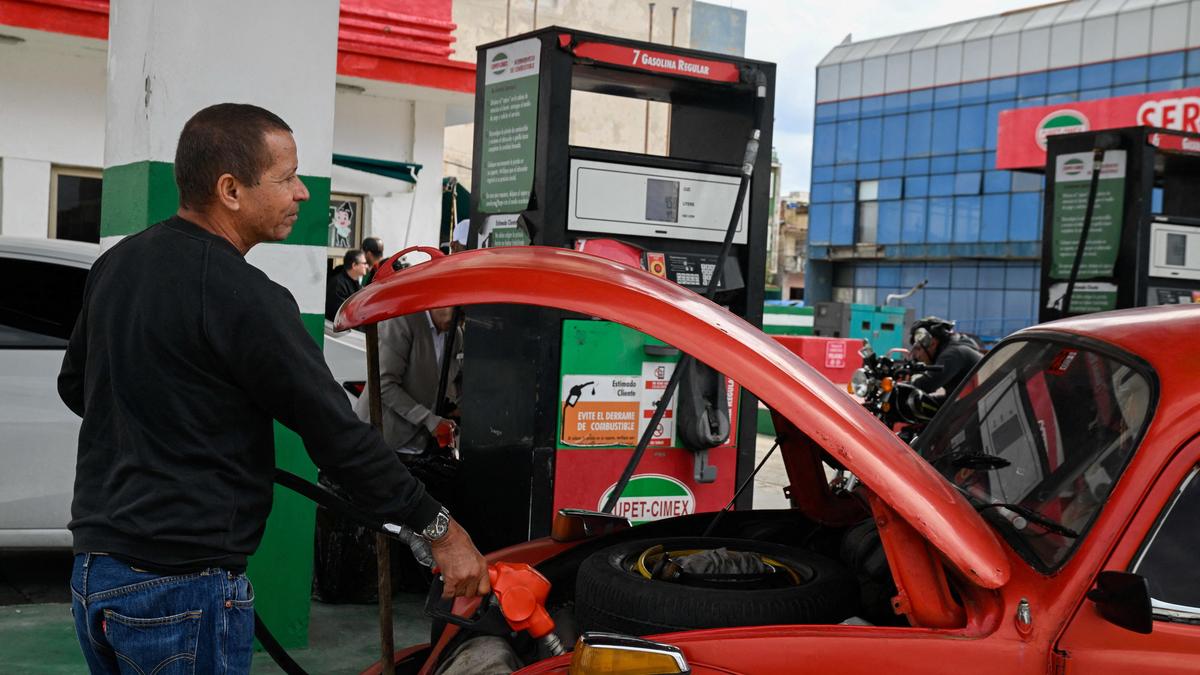
Cuba’s dependence on oil is structural as it accounts for 83% of total power generation and oil products make up 56% of total energy consumption across industry, transport, agriculture and households. For a country that imports roughly 80% of its food, power blackouts are catastrophic, as they disrupt refrigeration that is vital to preserving perishables.

The Venezuelan oil that flowed to Cuba, under the oil-for-doctors scheme instituted by former Venezuelan President Hugo Chávez, was a major lifeline for the nation and its primary source of imported oil. In 2022, Venezuela supplied 75% of Cuba’s crude oil imports. This dropped to 58% in 2023, when Cuba diversified as Mexico emerged as a significant supplier with a 31% share. By 2025, after Mr. Trump returned to power, oil imports had shrunk drastically. Venezuela still supplied an average of 46,500 barrels of oil per day to Cuba in December 2025, before this dropped to zero following Mr. Maduro’s abduction.

Mexico stepped in to fill the gap, but the January 29 order put enormous pressure on the country and its President Claudia Sheinbaum. She initially called the halting of a planned shipment a “sovereign decision”. But Mr. Trump claimed on Saturday that Ms. Sheinbaum had agreed to stop oil shipments at his request—a claim she explicitly denied, stating, “We never discussed with President Trump the issue of oil with Cuba.”

She later said Mexico was “exploring all diplomatic avenues” to send fuel as humanitarian aid. The threat that Mexico’s crude could be seized if Mr. Trump proceeded with a total oil blockade appears to have constrained Mexico’s options, particularly with a key free-trade pact with the U.S. and Canada up for renegotiation this year.

Economic coercion

The current crisis in Cuba is also the culmination of a six-decade-old policy of economic coercion by the U.S. What Cubans refer to as the “blockade” began in 1962 following the Cuban Revolution and nationalisation of industries, including foreign-owned enterprises. This embargo was later reinforced in 1992 by the “Torricelli Act”, which prohibited foreign subsidiaries of U.S. firms from trading with Cuba and barred ships that had docked in Cuba from entering U.S. ports for 180 days.

The 1996 Helms-Burton Act codified the embargo into law, extended sanctions to foreign companies doing business in Cuba, and allowed U.S. citizens to sue foreign investors using confiscated American property. The first Trump administration redesignated Cuba as a “State Sponsor of Terrorism” in January 2021, days before leaving office, deepening its financial exclusion from world trade. Cuban authorities have documented over 1,000 instances of foreign banks refusing services between 2021 and 2024.

Call for regime change

In the second Trump administration, U.S. policy towards Cuba is fronted by Secretary of State Marco Rubio, the son of Cuban immigrants who left Cuba in 1956. Mr. Rubio grew up immersed in Miami’s Cuban émigré community, where memories of the island and deep hostility towards the Castro government have remained powerful forces. He has openly called for regime change in Havana. “This is our hemisphere,” Mr. Rubio declared on X after the January 3 attack on Venezuela.

Cuba has weathered severe economic crises before. Following the collapse of the Soviet Union—Cuba’s major trading partner, which had provided subsidies averaging $4.3 billion annually—the island endured what it termed the “Special Period” through the 1990s. GDP fell by 35% between 1989 and 1993, and Cubans faced severe food shortages. The government responded with partial economic liberalisation, allowing small businesses and decriminalising the circulation of U.S. dollars. More recently, it has permitted the establishment of micro, small and medium enterprises (MSMEs). But these reforms have proved insufficient against the combined weight of the embargo and subsequent sanctions.

The current crisis may be more severe. The Special Period came with suffering but also with the eventual emergence of Venezuela as an economic lifeline under Hugo Chávez in the 2000s. Today, that lifeline has been severed by U.S. military action, and the executive order explicitly threatens any government contemplating humanitarian relief through fuel supplies.

The January 29 executive order declares Cuba “an unusual and extraordinary threat” to U.S. national security, citing alleged alignment with Russia, China, Iran, Hamas and Hezbollah. It claims Cuba “hosts Russia’s largest overseas signals intelligence facility” and provides “a safe haven for transnational terrorist groups”. No evidence has been provided for these allegations.

Defiant Havana 

Cuba’s Foreign Ministry has categorically denied accommodating, supporting, financing, or permitting terrorist groups, and has offered to cooperate with the U.S. on counter-terrorism, anti-money laundering, drug trafficking, and cybersecurity. The executive order also accuses Cuba of “destabilising the region through migration”, an assertion that inverts cause and effect, given that Cuban migration is driven substantially by economic hardship resulting from U.S. sanctions.

The Cuban government has remained defiant. President Miguel Díaz-Canel posted on X: “The harshness of these times and the brutality of the threats against Cuba will not hold us back.” Meanwhile, Mr. Trump has suggested negotiations are underway, stating, “I think we’re going to make a deal with Cuba,” though he offered no specifics. Mr. Trump’s actions suggest this is less an opening than another pressure tactic aimed at bringing down the communist government. One outcome, however, is certain: ordinary Cubans—already enduring 12-hour-plus power blackouts and severe fuel shortages—will bear the brunt of the situation.

Published – February 04, 2026 05:19 pm IST



Source link

World Tags:Cuban oil crisis, Cuba’s energy crisis, Oil shock pushes Cuba to brink, U.S. military operations in Venezuela, US sanctions on Cuba

Post navigation

Previous Post: Access Denied
Next Post: Access Denied

Related Posts

  • Sri Lanka’s former police chief found dead
    Sri Lanka’s former police chief found dead World
  • Access Denied World
  • Air ambulance delay defers Bangladesh ex-PM Zia’s departure to London to Sunday: BNP
    Air ambulance delay defers Bangladesh ex-PM Zia’s departure to London to Sunday: BNP World
  • Turkish President Recep Tayyip Erdogan Raises Kashmir Issue During UN General Assembly Address
    Turkish President Recep Tayyip Erdogan Raises Kashmir Issue During UN General Assembly Address World
  •  Million Settlement For Family Of Black Woman Shot Dead By US Police
    $10 Million Settlement For Family Of Black Woman Shot Dead By US Police World
  • Access Denied World

More Related Articles

Israel-Hezbollah ceasefire: Israel army says hit dozens of Hezbollah targets before ceasefire Israel-Hezbollah ceasefire: Israel army says hit dozens of Hezbollah targets before ceasefire World
Access Denied World
Israel’s Netanyahu agrees to join Trump’s Board of Peace Israel’s Netanyahu agrees to join Trump’s Board of Peace World
Gunmen open fire at soccer field in central Mexico, killing 11 and wounding 12 Gunmen open fire at soccer field in central Mexico, killing 11 and wounding 12 World
Diella | Virtual minister – The Hindu Diella | Virtual minister – The Hindu World
Norway palace declares court mourning, cancels activities until October 9 Norway palace declares court mourning, cancels activities until October 9 World
SiteLock

Archives

  • September 2026
  • August 2026
  • July 2026
  • June 2026
  • May 2026
  • April 2026
  • March 2026
  • February 2026
  • January 2026
  • December 2025
  • November 2025
  • October 2025
  • September 2025
  • August 2025
  • July 2025
  • June 2025
  • May 2025
  • April 2025
  • March 2025
  • February 2025
  • January 2025
  • December 2024
  • November 2024
  • October 2024
  • September 2024
  • August 2024
  • July 2024
  • June 2024
  • May 2024
  • April 2024
  • March 2024
  • February 2024
  • January 2024
  • December 2023
  • November 2023
  • October 2023
  • September 2023
  • August 2023
  • July 2023
  • June 2023
  • May 2023
  • April 2023
  • March 2023
  • February 2023
  • January 2023
  • December 2022
  • November 2022
  • October 2022
  • September 2022
  • August 2022
  • July 2022
  • June 2022
  • May 2022

Categories

  • Business
  • Nation
  • Science
  • Sports
  • World

Recent Posts

  • Donald Trump seeks to bring health-research funding under his control, Politico reports
  • Residents want dislodged railings along tracks on GST Road in East Tambaram fixed and opening on Sudhanandha Bharati Salai closed
  • The Hindu Foundation Day: revisiting the journey
  • Medians needed at sharp bends in Guindy – The Hindu
  • Why has the U.S. deployed ‘weapons’ in space? | Explained

Recent Comments

  1. DonaldFrosy on UP Teacher Who Asked Students To Slap Muslim Classmate
  2. DonaldFrosy on UP Teacher Who Asked Students To Slap Muslim Classmate
  3. YWgliuZUXRuWYumGOFzzpY on UP Teacher Who Asked Students To Slap Muslim Classmate
  4. AlvinNet on UP Teacher Who Asked Students To Slap Muslim Classmate
  5. AlvinNet on UP Teacher Who Asked Students To Slap Muslim Classmate
  • Epic Group’s 0 million-garment manufacturing unit inaugurated in Odisha
    Epic Group’s $100 million-garment manufacturing unit inaugurated in Odisha Business
  • Iran rejects latest ceasefire proposal as Trump deadline approaches
    Iran rejects latest ceasefire proposal as Trump deadline approaches World
  • Pakistan vs Bangladesh Live Score, 1st Test Day 2: Rizwan, Shakeel Look To Revive Pakistan
    Pakistan vs Bangladesh Live Score, 1st Test Day 2: Rizwan, Shakeel Look To Revive Pakistan Sports
  • U.S. FDA issues seven observations to Dr. Reddy’s biologics manufacturing facility in Hyderabad
    U.S. FDA issues seven observations to Dr. Reddy’s biologics manufacturing facility in Hyderabad Nation
  • Access Denied World
  • Access Denied
    Access Denied Nation
  • Deal to force multinational companies to pay 15% minimum tax is marred by loopholes: EU Tax Observatory
    Deal to force multinational companies to pay 15% minimum tax is marred by loopholes: EU Tax Observatory Business
  • Access Denied
    Access Denied Nation

Editor-in-Chief:
Mohammad Ariff,
MSW, MAJMC, BSW, DTL, CTS, CNM, CCR, CAL, RSL, ASOC.
editor@artifex.news

Associate Editors:
1. Zenellis R. Tuba,
zenelis@artifex.news
2. Haris Daniyel
daniyel@artifex.news

Photograher:
Rohan Das
rohan@artifex.news

Artifex.News offers Online Paid Internships to college students from India and Abroad. Interns will get a PRESS CARD and other online offers.
Send your CV (Subjectline: Paid Internship) to internship@artifex.news

Links:
Associate Journalism
About Us
Privacy Policy

News Links:
Breaking News
World
Nation
Sports
Business
Entertainment
Lifestyle

Registered Office:
72/A, Elliot Road, Kolkata - 700016
Tel: 033-22277777, 033-22172217
Email: office@artifex.news

Editorial Office / News Desk:
No. 13, Mezzanine Floor, Esplanade Metro Rail Station,
12 J. L. Nehru Road, Kolkata - 700069.
(Entry from Gate No. 5)
Tel: 033-46011099, 033-46046046
Email: editor@artifex.news

Copyright © 2023 Artifex.News Newsportal designed by Artifex Infotech.