



Skip to content
  • Facebook
  • X
  • Linkedin
  • WhatsApp
  • Associate Journalism
  • About Us
  • Privacy Policy
  • 033-46046046
  • editor@artifex.news
Artifex.News

Artifex.News

Stay Connected. Stay Informed.

  • Breaking News
  • World
  • Nation
  • Sports
  • Business
  • Science
  • Entertainment
  • Lifestyle
  • Toggle search form
  • 427 Runs In 20 Overs, 52 In Just One! Argentina Women’s Cricket Team Shatters Multiple World Records
    427 Runs In 20 Overs, 52 In Just One! Argentina Women’s Cricket Team Shatters Multiple World Records Sports
  • Access Denied Sports
  • Indian Squad For Special Olympics Asia Pacific Bocce And Bowling Competition Announced
    Indian Squad For Special Olympics Asia Pacific Bocce And Bowling Competition Announced Sports
  • Nepal PM Loses Vote Of Confidence In Parliament
    Nepal PM Loses Vote Of Confidence In Parliament World
  • Australian Employees Now Have Right To Ignore Work Calls After Office Hours
    Australian Employees Now Have Right To Ignore Work Calls After Office Hours World
  • Markets decline in early trade amid weak global trends
    Markets decline in early trade amid weak global trends Business
  • Access Denied
    Access Denied Nation
  • Goa Chief Minister’s Wife Files Rs 100 Crore Defamation Suit Against AAP’s Sanjay Singh
    Goa Chief Minister’s Wife Files Rs 100 Crore Defamation Suit Against AAP’s Sanjay Singh Nation
The Doomsday Clock shows the danger, but not a way-out for the world

The Doomsday Clock shows the danger, but not a way-out for the world

Posted on January 29, 2026 By admin


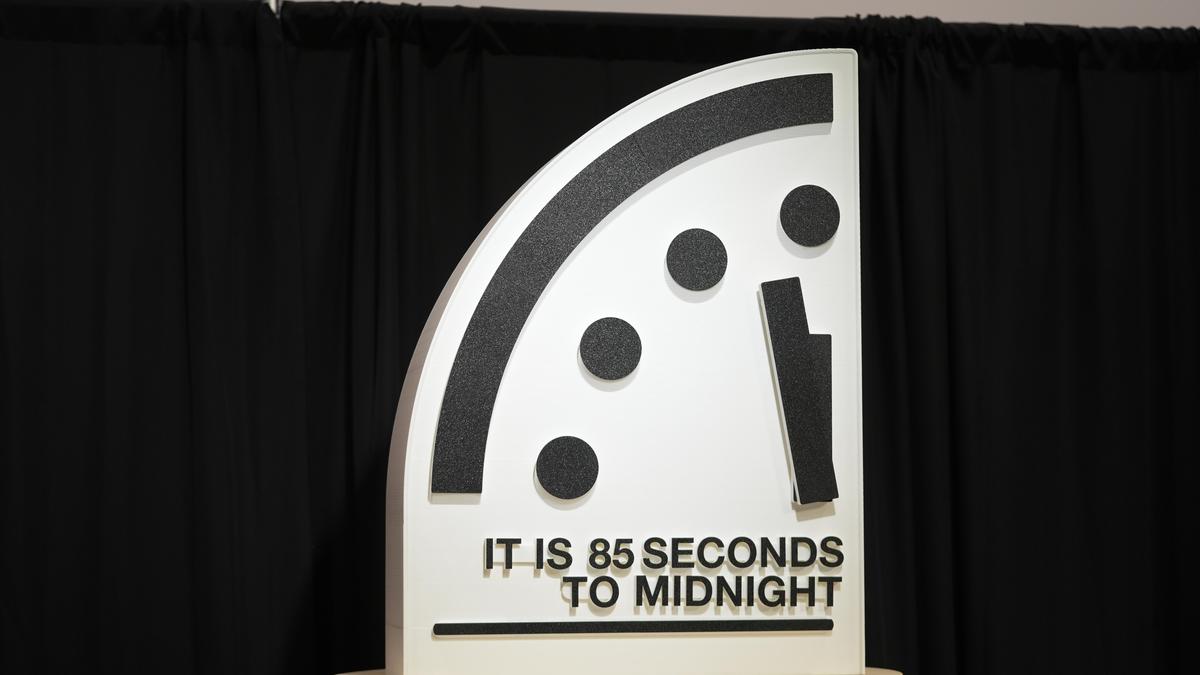
The Doomsday Clock, set at 85 seconds to midnight, is displayed during a news conference on January 23, in Washington
| Photo Credit: AP

On January 27, the Bulletin of the Atomic Scientists moved its Doomsday Clock to 85 seconds to midnight, the closest it has been to the metaphorical point of global catastrophe. The Doomsday Clock is historically significant because it transformed the abstract, technical threat of nuclear war into a universally understood symbol of urgency. Since the so-called Chicago group of scientists involved in the Manhattan Project created it in 1947, the clock has bridged the gap between scientific experts and the general public, forcing the world to confront the reality of potential self-destruction through a simple visual metaphor.

As the Bulletin has moved the clock’s hands back and forth, but mostly forth, their movements have validated major arms control treaties or condemned dangerous escalations like the hydrogen bomb. And in the last eight decades it has become a cornerstone of the cultural framework that treats nuclear weapons and climate change as existential, rather than just political, problems.

But for all the ease with which the clock has raised alarms — thanks in no small part to its iconic design by the American artist Martyl Langsdorf — the clock has also failed to put out the fires. This is because the clock banks on the idea that if you show people a sufficiently frightening picture of their future, they will demand change. But history is clear that this strategy is flawed: while the clock has successfully branded the apocalypse, it has failed to overcome the political gridlock that actually drives the arms race.

That said, perhaps its most significant achievement is to set the agenda. Before the clock, nuclear strategy was a secret language spoken only by generals and physicists. The Bulletin changed that by creating a symbol everyone could understand, one of the number of minutes to midnight. This was clever because it forced the media to talk about nuclear risk every single year. It turned abstract scientific ideas into a story about time running out. When the U.S. and the Soviet Union signed major arms control treaties in the late 1980s and when the Copenhagen Summit concluded in 2009 with the 2º C climate goal, the clock moved backwards, giving people a clear way to see that diplomacy was working.

Unfortunately for the clock, constant fear often leads to paralysis, an effect psychologists call psychic numbing. When the clock stayed at two minutes to midnight for decades or hovered at 90 seconds as it did recently, its shock value wore off. Instead of rushing to fix the problem, people get used to living on the edge of destruction. Keeping the alert level so high for so long unintentionally normalised the very danger the Bulletin wished to eliminate. It’s understandable: if it’s always the end of the world, people stop believing the end is actually coming.

Equally understandably, the clock hasn’t been able to change the behaviour of national governments. The scientists behind the clock have appealed to securing the safety of the human race — what could be more important? — but governments have increasingly cared only about the safety of their own borders. And these goals often clash. For instance when India and Pakistan tested nuclear weapons in 1998, the Clock moved forward to condemn them, yet that condemnation meant nothing to the leaders in New Delhi or Islamabad, who believed they needed the weapons to survive. Even the current setting of 85 seconds to midnight is proof of this restriction: the fact that we’re closer to doom now than at any point in the Cold War suggests the people with the power to launch the missiles have ignored the clock’s warnings.

Too many threats

The clock’s effectiveness was further complicated when the Bulletin decided to include climate change and disruptive technologies in its calculations. To be sure, this decision was scientifically sound — climate change is indeed an existential threat — but it also muddled the message. Whenever the clock moved before, everyone knew it was about nuclear bombs. Today its moves are a mix of nuclear tension, rising temperatures, mis- and dis-information risks, biological threats, and so on. The clock is an example of science communication in action yet its attempts to account for all possible threats, even if they’re all equally real, undermines the people’s ability to understand what to demand from their leaders. A politician can claim they’re addressing the clock’s warning by passing a climate bill even as the government builds more nuclear weapons.

The Doomsday Clock is ultimately a good diagnostic tool, just not a cure. It banks on shame and reason in a world that, more signs by the day indicated, runs on fear and power. It tells us exactly what time it is but it’s silent on how we can stop the ticking.

Published – January 29, 2026 05:30 am IST



Source link

World

Post navigation

Previous Post: Can international patent law handle a permanent space presence?
Next Post: Access Denied

Related Posts

  • The Hindu Morning Digest, August 12, 2024
    The Hindu Morning Digest, August 12, 2024 World
  • One Of America’s Deadliest, Most Popular Guns Used In Trump Attack
    One Of America’s Deadliest, Most Popular Guns Used In Trump Attack World
  • OVL seeks legal advice after U.S. sanctions oilfield with Indian stake
    OVL seeks legal advice after U.S. sanctions oilfield with Indian stake World
  • Access Denied World
  • This Canadian Town Can’t Find Anyone To Run For Mayor
    This Canadian Town Can’t Find Anyone To Run For Mayor World
  • Israel PM Benjamin Netanyahu warns Iran that Israel can strike anywhere
    Israel PM Benjamin Netanyahu warns Iran that Israel can strike anywhere World

More Related Articles

Thailand frees 18 Cambodian soldiers as ceasefire holds Thailand frees 18 Cambodian soldiers as ceasefire holds World
Ecuador says no evidence to detain survivor of U.S. strike on suspected drug vessel Ecuador says no evidence to detain survivor of U.S. strike on suspected drug vessel World
Guyana President Schools BBC Reporter Guyana President Schools BBC Reporter World
Brazil’s first lady insults Elon Musk at G20 social event Brazil’s first lady insults Elon Musk at G20 social event World
Donald Trump And Kamala Harris Are “Against Life”, Says Pope Francis Donald Trump And Kamala Harris Are “Against Life”, Says Pope Francis World
Access Denied World
SiteLock

Archives

  • January 2026
  • December 2025
  • November 2025
  • October 2025
  • September 2025
  • August 2025
  • July 2025
  • June 2025
  • May 2025
  • April 2025
  • March 2025
  • February 2025
  • January 2025
  • December 2024
  • November 2024
  • October 2024
  • September 2024
  • August 2024
  • July 2024
  • June 2024
  • May 2024
  • April 2024
  • March 2024
  • February 2024
  • January 2024
  • December 2023
  • November 2023
  • October 2023
  • September 2023
  • August 2023
  • July 2023
  • June 2023
  • May 2023
  • April 2023
  • March 2023
  • February 2023
  • January 2023
  • December 2022
  • November 2022
  • October 2022
  • September 2022
  • August 2022
  • July 2022
  • June 2022
  • May 2022

Categories

  • Business
  • Nation
  • Science
  • Sports
  • World

Recent Posts

  • Ajit Pawar Mortal Remains Leave From His Residence
  • Access Denied
  • Access Denied
  • Access Denied
  • Access Denied

Recent Comments

  1. Jeffreytat on UP Teacher Who Asked Students To Slap Muslim Classmate
  2. Jeffreytat on UP Teacher Who Asked Students To Slap Muslim Classmate
  3. Jeffreytat on UP Teacher Who Asked Students To Slap Muslim Classmate
  4. Jeffreytat on UP Teacher Who Asked Students To Slap Muslim Classmate
  5. Jeffreytat on UP Teacher Who Asked Students To Slap Muslim Classmate
  • Sonia Gandhi To Lead Congress Debate On Women’s Quota Bill Today
    Sonia Gandhi To Lead Congress Debate On Women’s Quota Bill Today Nation
  • 6.77 crore IT returns, a surge of 16.1%, filed by July 31
    6.77 crore IT returns, a surge of 16.1%, filed by July 31 Business
  • From Munjya To Srikanth, It’s Time Bollywood Accorded Small-Budget Films The Respect They Deserve
    From Munjya To Srikanth, It’s Time Bollywood Accorded Small-Budget Films The Respect They Deserve Nation
  • North Korea slams U.S. sanctions on cybercrimes, says pressure tactics will fail
    North Korea slams U.S. sanctions on cybercrimes, says pressure tactics will fail World
  • PM Narendra Modi Presents 12-Point Proposals To Expand India-ASEAN Cooperation
    PM Narendra Modi Presents 12-Point Proposals To Expand India-ASEAN Cooperation Nation
  • “Mumbai Cha Raja”: Rohit Sharma Ends Fan’s 10-Year-Long Wait For Autograph – Watch
    “Mumbai Cha Raja”: Rohit Sharma Ends Fan’s 10-Year-Long Wait For Autograph – Watch Sports
  • What To Watch For Ahead Of US Donald Trump’s Inauguration
    What To Watch For Ahead Of US Donald Trump’s Inauguration World
  • Rupee ends flat at 85.64 against U.S. dollar
    Rupee ends flat at 85.64 against U.S. dollar Business

Editor-in-Chief:
Mohammad Ariff,
MSW, MAJMC, BSW, DTL, CTS, CNM, CCR, CAL, RSL, ASOC.
editor@artifex.news

Associate Editors:
1. Zenellis R. Tuba,
zenelis@artifex.news
2. Haris Daniyel
daniyel@artifex.news

Photograher:
Rohan Das
rohan@artifex.news

Artifex.News offers Online Paid Internships to college students from India and Abroad. Interns will get a PRESS CARD and other online offers.
Send your CV (Subjectline: Paid Internship) to internship@artifex.news

Links:
Associate Journalism
About Us
Privacy Policy

News Links:
Breaking News
World
Nation
Sports
Business
Entertainment
Lifestyle

Registered Office:
72/A, Elliot Road, Kolkata - 700016
Tel: 033-22277777, 033-22172217
Email: office@artifex.news

Editorial Office / News Desk:
No. 13, Mezzanine Floor, Esplanade Metro Rail Station,
12 J. L. Nehru Road, Kolkata - 700069.
(Entry from Gate No. 5)
Tel: 033-46011099, 033-46046046
Email: editor@artifex.news

Copyright © 2023 Artifex.News Newsportal designed by Artifex Infotech.