


Skip to content
  • Facebook
  • X
  • Linkedin
  • WhatsApp
  • YouTube
  • Associate Journalism
  • About Us
  • Privacy Policy
  • 033-46046046
  • editor@artifex.news
Artifex.News

Artifex.News

Stay Connected. Stay Informed.

  • Breaking News
  • World
  • Nation
  • Sports
  • Business
  • Science
  • Entertainment
  • Lifestyle
  • Toggle search form
  • Arvind Kejriwal Challenges Arrest In High Court, Seeks Immediate Release
    Arvind Kejriwal Challenges Arrest In High Court, Seeks Immediate Release Nation
  • UN On “Crimes Against Humanity” By Sheikh Hasina Government
    UN On “Crimes Against Humanity” By Sheikh Hasina Government World
  • ISRO Chairman S. Somanath receives IAF World Space Award for Chandrayaan-3’s remarkable achievement
    ISRO Chairman S. Somanath receives IAF World Space Award for Chandrayaan-3’s remarkable achievement Science
  • Woman Alleges Assault By Kuki “Tenants” Over Land, Naga Village Authority In Manipur Sends Warning
    Woman Alleges Assault By Kuki “Tenants” Over Land, Naga Village Authority In Manipur Sends Warning Nation
  • Nearly 12% Of India’s Tested Spice Samples Fail Quality, Safety Standards
    Nearly 12% Of India’s Tested Spice Samples Fail Quality, Safety Standards Nation
  • New Zealand vs Australia 3rd T20I Live Score Updates
    New Zealand vs Australia 3rd T20I Live Score Updates Sports
  • Access Denied
    Access Denied Nation
  • Access Denied Business
How reusability can lead to sustainable, cost-effective access to space

How reusability can lead to sustainable, cost-effective access to space

Posted on January 21, 2026 By admin


After four decades of government-led space exploration, the new millennium has ushered in a commercial revolution where private companies now lead and fund the industry’s most significant breakthroughs. Space is now a fast-growing industry, expected to exceed $1 trillion in value by 2030. The application of innovative technologies, notably partial reusability of rockets by these new players, has reduced the cost of access per kg to space by a factor of 5-20 compared to expendable rockets and increased the launch cadence considerably.

How efficiently can rockets launch payloads or crew?

Human space missions are 3-5-times more expensive than satellite missions because of the more complex requirements for life support, safety, redundancy, and mission planning. These systems require higher investment in technology and infrastructure compared to uncrewed satellite missions. In contrast, most satellite missions are one-way trips built with comparatively simpler hardware/software architectures.

Rockets have to face two major hurdles on their way to orbit through the atmosphere: gravity and aerodynamic drag. To move forward, the rocket has nothing to push against; hence, it must eject engine exhaust backward in a supersonic jet.

The Tsiolkovsky rocket equation connects how fast a rocket can go to the amount of fuel it burns and how much it weighs. It shows that space travel has a weight problem: because fuel is so heavy, the rocket needs more fuel just to lift the first load of fuel. This creates a cycle where over 90% of a rocket’s mass is dedicated to propellant and tankages, leaving less than 4% for the actual satellite.

Why do rockets have stages?

Staging splits a rocket into independent propulsion units that are discarded sequentially to shed dead weight. It’s an engineering trick used to beat the ‘trap’ of the Tsiolkovsky equation by discarding spent stages in-flight so that the propellant-to-mass fraction of the remaining vehicle improves. In traditional expendable rockets, including PSLV and LVM-3, each stage is used once and thrown away, usually falling into the ocean.

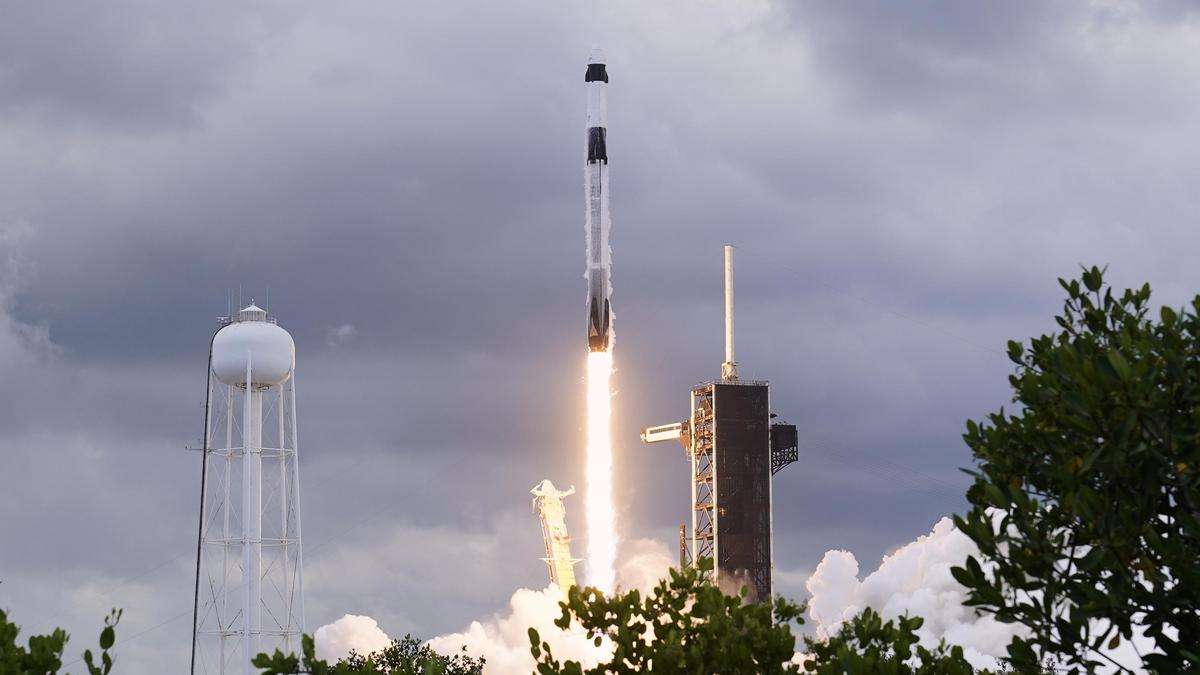
The private company SpaceX brought in many path-breaking technologies, including 3D printing rocket parts, modular design, making most parts in-house (called vertical integration), and reusing rocket stages. Together they have cut costs sharply and increased launch frequency.

Reusability is widely considered the single most significant game-changer for human access to space, fundamentally shifting the industry from a ‘disposable’ model to a ‘transportation’ model. The SpaceX Falcon 9 rocket’s first stage comes back to the earth using a mix of smart engineering and automation. Here, the stage fires its engines to slow down as it nears the ground, removing most of its kinetic energy. The remainder is dissipated by the aerodynamic drag during its journey through the air.

SpaceX has successfully recovered the first stages of its Falcon 9 rockets more than 520 times. It’s currently developing its next generation multi-purpose rocket, Starship, as a fully reusable vehicle with a more efficient architecture. It has enough power to carry crew and cargo to the earth’s orbit, the moon, and even Mars.

Worldwide there are more than a dozen private companies and start-ups actively developing reusable rocket technology. At least three of them are working on the more challenging fully-reusable rocket technology. Washington-based Blue Origin has successfully demonstrated recovery of the booster for its New Glenn vehicle via vertical landing. The commercial space sector in China is also rapidly advancing, with companies like LandSpace recently attempting to recover parts of its orbital-class Zhuque 3 rocket.

Can a stage be reused multiple times?

The number of times a recovered rocket stage can be used is limited primarily by structural and material fatigue, especially in the main engines and fuel tanks.

The extreme temperature swings from cryogenic propellants to combustion heat, combined with immense pressure and g-force cycling during ascent and re-entry, cause fatigue and microfractures. The practical limit is also set by refurbishment economics and acceptable risk. As the number of flights increase, the cost and time required for rigorous inspection, testing, and replacement of vulnerable components, to maintain high reliability, will eventually outweigh the cost savings compared to building a new stage. SpaceX has been known to reuse the first stage more than 30 times for launch missions.

Where does India stand?

The Indian Space Research Organisation (ISRO) has been working on different models of recovery technologies. One option is the Reusable Launch Vehicle (RLV), a winged spacecraft, like a mini shuttle, that can be launched to space on a rocket and then made to re-enter to land on a runway. The other option is recovering the spent first stage of a rocket with a combination of aerodynamic drag and retro-propulsion to land on a barge or land. Technology development activities are progressing in these domains.

In order to be competitive in a rapidly emerging space market where fully reusable launch vehicles are about to be a usual feature, the need of the hour is inducting disruptive technologies that will lower the cost of accessing space. Therefore, future launch vehicles should target configurations with a minimum number of stages with partial or full recovery and with reuse of stages as a non-negotiable design driver.

Today, advances in propellant density and engine efficiency allow two-stage systems to perform missions that previously required three or more stages. A careful balancing of the energy delivered by each stage, its cost share, innovative technologies for high performance, compact engine development, recovery of stages, and refurbishment for increasing launch cadence are some of the aspects to be seriously addressed while designing any future launch vehicle.

Unnikrishnan Nair S. is former director, VSSC and IIST; founding director, HSFC; and an expert in launch vehicle systems, orbital re-entry, and human spaceflight technologies.

Published – January 21, 2026 08:30 am IST



Source link

Science

Post navigation

Previous Post: Trump zigzags through wins, foreign policy in one-year anniversary remarks
Next Post: The importance of Pax Silica for India

Related Posts

  • What is ‘snowball earth’?
    What is ‘snowball earth’? Science
  • Sci-Five | The Hindu Science Quiz: On Woodpeckers
    Sci-Five | The Hindu Science Quiz: On Woodpeckers Science
  • How gels and shampoos move: Raman Research Institute builds a device to see it in action
    How gels and shampoos move: Raman Research Institute builds a device to see it in action Science
  • What is geospatial intelligence? A geographer explains the powerful melding of maps and data
    What is geospatial intelligence? A geographer explains the powerful melding of maps and data Science
  • The Science Quiz | Remembering a star that was briefly the brightest…
    The Science Quiz | Remembering a star that was briefly the brightest… Science
  • The Science Quiz | The weird shapes of space
    The Science Quiz | The weird shapes of space Science

More Related Articles

Unusual genetic code in Antarctic microbes yields rare amino acid Unusual genetic code in Antarctic microbes yields rare amino acid Science
Union Budget 2025: Finance Minister announces ₹20,000 crore Nuclear Energy Mission for small modular reactors Union Budget 2025: Finance Minister announces ₹20,000 crore Nuclear Energy Mission for small modular reactors Science
Malaria parasites corkscrew their way deeper through skin Malaria parasites corkscrew their way deeper through skin Science
Science Quiz: On travel health Science Quiz: On travel health Science
Glycemic index of diets: importance beyond diabetes control Glycemic index of diets: importance beyond diabetes control Science
Fossil dung reveals clues to the rise of dinosaurs Fossil dung reveals clues to the rise of dinosaurs Science
SiteLock

Archives

  • May 2026
  • April 2026
  • March 2026
  • February 2026
  • January 2026
  • December 2025
  • November 2025
  • October 2025
  • September 2025
  • August 2025
  • July 2025
  • June 2025
  • May 2025
  • April 2025
  • March 2025
  • February 2025
  • January 2025
  • December 2024
  • November 2024
  • October 2024
  • September 2024
  • August 2024
  • July 2024
  • June 2024
  • May 2024
  • April 2024
  • March 2024
  • February 2024
  • January 2024
  • December 2023
  • November 2023
  • October 2023
  • September 2023
  • August 2023
  • July 2023
  • June 2023
  • May 2023
  • April 2023
  • March 2023
  • February 2023
  • January 2023
  • December 2022
  • November 2022
  • October 2022
  • September 2022
  • August 2022
  • July 2022
  • June 2022
  • May 2022

Categories

  • Business
  • Nation
  • Science
  • Sports
  • World

Recent Posts

  • A summer camp with a difference in Madurai
  • At least nine militants, four security personnel killed in gunfire in northwest Pakistan
  • Earthquake of magnitude 6.4 strikes near east coast of Honshu in Japan, GFZ says
  • Former AIADMK Minister K.V. Ramalingam joins TVK
  • HOCKEY | Consistency and continuity in performance will help the team reach higher levels: Marijne

Recent Comments

  1. Hectortek on UP Teacher Who Asked Students To Slap Muslim Classmate
  2. MatthewReure on UP Teacher Who Asked Students To Slap Muslim Classmate
  3. CharlesHoups on UP Teacher Who Asked Students To Slap Muslim Classmate
  4. MichaelCom on UP Teacher Who Asked Students To Slap Muslim Classmate
  5. CarlosJacle on UP Teacher Who Asked Students To Slap Muslim Classmate
  • 2 Boys Rape Girl, 18, After Morphing Her Photos Using AI App In Madhya Pradesh
    2 Boys Rape Girl, 18, After Morphing Her Photos Using AI App In Madhya Pradesh Nation
  • Is the MBTI test just a trend or a real science?
    Is the MBTI test just a trend or a real science? Science
  • Access Denied
    Access Denied Nation
  • Here are the latest news and big news to follow today
    Here are the latest news and big news to follow today Science
  • Access Denied World
  • Yuvraj Singh Breaks Silence On Reports Claiming He’ll Contest Elections From Gurdaspur
    Yuvraj Singh Breaks Silence On Reports Claiming He’ll Contest Elections From Gurdaspur Sports
  • Access Denied World
  • Video Shows People Running In Panic As Earthquake Hits Wedding Venue In Morocco
    Video Shows People Running In Panic As Earthquake Hits Wedding Venue In Morocco World

Editor-in-Chief:
Mohammad Ariff,
MSW, MAJMC, BSW, DTL, CTS, CNM, CCR, CAL, RSL, ASOC.
editor@artifex.news

Associate Editors:
1. Zenellis R. Tuba,
zenelis@artifex.news
2. Haris Daniyel
daniyel@artifex.news

Photograher:
Rohan Das
rohan@artifex.news

Artifex.News offers Online Paid Internships to college students from India and Abroad. Interns will get a PRESS CARD and other online offers.
Send your CV (Subjectline: Paid Internship) to internship@artifex.news

Links:
Associate Journalism
About Us
Privacy Policy

News Links:
Breaking News
World
Nation
Sports
Business
Entertainment
Lifestyle

Registered Office:
72/A, Elliot Road, Kolkata - 700016
Tel: 033-22277777, 033-22172217
Email: office@artifex.news

Editorial Office / News Desk:
No. 13, Mezzanine Floor, Esplanade Metro Rail Station,
12 J. L. Nehru Road, Kolkata - 700069.
(Entry from Gate No. 5)
Tel: 033-46011099, 033-46046046
Email: editor@artifex.news

Copyright © 2023 Artifex.News Newsportal designed by Artifex Infotech.