


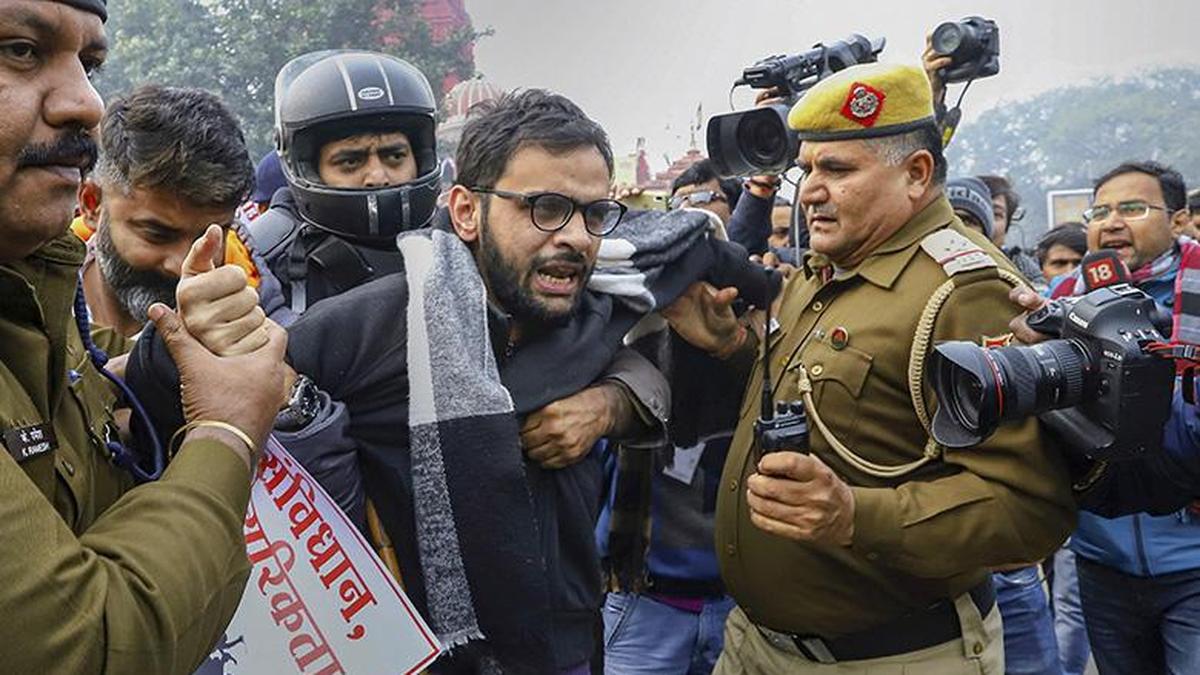
The story so far: The Supreme Court on January 5 declined to grant bail to activists Umar Khalid and Sharjeel Imam in the 2020 Delhi riots conspiracy case, notwithstanding their incarceration for nearly six years without the commencement of trial.
What did the court rule?
The court held that the constitutional guarantee of personal liberty is not “absolute”, and remains subject to the stringent bail regime prescribed under special statutes such as the Unlawful Activities (Prevention) Act (UAPA). A Bench comprising Justices Aravind Kumar and N.V. Anjaria, however, granted conditional bail to five other co-accused, observing that the allegations against them indicated conduct of a subsidiary or facilitative nature, thereby warranting differential treatment.
How was a ‘hierarchy of roles’ established?
The court held that prosecutorial evidence placed Mr. Khalid and Mr. Imam on a “qualitatively different footing” from the other accused, warranting a distinct assessment of the “hierarchy of participation”. It observed that the two did not stand on equal footing in terms of culpability, since they were the “ideological drivers” who allegedly devised the strategy of converting protests against the Citizenship (Amendment) Act into disruptive road blockades aimed at paralysing the national capital.
Hierarchy of roles: The Hindu editorial on no bail for Umar Khalid
By contrast, the court held that the five accused granted bail were “local-level facilitators”, whose alleged roles were confined to logistical arrangements at protest sites. It said their participation was “derivative” in nature, as they merely carried out directions from those positioned higher in the chain of command. In these circumstances, the judges found that continued custody of such “minor participants” would be disproportionate.
Why did prolonged custody not justify bail?
The accused had argued that their prolonged incarceration without trial violated their fundamental right to a speedy trial under Article 21 of the Constitution. They had relied on the Supreme Court’s 2021 ruling in Union of India versus K.A. Najeeb, which had held that the rigours of the stringent bail bar under the UAPA may “melt down” where there is no realistic prospect of the trial being completed within a reasonable time, as continued detention would offend constitutional guarantees. The court, however, distinguished the precedent, observing that it does not lay down a “mechanical rule” whereby delay, by itself, can override the statutory constraints governing bail under the UAPA. It emphasised that Section 43D(5) prescribes a stringent threshold for the grant of bail, which departs from the general principles applicable under ordinary criminal law.
Having found that Mr. Khalid and Mr. Imam prima facie occupied a “central role” in the alleged offence, the judges observed that the degree of circumspection required before constitutional guarantees are permitted to displace the statutory embargo on bail is “correspondingly greater”. By contrast, in the case of the co-accused granted relief, the court noted that the allegations against them were confined to facilitative tasks. In the absence of any “command authority” or capacity to interfere with the trial process, it held that the balance tilted in favour of granting them liberty. The judges also rejected the defence contention that the delay in the trial was attributable solely to the Delhi Police, noting that a perusal of the trial court record showed the prosecution had, at various stages, expressed readiness to commence arguments on the framing of charges, while multiple procedural objections were raised on behalf of the accused.
How expansive is the court’s reading of a ‘terrorist act’?
Section 15 of the UAPA defines a “terrorist act” as conduct undertaken with the intent to threaten, or likely to threaten, the unity, integrity, security, economic security, or sovereignty of India, or to strike terror among the people or any section thereof. While the provision refers to the use of weapons such as bombs, explosives, or firearms, it also extends to acts committed by “any other means”.
The defence had argued that, in the absence of overt violence, the organisation of protests and “chakka jams” (road blockades) attributed to the accused constituted a constitutionally protected form of protest and could not fall within the ambit of Section 15. It had contended that the residual phrase “any other means” must be read ejusdem generis (of the same kind) with the preceding reference to violent methods.
Rejecting this submission, the court agreed with the prosecution that Section 15 cannot be read as being confined to the use of conventional weapons alone. It observed that acts resulting in the “sustained choking of arterial roads” and the “systemic disruption of civic life” could attract the provision if they threaten economic security or disrupt essential services. The judges further noted that when such blockades are timed to coincide with major international events, such as the 2020 visit of U.S. President Donald Trump, they prima facie constitute an act of terror under the UAPA.
What happens next?
For the five accused granted relief, the apex court imposed onerous conditions to prevent any possibility of tampering with evidence or influencing witnesses. Each was directed to execute a personal bond of ₹2,00,000 with two local sureties and are restrained from leaving the national capital without prior permission of the trial court. Notably, until the conclusion of the trial, they have been barred from addressing or attending any gathering and from circulating any material, including posts in electronic or physical form, of any kind, not limited to the case. In the case of Mr. Khalid and Mr. Imam, the court carved out a limited window for them to revive their plea for bail, permitting them to approach the trial court either upon the completion of the examination of the protected witnesses relied upon by the prosecution or upon the expiry of one year from the date of the ruling, whichever is earlier.
What are the implications?
Advocate Vrinda Grover told The Hindu that the verdict marks a grave departure from settled judicial precedent. “When an individual is subjected to pre-trial detention, the presumption of innocence continues to operate. Any ruling that renders personal liberty subservient to state interests in such cases is anathema to the Constitution,” she said. Ms. Grover further cautioned that treating allegations of road blockades as “terrorist acts” risks emboldening governments to weaponise the law to criminalise dissent. “There is no jurisprudence to support the proposition that chakka jams can be treated as acts of terror. On the contrary, past precedents consistently hold that the more draconian the statute, the greater must be the degree of judicial scrutiny to ensure that the allegations squarely fall within its four corners,” she added.
Published – January 11, 2026 04:50 am IST