


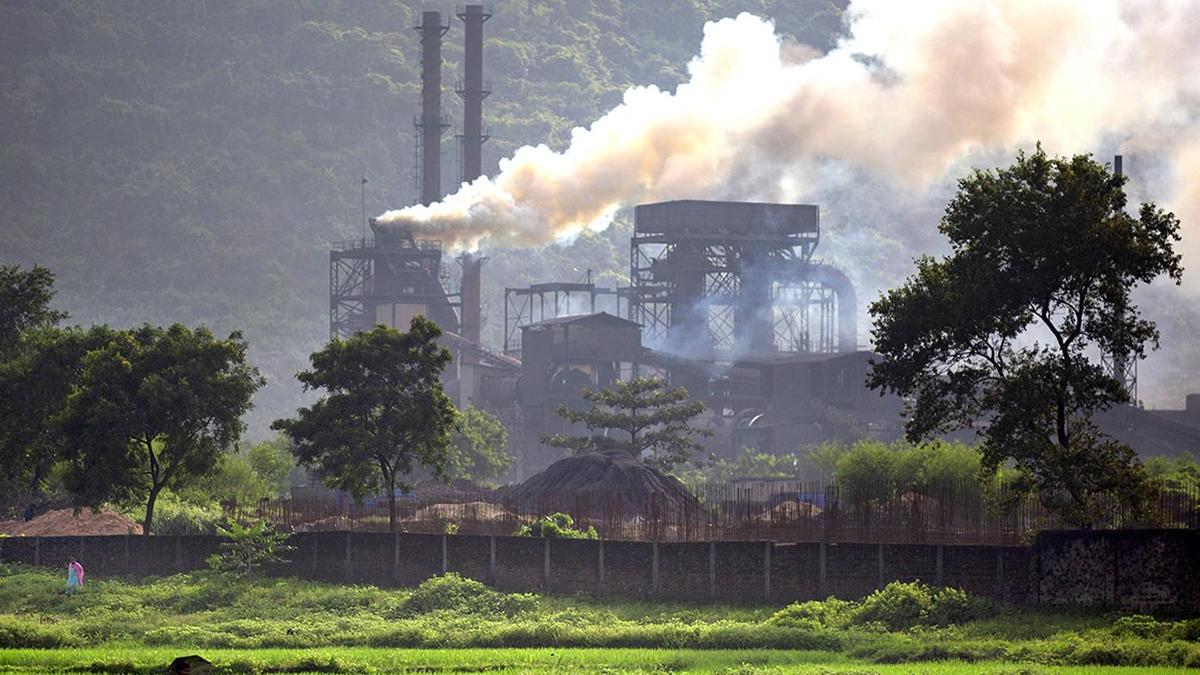
There has been a lot of focus on the recent Aravalli judgment and its implications for mining operations across the green belt as well as the government’s commitments regarding environmental standards and regulatory protection for ecologically sensitive areas.
In the Paris summit, India had committed to four quantified climate targets, grounded in the principle of “common but differentiated responsibilities” — a position that reflects how, historically, India’s per capita emissions were fractions compared to emissions of other major countries like the U.S. (however, currently India is the world’s third largest absolute emitter). The centrepiece of Prime Minister Modi’s statement at the Paris summit was the pledge to reduce emissions intensity by 33-35% by 2030 (based on the 2005 baseline), coupled with commitments to enhance non-fossil power capacity to 40%, 175 GW of renewable energy, and 2.5-3 billion tonnes of carbon sequestration through forests.
Now, more than 10 years later, one needs to evaluate whether these promises have actually been delivered.
Incomplete decoupling
India’s reduction in GDP emissions-intensity (greenhouse gases per unit of economic output) may appear to be a policy success. Using 2005 as baseline, emissions intensity decreased by approximately 36% by 2020, enabling India to meet its original 33-35% target well ahead of the 2030 deadline.
Three structural drivers explain this trajectory. First, the rapid expansion of non-fossil power capacity (solar, wind, hydro, and nuclear) lowered carbon intensity associated with harnessing electricity. By 2023, non-fossil capacity exceeded by approximately 43%, and it reached roughly 50% by mid-2025. Second, India’s economic composition shifted toward lower-carbon services and digital sectors, resulting in a reduction in emissions per unit of GDP. Third, national efficiency programmes like Perform, Achieve and Trade (PAT) and UJALA curbed demand growth in industry and households; national assessments record measurable electricity savings and avoided emissions in FY2020-21.
However, intensity gains still coexist with persistently high absolute emissions. India’s territorial greenhouse gas (GHG) emissions were approximately 2,959 MtCO₂e in 2020, and absolute emissions have remained high thereafter.
This phenomenon exists because of partial decoupling: GDP growth has outpaced emissions growth, so intensity has declined without an economy-wide absolute fall. This matters because national intensity averages mask sectoral divergence, as evidenced by the continued rise in emissions from the cement, steel, and transport sectors, even as the power sector’s CO2 growth moderated in 2024-25.
Analyses by Climate Transparency and the International Energy Agency show that India’s rate of intensity decline exceeds that of many G-20 peers, but coal’s large share keeps absolute per-kWh emissions high. For India’s 2070 net-zero pledge to be credible, remaining intensity gains must be translated into absolute emissions reductions through a transparent coal phase-down timetable and industrial decarbonisation roadmaps.
Generation gap
India’s renewable capacity scale-up is dramatic, but it does not yet replace fossil baseload. Non-fossil capacity rose from ~29.5% in 2015 to ≈51.4% by June 2025. Solar led the build-out (≈2.8 GW in 2014 to ~110.9 GW by mid-2025), supported by tariff competition and domestic photovoltaic manufacturing expansion. Wind power increased more modestly (≈21 GW to ~51.3 GW over the same period) but has been constrained by land, grid-connection delays and state-level regulatory bottlenecks. Crucially, electricity generation lacks capacity — renewables supplied ~22% of electricity in 2024-25 despite greater than 50% non-fossil capacity because of lower capacity factors and storage shortfalls; thermal (primarily coal) capacity remained ~240 GW in mid-2025 and still provides baseload.
The 175 GW renewables target for 2022 was missed, and although a 500 GW 2030 ambition is technically possible, converting installed capacity into sustained generation and emissions reduction will require rapid scaling of storage, transmission upgrades and stronger policy delivery.
The renewable energy targets that India has set for itself, initially 40% non-fossil fuel capacity by 2030 and now 50% by 2030, are headline successes that mask a vital subtext: capacity and actual production differ sharply due to limitations in renewable integration and intermittency patterns. Non-fossil fuel capacity accounted for 51% of India’s cumulative installed capacity of 495 GW as of June 2025, marking the achievement of the first commitment. But this is overshadowed by an essential reality that more than 70% of electricity production in India comes from coal, in spite of its comprising 51% non-fossil fuel capacity. The reason for this is that renewables operate at much shorter capacity compared to coal, as they produce intermittently on a solar and wind basis. In contrast, coal generates constant “baseload” electricity.
Storage is the major sticking point. The Central Electricity Authority has forecast a demand of 336 GWh of energy storage for the 2029-30 period. However, as of September 2025, only 500 MWh of battery energy storage capacity is operational.
Government driven programs such as the National Solar Mission, Solar Parks Scheme, UDAY, PM-KUSUM, and rooftop solar have successfully added 25 GW of renewable energy every year. However, the area of execution remains a challenge, as there is a delay in grid connectivity and limited land acquisition in the power sector. Although the pace of renewable energy in the Indian power sector has reached a groundbreaking level, the country’s backbone remains the 253 GW of coal-based capacity.
Forests only on paper
The figure of 2.5-3.0 billion tonnes of CO2 equivalent carbon sequestration by 2030, as pledged by India appears achievable in terms of numbers. The India State of Forest Report 2023 reveals that India has already sequestered 30.43 billion tonnes of CO2 equivalents of total carbon stock, representing 2.29 billion tonnes of additional sequestration over the 2005 level, with only 0.2 billion tonnes remaining to achieve the target by 2030.
However, the official figures do not capture the definition’s elasticity. The Forest Survey of India’s definition of “forest cover” includes any land of more than one hectare with the overstory 10% canopied, and includes eucalyptus monocultures and plantations of mango, tea, and roadside trees in addition to natural forests. Satellite imagery indicating that the country has 7,15,343 sq km of forest cover in 2023, with an increase of only 156 sq km from the previous census in 2021, confuses ecological performance with administrative designation.
Policy mechanisms indicate a friction in implementation. Under the Compensatory Afforestation Fund Act (2016), approximately ₹95,000 crore has been accumulated. However, there is unequal implementation, as States such as Delhi have been able to utilise only 23% of the allocated amount from 2019-20 to 2023-24. The Green India Mission Revised launched in June 2025 after a decade of ‘moderate progress,’ has proposed regenerating five million hectares through regional projects in the Aravallis, Western Ghats, and Himalayas. ‘Plantations’ are, however, equated to ‘natural regeneration’.
Moreover, climate change is an added stress. While satellite evidence reveals leaf index values that indicate “greening,” net primary productivity, and actual carbon assimilation rate are challenged by warming and water stress, especially in the Western Ghats and northeastern parts of India. The country is likely to meet its “forest sink” target by 2030 through mechanisms that are plantation dominated and governance limited, prioritising carbon accounting over ecological restoration.
The road ahead
While India has achieved meaningful progress on specific metrics, they also obscure fundamental problems with climate action in India. The intensity gains achieved coexist with rising absolute emissions, and renewable capacity expansion has not translated into a proportional share of generation due to the entrenched baseload of coal that mask the actual ecological impact.
The transition path that lies ahead demands sustained effort in areas requiring systemic coordination and coordinated governance like the rapid scaling of battery storage to bridge the capacity generation gap, the development of a coal transition roadmap, reformed forest governance to ensure quality biodiversity outcomes alongside carbon target numbers, and increase in data transparency to track progress across sectoral and regional variations as mere technology and capital influx will now no longer suffice.
The upcoming five years present a critical window for India to accelerate renewable energy growth, resolve storage bottlenecks, and strengthen government coordination on grid connectivity and land acquisition.
In summation, India’s performative standards may have broadly delivered on its quantified commitments. Still, the outcomes that matter most lie beyond headline metrics, in converting the now installed capacity into continued sustained generation and intensity gains into absolute emission ‘moderation’.
Deepanshu Mohan is professor and dean, O.P. Jindal Global University and Director, Centre for New Economics Studies (CNES). He is a visiting professor at the London School of Economics and a visiting fellow with AMES, University of Oxford. Nagappan Arun and Saksham Raj are research analysts at CNES. With inputs from Simar Kaur and Anvita Tripathi.