
Skip to content
  • Facebook
  • X
  • Linkedin
  • WhatsApp
  • YouTube
  • Associate Journalism
  • About Us
  • Privacy Policy
  • 033-46046046
  • editor@artifex.news
Artifex.News

Artifex.News

Stay Connected. Stay Informed.

  • Breaking News
  • World
  • Nation
  • Sports
  • Business
  • Science
  • Entertainment
  • Lifestyle
  • Toggle search form
  • In This UP Wedding, Uninvited Guest Was A Leopard. What Happened Next
    In This UP Wedding, Uninvited Guest Was A Leopard. What Happened Next Nation
  • Access Denied World
  • Donald Trump Leads Kamala Harris 48%-46% Among Registered Voters: Survey
    Donald Trump Leads Kamala Harris 48%-46% Among Registered Voters: Survey World
  • Illegal Migrant, On Bail And Under Surveillance, Rapes And Kills 12-Year-Old Girl
    Illegal Migrant, On Bail And Under Surveillance, Rapes And Kills 12-Year-Old Girl World
  • Muhammad Yunus Over Sheikh Hasina’s Ouster
    Muhammad Yunus Over Sheikh Hasina’s Ouster World
  • Access Denied Sports
  • U.N. chief decries global rise of ‘rule of force’
    U.N. chief decries global rise of ‘rule of force’ World
  • Iranian Woman Removes Cleric’s Turban, Wears It As Hijab In Bold Protest
    Iranian Woman Removes Cleric’s Turban, Wears It As Hijab In Bold Protest World
Why Trump is targeting Venezuela | Explained

Why Trump is targeting Venezuela | Explained

Posted on December 29, 2025 By admin


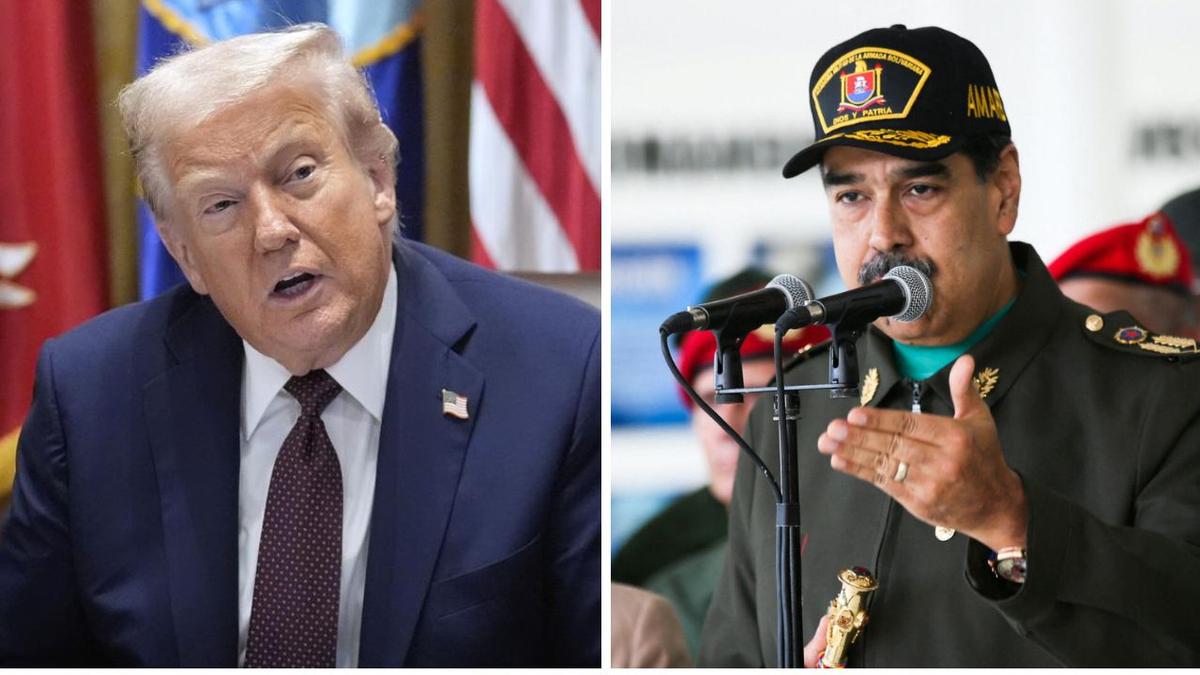
Venezuela on December 24 accused the U.S. of carrying out what it called the “greatest act of extortion” during an emergency meeting of the UN Security Council in New York. The accusation came after the U.S. seized two Venezuelan oil tankers in international waters. Venezuela’s Ambassador to the UN, Samuel Moncada, said the move was worse than piracy. Washington has enforced a naval quarantine on Venezuelan oil shipping and threatened to seize more tankers carrying Venezuelan oil.

Escalating tensions

Tensions between Washington and Caracas have been simmering for years and are now rising sharply, increasing fears of a possible conflict in the Caribbean. Since early September, the Trump administration has stepped up pressure on Venezuelan President Nicolas Maduro’s government, moving beyond economic sanctions to direct military action at sea.

U.S. forces have attacked at least 21 Venezuelan boats in the Caribbean and the eastern Pacific, killing 87 people, according to Venezuelan authorities. The U.S. says the vessels were involved in drug trafficking, but it has not publicly provided evidence backing its claims.

In late October, the Pentagon rerouted the USS Gerald R. Ford, the U.S. Navy’s most advanced aircraft carrier, to the Caribbean. Around 5,000 personnel were brought closer to Venezuela. More than 15,000 U.S. troops are now deployed in the region, the largest American military presence in the Caribbean in decades.

U.S. President Donald Trump has also authorised covert action against Venezuela and warned that U.S. attacks could soon move from offshore boats to targets inside the country. At the same time, he has spoken with Mr. Maduro by phone, suggesting diplomacy has not been fully ruled out.

Roots of the crisis

The roots of the crisis go back to the era of former left-wing President Hugo Chavez. Chavez, who came to power in 1999 on an anti-poverty platform, nationalised Venezuela’s oil industry, reduced the role of American companies in the sector, and built close ties with Cuba, Russia, China, and Iran. Relations worsened further after a failed coup against Chavez in 2002, which his government accused the U.S. of supporting. Mr. Maduro, who succeeded Chavez after his death in 2013, has continued the same foreign policy. But the Venezuelan economy, under biting American sanctions, steadily deteriorated on Mr. Maduro’s watch.

The Trump administration says its actions are aimed at stopping illegal drugs from entering the U.S., framing the issue as a national security threat. Mr. Maduro, however, says Washington’s real aim is to remove him from power, not to fight drug trafficking. Trump administration officials have also said Mr. Maduro will have to go. Mr. Maduro has, however, warned that Venezuela would resist any invasion.

Washington claims Mr. Maduro leads the Cartel de los Soles, a Venezuela-based drug network designated by the U.S. as a “global terrorist organisation”. The Treasury Department has accused the Maduro government of facilitating “narco-terrorism”, while U.S. officials allege links between Mr. Maduro and criminal groups such as Tren de Aragua and Mexico’s Sinaloa Cartel. Caracas has denied the allegations as baseless, and Washington has not produced any convincing evidence.

Venezuela is not a major source of illicit fentanyl, and experts agree that Colombia and Mexico play far larger roles in global narcotics trafficking.

Strategic importance

So why is Venezuela being targeted? One major reason is the strategic importance of the South American country. Venezuela has oil, gold, and gas. It holds the world’s largest proven oil reserves, estimated at about 303 billion barrels, more than Saudi Arabia’s. Although the country’s sanctions-hit oil production has drastically fallen in recent years, control over such vast reserves could affect global energy markets and reduce U.S. dependence on West Asian oil.

Geopolitics also plays a role. China and Russia have lent Venezuela billions of dollars, much of it repaid with oil shipments. Venezuela has also bought weapons and security support from Russia, Iran, China, and Cuba. For Washington, putting pressure on Mr. Maduro also means weakening the influence of these U.S. rivals in the region.

Regime change

The U.S. push against Mr. Maduro fits into a long pattern. Neither the Trump nor the Biden administrations have recognised Mr. Maduro as Venezuela’s legitimate President, claiming his government is authoritarian, corrupt, and destabilising.

In 2015, the Obama administration declared Venezuela a national security threat and imposed targeted sanctions. The first Trump administration later expanded those measures to Venezuela’s financial sector, and in 2020 U.S. prosecutors charged Mr. Maduro with narco-terrorism, offering a reward that eventually rose to $20 million for his capture.

While the Biden administration maintained most sanctions, it briefly eased some restrictions in 2023 in exchange for promised electoral reforms, which were later judged to have fallen short. Mr. Trump’s return to office this year has marked a decisive shift toward military pressure, including naval deployments, strikes on Venezuelan vessels, and explicit threats of attacks inside the country. Meanwhile, at home, Venezuela’s right-wing Opposition leader Maria Corina Machado, who won the Nobel Peace Prize this year, has publicly backed the U.S. military build-up.

Across Latin America, reactions are mixed. Mexico and Brazil have criticised Mr. Maduro’s governance but strongly oppose U.S. military intervention, warning it would destabilise the region. Colombia, which has recently normalised relations with Caracas, fears a large refugee flow if fighting breaks out. Argentina’s right-wing Javier Milei government has taken a tougher stance, aligning more closely with Washington’s position.

High stakes

The stakes are high for Venezuela itself. The country’s economy has shrunk by more than 75% since 2013, hyperinflation once exceeded one million percent, and an estimated seven million Venezuelans have fled abroad.

A full-scale U.S. military assault could turn out to be disastrous for both sides. The U.S. can carry out targeted air strikes weakening Mr. Maduro’s grip on power. But Venezuela maintains one of the largest standing armies in Latin America. Mr. Maduro also relies on pro-regime armed groups known as colectivos. If Mr. Maduro refuses to leave power, colectivos could complicate U.S. efforts to topple the regime and restore order. Recent examples of America’s military interventions in Afghanistan, Iraq and Libya suggest that toppling the regime could be possible but rebuilding order could be not.

For now, the situation remains tense and uncertain. The crisis could worsen as Mr. Trump appears to be adamant on continuing with his policy of militarily choking the Maduro regime.

Published – December 29, 2025 12:05 pm IST


Source link

World Tags:us venezuela conflict reason, us venezuela oil tensions, US Venezuela tensions, venezuela oil

Post navigation

Previous Post: Access Denied
Next Post: Access Denied

Related Posts

  • Tear Gas, Rocks, And Looting As Kenya Police And Protesters Clash
    Tear Gas, Rocks, And Looting As Kenya Police And Protesters Clash World
  • Israel pummels Gaza as troops push into central Rafah
    Israel pummels Gaza as troops push into central Rafah World
  • Putin claims Russian troops have surrounded 2 Ukrainian cities but Ukraine says that’s not true
    Putin claims Russian troops have surrounded 2 Ukrainian cities but Ukraine says that’s not true World
  • Japan’s new PM commits to higher defence spend, ties with India, Quad
    Japan’s new PM commits to higher defence spend, ties with India, Quad World
  • Nepal protests death toll rises to 34; three inmates killed in clashes with security personnel
    Nepal protests death toll rises to 34; three inmates killed in clashes with security personnel World
  • News Analysis: Trump gains among young men, Harris seeks votes from women, Republicans
    News Analysis: Trump gains among young men, Harris seeks votes from women, Republicans World

More Related Articles

Access Denied World
Surveillance of Maldives’ vast maritime territory not a concern of ‘external parties’: Prez Muizzu Surveillance of Maldives’ vast maritime territory not a concern of ‘external parties’: Prez Muizzu World
Hamas Names New Chief After Ismail Haniyeh’s Killing Hamas Names New Chief After Ismail Haniyeh’s Killing World
Robots Might Be Able To Sense Human Feelings Just By Touching Skin, Scientists Claim Robots Might Be Able To Sense Human Feelings Just By Touching Skin, Scientists Claim World
How Elon Musk’s X could be suspended by one Brazilian judge in the coming hours How Elon Musk’s X could be suspended by one Brazilian judge in the coming hours World
Russian forces thwart attempted cross-border assault from Ukraine, official says Russian forces thwart attempted cross-border assault from Ukraine, official says World
SiteLock

Archives

  • May 2026
  • April 2026
  • March 2026
  • February 2026
  • January 2026
  • December 2025
  • November 2025
  • October 2025
  • September 2025
  • August 2025
  • July 2025
  • June 2025
  • May 2025
  • April 2025
  • March 2025
  • February 2025
  • January 2025
  • December 2024
  • November 2024
  • October 2024
  • September 2024
  • August 2024
  • July 2024
  • June 2024
  • May 2024
  • April 2024
  • March 2024
  • February 2024
  • January 2024
  • December 2023
  • November 2023
  • October 2023
  • September 2023
  • August 2023
  • July 2023
  • June 2023
  • May 2023
  • April 2023
  • March 2023
  • February 2023
  • January 2023
  • December 2022
  • November 2022
  • October 2022
  • September 2022
  • August 2022
  • July 2022
  • June 2022
  • May 2022

Categories

  • Business
  • Nation
  • Science
  • Sports
  • World

Recent Posts

  • Science Snapshots: May 10, 2026
  • Iran-Israel war LIVE: Rubio meets Qatari PM as U.S. awaits Iran’s response
  • Tamil Nadu swearing-in ceremony LIVE: TVK president C. Joseph Vijay to take oath as Chief Minister
  • ‘Awful experience’, Supriya Sule says after her car dashed by another vehicle on Expressway
  • India may not sign FTAs, to opt for deeper ties with customs unions in Africa, say officials

Recent Comments

  1. SteveTeF on UP Teacher Who Asked Students To Slap Muslim Classmate
  2. Andrewfoods on UP Teacher Who Asked Students To Slap Muslim Classmate
  3. DonaldGlymn on UP Teacher Who Asked Students To Slap Muslim Classmate
  4. ShaneElden on UP Teacher Who Asked Students To Slap Muslim Classmate
  5. JasonCobby on UP Teacher Who Asked Students To Slap Muslim Classmate
  • Access Denied Business
  • OpenAI Says Dedicated To Safety In Letter To US Lawmakers
    OpenAI Says Dedicated To Safety In Letter To US Lawmakers World
  • Access Denied Sports
  • Khaleda Zia: The Begum who came in from the cold
    Khaleda Zia: The Begum who came in from the cold World
  • “BRICS Is For The Fairies Until China, India Get Serious,” Says Mr ‘BRICS’
    “BRICS Is For The Fairies Until China, India Get Serious,” Says Mr ‘BRICS’ Nation
  • Ukraine President Zelenskyy says Donald Trump exerting undue pressure for Russia war peace
    Ukraine President Zelenskyy says Donald Trump exerting undue pressure for Russia war peace World
  • Mohammad Rizwan Backs Babar Azam Amid Form Struggles As Pakistan Eye Tri-Series Final
    Mohammad Rizwan Backs Babar Azam Amid Form Struggles As Pakistan Eye Tri-Series Final Sports
  • Access Denied Business

Editor-in-Chief:
Mohammad Ariff,
MSW, MAJMC, BSW, DTL, CTS, CNM, CCR, CAL, RSL, ASOC.
editor@artifex.news

Associate Editors:
1. Zenellis R. Tuba,
zenelis@artifex.news
2. Haris Daniyel
daniyel@artifex.news

Photograher:
Rohan Das
rohan@artifex.news

Artifex.News offers Online Paid Internships to college students from India and Abroad. Interns will get a PRESS CARD and other online offers.
Send your CV (Subjectline: Paid Internship) to internship@artifex.news

Links:
Associate Journalism
About Us
Privacy Policy

News Links:
Breaking News
World
Nation
Sports
Business
Entertainment
Lifestyle

Registered Office:
72/A, Elliot Road, Kolkata - 700016
Tel: 033-22277777, 033-22172217
Email: office@artifex.news

Editorial Office / News Desk:
No. 13, Mezzanine Floor, Esplanade Metro Rail Station,
12 J. L. Nehru Road, Kolkata - 700069.
(Entry from Gate No. 5)
Tel: 033-46011099, 033-46046046
Email: editor@artifex.news

Copyright © 2023 Artifex.News Newsportal designed by Artifex Infotech.