



Skip to content
  • Facebook
  • X
  • Linkedin
  • WhatsApp
  • YouTube
  • Associate Journalism
  • About Us
  • Privacy Policy
  • 033-46046046
  • editor@artifex.news
Artifex.News

Artifex.News

Stay Connected. Stay Informed.

  • Breaking News
  • World
  • Nation
  • Sports
  • Business
  • Science
  • Entertainment
  • Lifestyle
  • Toggle search form
  • Access Denied Sports
  • Access Denied World
  • Israel-Hamas draft ceasefire deal: A look at the terms and tensions
    Israel-Hamas draft ceasefire deal: A look at the terms and tensions World
  • Access Denied
    Access Denied Nation
  • PM Modi On Ukraine Conflict
    PM Modi On Ukraine Conflict Nation
  • Trade ministry proposes anti-dumping duty on Chinese aluminium foil imports
    Trade ministry proposes anti-dumping duty on Chinese aluminium foil imports Nation
  • Pakistan Announce Playing XI For Asia Cup 2023 Opener Against Nepal
    Pakistan Announce Playing XI For Asia Cup 2023 Opener Against Nepal Sports
  • Access Denied
    Access Denied Nation
India and the U.S.: 2005 versus 2025

India and the U.S.: 2005 versus 2025

Posted on December 16, 2025 By admin


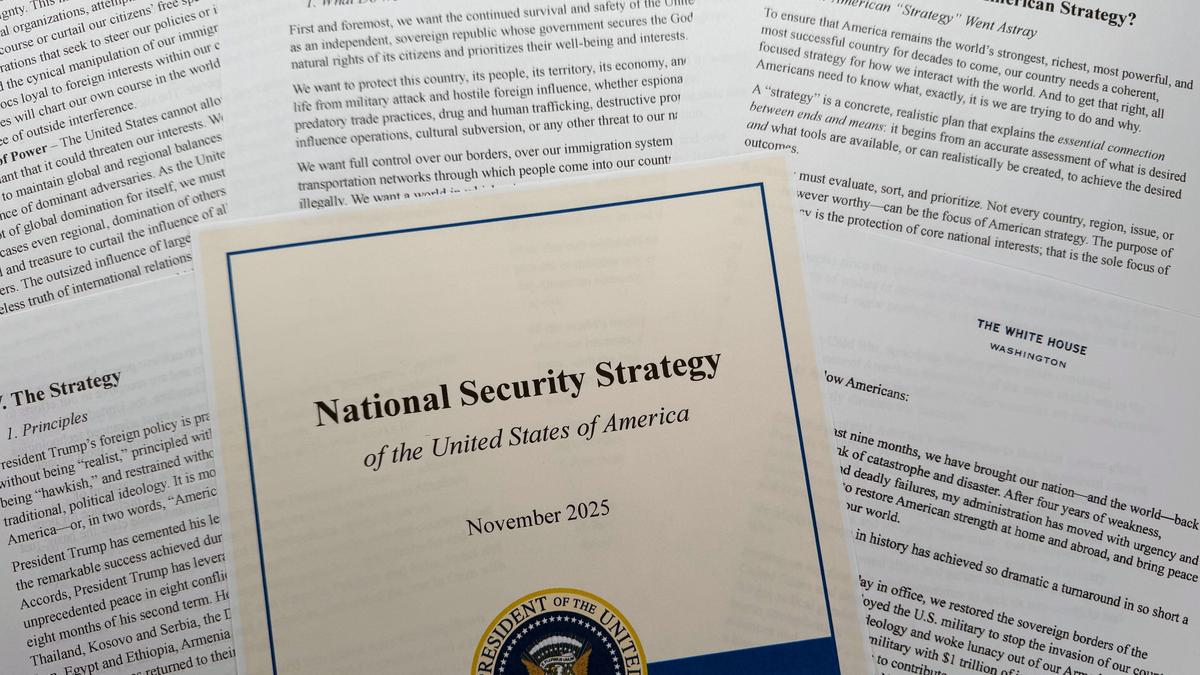
The National Security Strategy document, released in November 2025, is photographed on December 10, 2025.
| Photo Credit: AP

In 2005, when I served on the Prime Minister’s Task Force on Global Strategic Developments chaired by K. Subrahmanyam, India and the U.S. stood at the threshold of a historic transformation. Washington had declared that it wished to “help India become a major world power in the 21st century.” It was an extraordinary statement, not merely because of what it promised but because of the confidence it reflected. The U.S. then still believed that strengthening responsible rising powers would strengthen the world. That belief seemed to form, for many, the bedrock of the civil nuclear breakthrough and of a strategic partnership built on a shared sense of possibility.

The U.S.’s retreat

Reading the 2025 U.S. National Security Strategy (NSS) is therefore an unsettling experience. The document is saturated with self-praise. It claims to have “brought our nation — and the world — back from the brink of catastrophe and disaster” and asserts that “no administration in history has achieved so dramatic a turnaround in so short a time.” But this assertiveness feels defensive. It projects a nation unsure of its place in a world it no longer fully comprehends, yet unwilling to concede that uncertainty even to itself. The result is a strategy that is less a map for global action and more an exercise in national reassurance.

The contrast with the intellectual spirit of 2005 could not be sharper. Then, Washington spoke the language of partnership. Today, it speaks the language of burdens. “The days of the United States propping up the entire world order like Atlas are over,” the strategy declares. Global leadership, once embraced with ease, is now treated as a cost to be minimised. The overriding imperative is not to elevate the international system but to lighten America’s load.


Editorial | Notional security: On the U.S.’s National Security Strategy

Nowhere is this shift more stark than in the treatment of India. Cooperation is acknowledged but is instrumental. India is framed less as a civilisational actor and more as a component in America’s China calculus. The NSS states that the U.S. must “continue to improve commercial (and other) relations with India to encourage New Delhi to contribute to Indo-Pacific security, including through continued quadrilateral cooperation with… ‘the Quad’.” In this framing, India is not an end in itself but a means to a balance-of-power arrangement the U.S. seeks to preserve.

In 2005, India’s rise was an objective; now, it is a function. This narrowing is part of a broader retreat from internationalist confidence. The so-called Trump Corollary to the Monroe Doctrine, declaring an intent to “assert and enforce” hemispheric exclusivity, speaks to a nation turning inward. The irony is difficult to miss. In 2005, when India spoke of strategic autonomy, many in Washington bristled. In 2025, when America claims an expansive and unilateral autonomy, it calls it realism.

The document’s tone reinforces this inwardness. It catalogues a series of claimed diplomatic triumphs, resolving multiple global conflicts “from Cambodia and Thailand” to “Pakistan and India”. These read less like diplomatic achievements and more like political assertions crafted for domestic effect. Strategy becomes performance, and performance becomes a substitute for engagement with the world’s real fissures.

For India, the implications are clear. The U.S. that sought to create strategic space for India in 2005 is not the U.S. reflected in the NSS — it is preoccupied with its own vulnerabilities, identity, and hierarchy of burdens. It demands more from partners yet offers less in return. It speaks of shared interests while retreating from shared responsibilities. It calls for burden-sharing but often means burden-shifting.

This does not diminish the importance of India-U.S. cooperation. It simply changes its foundations. India cannot rely on the assumption that Washington will invest in India’s rise as a matter of strategic design. India’s rise will depend on India. Partnership will endure where interests converge and remain measured where they do not. As the NSS itself insists, partners must increasingly “assume primary responsibility for their regions,” a polite but unmistakable signal that U.S. support will be conditional and limited.

The path forward

The lesson of 2005 remains valuable because it reminds us of the conditions under which strategic transformations occur: confidence on both sides and a belief that the other’s ascent strengthens one’s own. The 2025 strategy lacks that confidence. It is shaped by grievance at past overreach, suspicion of institutions, and a preoccupation with restoring an earlier notion of American primacy.

India therefore must resist the temptation to interpret this document through the lens of earlier hopes. The era that produced the civil nuclear breakthrough was an era of widening horizons for both India and the U.S. The era that produced this strategy is one of contracting horizons for the U.S. and expanding responsibilities for India. If India is to be a major world power in the 21st century, it will not be because any external actor wills it. It will be because India possesses the strategic confidence and material capacity to act independently within a fragmented global order.

Paradoxically, the 2025 strategy makes that reality clearer than its authors intend. By reducing the scope of American commitments, it widens the space for others. For India, the challenge is not to fill a vacuum but to craft a role suited to its scale, interests, and civilisational temperament. The assumptions of 2005 cannot return, but the aspiration that animated them is ours to pursue.

Amitabh Mattoo, Dean and Professor, School of International Studies, JNU and former Member National Security Advisory Board

Published – December 17, 2025 12:39 am IST


Source link

World Tags:2025 U.S. National Security Strategy document, National Security Strategy

Post navigation

Previous Post: The time has come to split the coaching job in Indian cricket
Next Post: Access Denied

Related Posts

  • Pope Francis calls at G7 for ban on ‘lethal autonomous weapons’
    Pope Francis calls at G7 for ban on ‘lethal autonomous weapons’ World
  • Carney suspends Canada’s fuel tax in first act after securing majority government
    Carney suspends Canada’s fuel tax in first act after securing majority government World
  • Access Denied World
  • An Indian restaurant in Tashkent celebrates Uzbekistan’s love for Bollywood
    An Indian restaurant in Tashkent celebrates Uzbekistan’s love for Bollywood World
  • Access Denied World
  • Militia infighting kills at least 9 in Libya’s capital, officials say
    Militia infighting kills at least 9 in Libya’s capital, officials say World

More Related Articles

Donald Trump says U.S. negotiating with Iran directly and indirectly Donald Trump says U.S. negotiating with Iran directly and indirectly World
Access Denied World
Access Denied World
Sam Altman’s Net Worth Touches The  Billion Mark And Not Because Of OpenAI  Sam Altman’s Net Worth Touches The $2 Billion Mark And Not Because Of OpenAI  World
US Woman Jailed For Waterboarding Baby, Putting Him In Freezer US Woman Jailed For Waterboarding Baby, Putting Him In Freezer World
Mobile internet restored in violence-hit Bangladesh Mobile internet restored in violence-hit Bangladesh World
SiteLock

Archives

  • May 2026
  • April 2026
  • March 2026
  • February 2026
  • January 2026
  • December 2025
  • November 2025
  • October 2025
  • September 2025
  • August 2025
  • July 2025
  • June 2025
  • May 2025
  • April 2025
  • March 2025
  • February 2025
  • January 2025
  • December 2024
  • November 2024
  • October 2024
  • September 2024
  • August 2024
  • July 2024
  • June 2024
  • May 2024
  • April 2024
  • March 2024
  • February 2024
  • January 2024
  • December 2023
  • November 2023
  • October 2023
  • September 2023
  • August 2023
  • July 2023
  • June 2023
  • May 2023
  • April 2023
  • March 2023
  • February 2023
  • January 2023
  • December 2022
  • November 2022
  • October 2022
  • September 2022
  • August 2022
  • July 2022
  • June 2022
  • May 2022

Categories

  • Business
  • Nation
  • Science
  • Sports
  • World

Recent Posts

  • Gold ETF prices revive as investors flock on higher import duties on yellow metal
  • Assam ships first legal agarwood chips to West Asia
  • How the anti-defection law is going to operate in the AIADMK case?
  • ATS questions 57 in Maharashtra over alleged gangster network links
  • Nicobarese oppose proposal for three wildlife sanctuaries

Recent Comments

  1. Stevemonge on UP Teacher Who Asked Students To Slap Muslim Classmate
  2. RichardClage on UP Teacher Who Asked Students To Slap Muslim Classmate
  3. StevenLek on UP Teacher Who Asked Students To Slap Muslim Classmate
  4. Leonardren on UP Teacher Who Asked Students To Slap Muslim Classmate
  5. NathanQuins on UP Teacher Who Asked Students To Slap Muslim Classmate
  • Ranji Trophy | A campaign with promise ends on a sour note on and off the field for Tamil Nadu
    Ranji Trophy | A campaign with promise ends on a sour note on and off the field for Tamil Nadu Sports
  • Voting begins for Maldives Parliament, watched by India and China vying for control of Indian Ocean
    Voting begins for Maldives Parliament, watched by India and China vying for control of Indian Ocean World
  • Asia Cup 2023: Babar Azam Surpasses Virat Kohli For A Massive World Record
    Asia Cup 2023: Babar Azam Surpasses Virat Kohli For A Massive World Record Sports
  • Russia Says It Intercepted Two US Drones Near Crimea
    Russia Says It Intercepted Two US Drones Near Crimea World
  • Australia’s Great Barrier Reef in grip of ‘mass bleaching event’
    Australia’s Great Barrier Reef in grip of ‘mass bleaching event’ World
  • India’s Financial System Is Now In Much Stronger Position: RBI Governor Shaktikanta Das
    India’s Financial System Is Now In Much Stronger Position: RBI Governor Shaktikanta Das Nation
  • Access Denied
    Access Denied Nation
  • It Makes More Sense For IOC To Give 2036 Olympics To India: Anurag Thakur
    It Makes More Sense For IOC To Give 2036 Olympics To India: Anurag Thakur Sports

Editor-in-Chief:
Mohammad Ariff,
MSW, MAJMC, BSW, DTL, CTS, CNM, CCR, CAL, RSL, ASOC.
editor@artifex.news

Associate Editors:
1. Zenellis R. Tuba,
zenelis@artifex.news
2. Haris Daniyel
daniyel@artifex.news

Photograher:
Rohan Das
rohan@artifex.news

Artifex.News offers Online Paid Internships to college students from India and Abroad. Interns will get a PRESS CARD and other online offers.
Send your CV (Subjectline: Paid Internship) to internship@artifex.news

Links:
Associate Journalism
About Us
Privacy Policy

News Links:
Breaking News
World
Nation
Sports
Business
Entertainment
Lifestyle

Registered Office:
72/A, Elliot Road, Kolkata - 700016
Tel: 033-22277777, 033-22172217
Email: office@artifex.news

Editorial Office / News Desk:
No. 13, Mezzanine Floor, Esplanade Metro Rail Station,
12 J. L. Nehru Road, Kolkata - 700069.
(Entry from Gate No. 5)
Tel: 033-46011099, 033-46046046
Email: editor@artifex.news

Copyright © 2023 Artifex.News Newsportal designed by Artifex Infotech.