





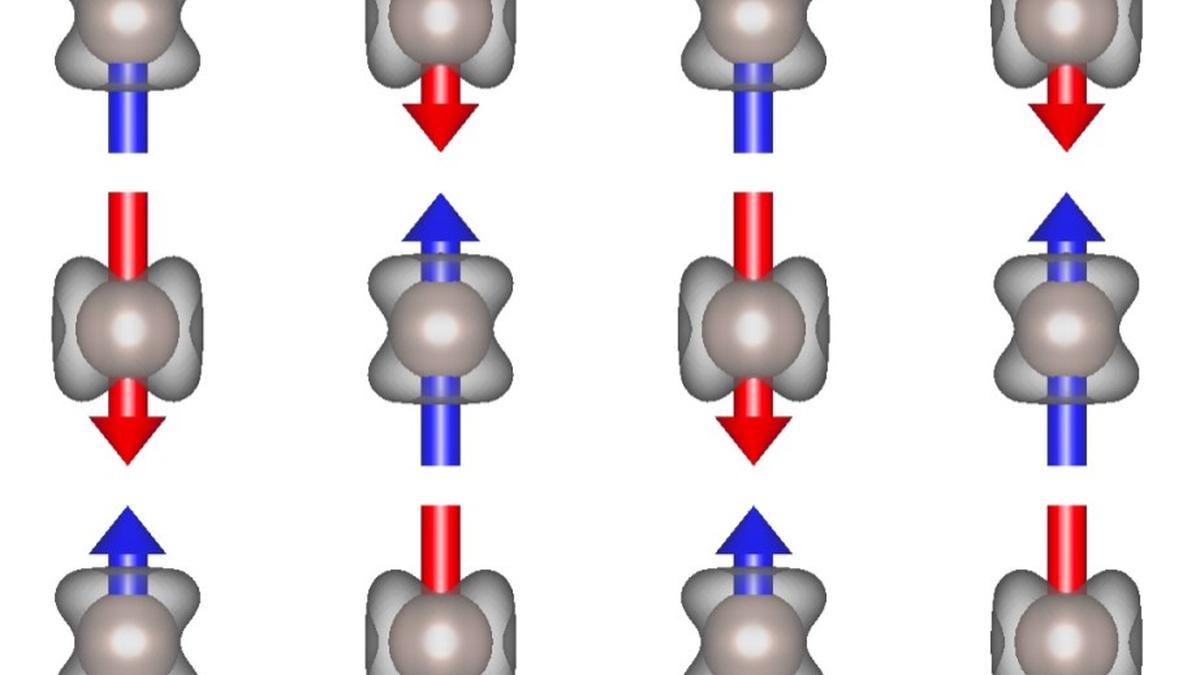
For well over a century, our understanding of the magnetic world had been neatly compartmentalised into two categories: ferromagnetism and antiferromagnetism. Ferromagnetism, which is the familiar force that pins a souvenir magnet to a refrigerator door, arises because many small, atom-scale magnetic moments are aligned in parallel, creating a strong, external magnetic field. Antiferromagnetism, its more elusive counterpart, features alternating magnetic moments that cancel each other out, resulting in no net external magnetic field.
This simple dichotomy provided the foundation for countless technological advances, including most famously the hard disk drive. However, in recent years, researchers have identified a third and distinct form of magnetism that extends beyond this longstanding binary classification. Scientists call it altermagnetism. First formulated around 2019 and supported by important experiments in 2024, altermagnetism is drawing strong interest for possible applications in spintronics and quantum technologies.
Complex world
You can think of altermagnetism as a third kind of magnetism in which rotating or mirror-flipping the crystal pattern matches sites in cancelling pairs, leaving no net magnetisation — thus bridging the gap between its two well-known magnetic cousins. At a macroscopic level, altermagnetic materials behave like antiferromagnets. Their neighbouring magnetic moments are antiparallel (meaning if one moment is pointing ‘up’, its neighbour is pointing ‘down’) — and they’re arranged in a way that their individual magnetic fields cancel each other out. As a result, an altermagnet, much like an antiferromagnet, produces no external magnetic field. This property makes an altermagnet less susceptible to external magnetic disturbances and prevents interference between closely packed components in electronic devices.
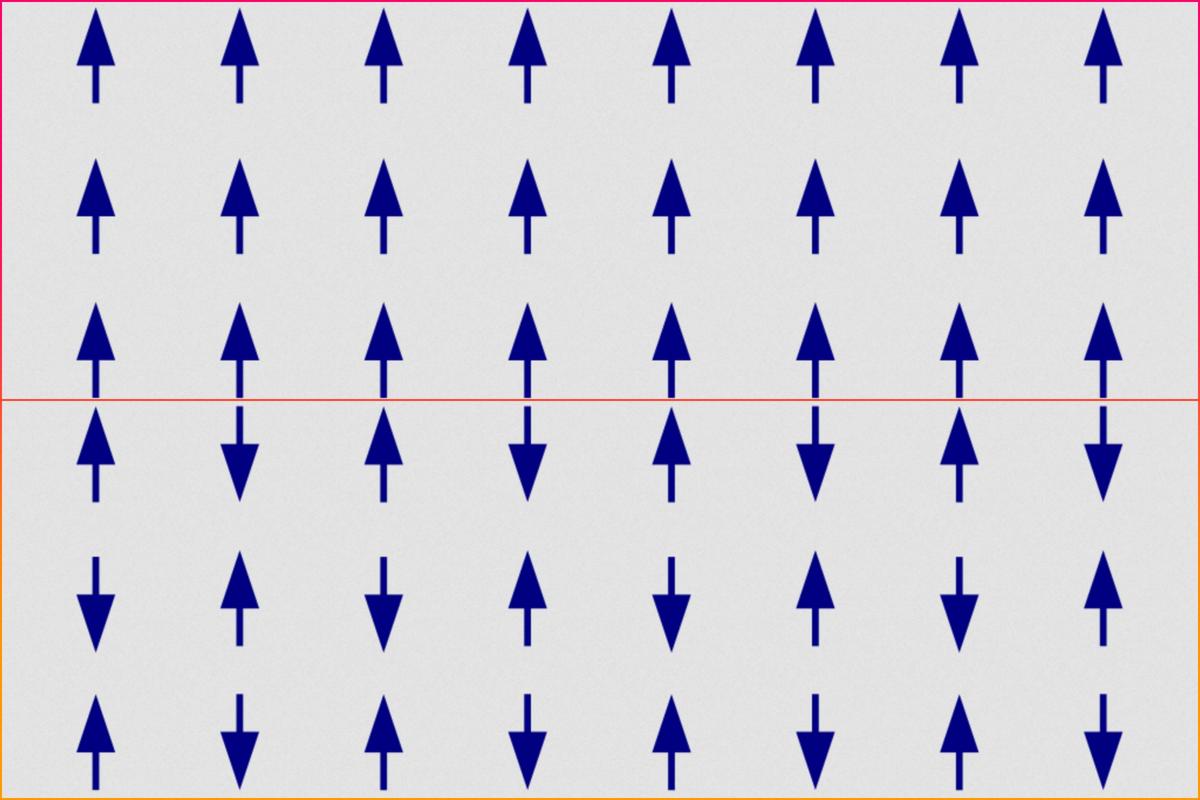
A schematic illustration of the arrangement of spins in ferromagnetic (top) and antiferromagnetic (bottom) order.
| Photo Credit:
Michael Schmid (CC BY-SA)
This absence of a net magnetic moment is a crucial feature because it could enable a new generation of dense and stable technologies. Yet beneath this magnetically silent exterior lies a world of surprising complexity. While their external magnetic presence is nullified, altermagnets possess an internal electronic structure that is reminiscent of ferromagnets. This duality is the cornerstone of their potential and what sets them apart as a new class of magnetic order.
The secret to this seemingly paradoxical behaviour lies in the interplay of the material’s crystal structure and the spin of its electrons. An electron’s spin is an intrinsic quantum property, just like its charge. Because the electron is a charged particle, this intrinsic spin causes it to act like a small magnet. The magnetic moment is the term for that resulting magnetism: it quantifies the strength and direction of the magnetic field generated by the electron’s spin.
In conventional antiferromagnets, the oppositely aligned spins are typically related by simple symmetry operations like inversion or translation. This pattern often forces ‘spin up’ and ‘spin down’ electrons to have the same energy in many directions.
Spin up, spin down
In fact, to really appreciate the novelty of altermagnetism, it’s important to visualise the arrangement of atoms within these materials. Imagine a crystal as a perfectly ordered, three-dimensional wallpaper pattern, where each repeating element is an atom. In conventional antiferromagnets, the relationship between an atom with an upward-pointing magnetic moment (‘spin up’) and its neighbor with a downward-pointing moment (‘spin down’) is typically straightforward. One can be transformed into the other by a simple shift, known as a translation — like moving from one identical flower to the next on a wallpaper roll.
However, the atomic arrangement in altermagnets follows a different rule. Here, the atoms with opposing magnetic spins are connected by more complex symmetry operations, such as being rotated into place or reflected across a mirror plane. In simple terms, instead of a shift, a turn or a mirror-flip would map a ‘spin up’ site to a ‘spin down’ site. (Here, ‘operations’ just means simple moves you can perform on the crystal, like shift it, turn it around, flip it in a mirror or reversing time, that line up one part of the pattern with another and determine what the electrons are allowed to do.)
This arrangement achieves two seemingly contradictory goals. First, it preserves the overall magnetic neutrality that’s characteristic of antiferromagnets. Because the rotation or reflection is part of the repeating crystal pattern, for every ‘spin up’ magnetic moment, there’s a matching ‘spin down’ moment. When viewed from the outside, these opposing moments cancel, so there is no net external magnetic field. On the other hand, the same “twist” in the pattern creates an unusual setting for the electrons moving in the material.

To understand this, think of the allowed energy levels for electrons in a solid not as a simple ladder, but as broad energy highways, known as electronic bands. In many materials, up-spin and down-spin electrons are like the same kind of car and can use the same lanes. In an altermagnet, the crystal rules act like special traffic rules. For electrons moving in some directions, the highway splits into two lanes at slightly different heights: one lane mainly for up-spin, the other for down-spin. This split is called spin-splitting. It means one spin can move a bit more easily than the other — a feature long associated with ferromagnets.
This effect also lets altermagnets carry spin-polarised currents, where most moving electrons share the same spin. The important point is that the crystal’s turns or mirror-flips let bands split by spin even though the overall magnet cancels to zero. And the ability to guide spin without making stray magnetic fields is an appealing idea in magnetism and spintronics.
Close encounters
The journey to show altermagnetism in the lab needed new tools. Since altermagnets don’t make an external magnetic field, traditional magnetometers are not the best way to see them. Instead, scientists used methods that look straight at the electrons’ energies and patterns. One important step came in early 2024 with manganese telluride (MnTe), once treated as a standard antiferromagnet. Using angle-resolved photoemission spectroscopy (ARPES) — which shines light on a surface and measures the energies of electrons that come out — researchers saw the expected spin-splitting of the bands. This supported the existence of altermagnetism. Further work with X-ray magnetic dichroism, an X-ray method that changes with magnetic direction, imaged tiny magnetic patterns and showed they can be formed in thin films on purpose.

The swirling textures of the altermagnetic order vector in manganese telluride, indicated by the six colours and overlaid vector plot. This image was developed in a December 2024 study led by University of Nottingham researchers; this study provided the first experimental visual evidence of altermagnetism.
| Photo Credit:
Nature vol. 636, pages 348–353 (2024)
Studies published onNovember 6 proposed two new ways to probe the hidden magnetic structure of altermagnets using circularly polarised X-rays. The techniques are predicted to distinguish the two distinct groups of atoms with opposing spins, allowing scientists to directly measure their individual magnetic moments.
The implications of altermagnetism are encouraging. Spintronics, which uses electron spin as well as charge to store and process information, may benefit first. Today’s spintronic parts often use ferromagnets, whose stray fields can limit how tightly parts can be packed. Altermagnets, with zero net magnetisation, can reduce such stray-field problems and may help designs that aim for smaller, faster, more energy-efficient memory and logic. Their spins can switch very fast — up to trillions of times per second — but real device speedups have yet to be demonstrated.
This high-speed potential stems from the nature of the magnetic ordering. In altermagnets, the spin dynamics are governed by exchange interactions that can operate on picosecond or even sub-picosecond timescales. This intrinsic property allows for potential switching speeds in the terahertz (THz) range, which is theoretically up to a thousand-times faster than the gigahertz (GHz) speeds that are typical for current ferromagnetic components. Achieving this in practical devices remains a long-term goal but it highlights the fundamental performance advantages that altermagnetic materials could offer.
Anomalous Hall effect
Beyond spintronics, scientists are also exploring possible links to quantum computing. The absence of stray magnetic fields in altermagnets can lower some kinds of magnetic noise in test devices. Scientists are still figuring out how they work alongside superconductors, to be fair.
Further yet, the discovery that altermagnetism can show up in a wide range of materials — including insulators, semiconductors, and metals — opens up many options for materials design. Some early studies even look at organic crystals, but this line of work is still exploratory.

Hard disk drives store data in a thin ferromagnetic layer on the platters, where small domains are magnetizsed one way or the other to encode bits. The write head, an electromagnet, flips these domains while the read head detects their magnetic orientation.
| Photo Credit:
William Warby/Unsplash
The theoretical framework behind altermagnetism is simple: if you imagine running time backward, magnets usually don’t look the same. That is true for both ferromagnets and antiferromagnets. Even so, many antiferromagnets keep a pairing rule with the crystal pattern that still forces ‘spin up’ and ‘spin up’ to match in many directions. Altermagnets break that matching while keeping zero overall magnetisation.
In some altermagnets, the crystal rules even allow a sideways voltage when a current flows through it; this is known as the anomalous Hall effect. And the significance of the anomalous Hall effect is that it provides a straightforward electrical method to ‘read’ the material’s magnetic state. Conventional antiferromagnets typically lack this effect, making their states difficult to detect with simple electronics. This property gives altermagnets a notable advantage for potential device integration.
Finally, computer searches have suggested many possible altermagnetic materials, giving scientists a long list to test in experiments.

Good signs
The exploration of altermagnetism is still in its infancy and many challenges remain. The synthesis of high-quality, single-domain altermagnetic materials is a crucial hurdle that needs to be overcome for their practical application. Besides manganese telluride, another widely studied material is ruthenium dioxide (RuO2), which has also been central in demonstrating certain altermagnetic effects. A significant practical issue is that these materials often form with many small magnetic regions, or domains, where the alternating spin pattern is oriented differently. For a device to function reliably, it typically requires a single, well-ordered domain. Learning how to control the growth of these materials to eliminate such domain boundaries is therefore a central focus of current research.
Developing scalable and cost-effective fabrication techniques will also be essential to integrate them into commercial devices. However, the rapid pace of discovery and the intense interest from the scientific community are good signs that steady work can tackle these problems.
Taken together, the discovery of altermagnetism represents a step forward in physicists’ understanding of the magnetic world. It adds a new option to ferromagnetism and antiferromagnetism, introducing a well-defined magnetic phase with a distinctive combination of properties. Because they keep zero net magnetisation yet still split spins in the bands, altermagnets could lead to faster, smaller, and more energy-efficient technologies.
mukunth.v@thehindu.co.in