

Skip to content
  • Facebook
  • X
  • Linkedin
  • WhatsApp
  • Associate Journalism
  • About Us
  • Privacy Policy
  • 033-46046046
  • editor@artifex.news
Artifex.News

Artifex.News

Stay Connected. Stay Informed.

  • Breaking News
  • World
  • Nation
  • Sports
  • Business
  • Science
  • Entertainment
  • Lifestyle
  • Toggle search form
  • Access Denied
    Access Denied Nation
  • U.S. and China in March held first informal nuclear talks in 5 years, delegates reveal
    U.S. and China in March held first informal nuclear talks in 5 years, delegates reveal World
  • Indian Immunologicals Ltd develops needle-free COVID-19 intranasal booster vaccine in collaboration with Australian university
    Indian Immunologicals Ltd develops needle-free COVID-19 intranasal booster vaccine in collaboration with Australian university Science
  • 22 Killed As Bus Falls Into Valley In Pakistan
    22 Killed As Bus Falls Into Valley In Pakistan World
  • Zomato Launches AI Platform Nugget
    Zomato Launches AI Platform Nugget Nation
  • Virat Kohli’s ‘Unreal’ Act In Practice Amid Heavy Rain In Perth Breaks Internet
    Virat Kohli’s ‘Unreal’ Act In Practice Amid Heavy Rain In Perth Breaks Internet Sports
  • Huge Rush Of Devotees At Gangotri, Yamunotri Dhams
    Huge Rush Of Devotees At Gangotri, Yamunotri Dhams Nation
  • Access Denied
    Access Denied Nation

IIT Bombay researchers develop GPS-free control scheme for autonomous drone swarms

Posted on November 2, 2025 By admin


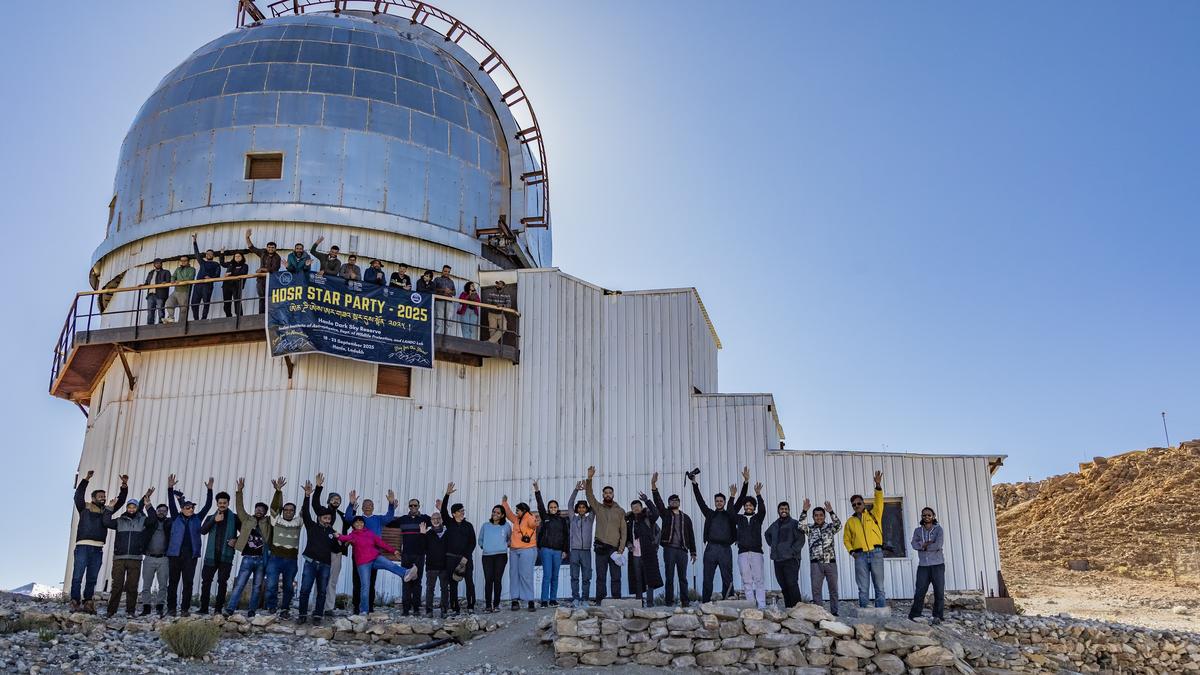
Novel scheme by IIT Bombay researchers to control drones can enable complex formation flying using only camera data, without GPS or inter-drone communication.

A new control scheme developed by Professor Dwaipayan Mukherjee and research scholar Chinmay Garanayak at the Indian Institute of Technology (IIT) Bombay enables unmanned aerial vehicles (UAVs) to fly in coordinated swarms without relying on GPS, inter-drone communication, or centralised control systems. The method uses bearing-only measurements obtained through onboard cameras to determine relative positions and maintain formation.

The researchers applied the scheme to Vertical Take-Off and Landing (VTOL) UAVs, which can lift off without a runway and hover mid-air. These drones are suitable for operations in confined spaces such as surveillance and monitoring. “Autonomy in a swarm is a critical task,” Mr. Mukherjee said. “This means that vehicles in a swarm should be able to decide their ‘actions’ based on variables they can measure with their on-board sensors, instead of having to rely on some global information being fed to them or some human/centralised computer deciding what their action ought to be. This is where our paradigm differs from usual ones,” he added.

The proposed ‘bearing-only’ control scheme allows each drone to use its onboard camera to observe its immediate neighbours and calculate bearing information. “In bearing-only control, the goal is to achieve formation control using only interagent bearing measurements,” Mr. Garanayak said. The system does not require GPS or communication with other drones or a central computer.

Camera-based measurements are less prone to noise than conventional distance sensors, simplifying the drone’s sensor system and reducing battery requirements and overall weight. The scheme is designed to work in areas where GPS is unavailable, or communication could be jammed, making it suitable for stealth-mode operations such as covert military missions.

VTOL drones are underactuated systems, which means they have six degrees of freedom but fewer directly controllable movements. While they can move vertically and rotate around three axes, lateral and forward-backward movements must be indirectly controlled. “Many of the results in the literature do not address the underactuated dynamics of VTOL vehicles and only focus on the kinematic model. This motivated us to consider the fully underactuated model of the VTOL UAV and explore its applicability to formation control,” Mr. Mukherjee said.

Underactuated systems require dynamic models that include position, orientation, velocities, forces, torques, and inertia. Previous attempts to apply bearing-only control to such models often fail due to instability or breakdowns in certain conditions. Mr. Mukherjee and Mr. Garanayak developed a control mechanism that ensures convergence and maintenance of the desired formation, even when drones start from imperfect positions. They have provided rigorous mathematical proof to support the reliability of the system. 

Their work addresses two operational scenarios. In the first, drones maintain formation at constant velocity using bearing and bearing-rate data. In the second, where formation and velocity vary over time, drones incorporate their own velocity measurements in addition to bearing data. The system can handle arbitrary time-varying configurations, allowing drones to navigate narrow passages, reconfigure into single-line formations, and adapt to changing mission requirements. 

The researchers plan to test the control scheme experimentally, using a drone swarm. On the future roadmap, they aim to address collision avoidance with theoretical guarantees. “Most existing algorithms rely on ad hoc collision avoidance schemes that do not come with any theoretical guarantees. Collision avoidance with objects in the environment and among drones is a challenge we are trying to tackle at a theoretical level,” Mr. Mukherjee said. 

Published – November 02, 2025 07:44 pm IST


Source link

Science

Post navigation

Previous Post: Access Denied
Next Post: Access Denied

Related Posts

  • Hanle protects its dark skies and builds a future on stargazing
    Hanle protects its dark skies and builds a future on stargazing Science
  • Karman Line: Where space begins
    Karman Line: Where space begins Science
  • How did the Baltimore bridge disaster happen? | Explained
    How did the Baltimore bridge disaster happen? | Explained Science
  • How big fossil-fuel-producing countries export emissions abroad | Explained
    How big fossil-fuel-producing countries export emissions abroad | Explained Science
  • HPV vaccine prevents cervical cancer cases in deprived groups: study
    HPV vaccine prevents cervical cancer cases in deprived groups: study Science
  • Brumation: Winter is coming for reptiles
    Brumation: Winter is coming for reptiles Science

More Related Articles

India’s fossil fuel capacity grows 2.44% in FY24; non fossil-fuel rises 11%: Government data India’s fossil fuel capacity grows 2.44% in FY24; non fossil-fuel rises 11%: Government data Science
A (very) basic guide to artificial intelligence A (very) basic guide to artificial intelligence Science
Double the positivity: How are double rainbows formed? Double the positivity: How are double rainbows formed? Science
NIMHANS releases Pre-CURB, a digital learning resource on prevention of cannabis use NIMHANS releases Pre-CURB, a digital learning resource on prevention of cannabis use Science
Eye care diagnosis from a distance Eye care diagnosis from a distance Science
What is the latest science telling us about climate change? What is the latest science telling us about climate change? Science
SiteLock

Archives

  • November 2025
  • October 2025
  • September 2025
  • August 2025
  • July 2025
  • June 2025
  • May 2025
  • April 2025
  • March 2025
  • February 2025
  • January 2025
  • December 2024
  • November 2024
  • October 2024
  • September 2024
  • August 2024
  • July 2024
  • June 2024
  • May 2024
  • April 2024
  • March 2024
  • February 2024
  • January 2024
  • December 2023
  • November 2023
  • October 2023
  • September 2023
  • August 2023
  • July 2023
  • June 2023
  • May 2023
  • April 2023
  • March 2023
  • February 2023
  • January 2023
  • December 2022
  • November 2022
  • October 2022
  • September 2022
  • August 2022
  • July 2022
  • June 2022
  • May 2022

Categories

  • Business
  • Nation
  • Science
  • Sports
  • World

Recent Posts

  • Access Denied
  • Israeli strike kills one in Gaza as sides trade blame for truce violations
  • Access Denied
  • IIT Bombay researchers develop GPS-free control scheme for autonomous drone swarms
  • IIT Bombay researchers develop GPS-free control scheme for autonomous drone swarms

Recent Comments

  1. dfb{{98991*97996}}xca on UP Teacher Who Asked Students To Slap Muslim Classmate
  2. "dfbzzzzzzzzbbbccccdddeeexca".replace("z","o") on UP Teacher Who Asked Students To Slap Muslim Classmate
  3. 1}}"}}'}}1%>"%>'%> on UP Teacher Who Asked Students To Slap Muslim Classmate
  4. bfg6520<s1﹥s2ʺs3ʹhjl6520 on UP Teacher Who Asked Students To Slap Muslim Classmate
  5. pHqghUme9356321 on UP Teacher Who Asked Students To Slap Muslim Classmate
  • Rohit Sharma Kisses Hardik Pandya After India’s Historic T20 World Cup 2024 Win. Video Viral. Watch
    Rohit Sharma Kisses Hardik Pandya After India’s Historic T20 World Cup 2024 Win. Video Viral. Watch Sports
  • Massive sinkhole in Bangkok street forces evacuations
    Massive sinkhole in Bangkok street forces evacuations World
  • Join Central schemes and be self-reliant, Nirmala Sitharaman urges women
    Join Central schemes and be self-reliant, Nirmala Sitharaman urges women Business
  • Neeraj Chopra To Reduce Time Spent With Coach Jan Zelezny In 2025. Here’s Why
    Neeraj Chopra To Reduce Time Spent With Coach Jan Zelezny In 2025. Here’s Why Sports
  • S8UL Esports becomes World’s First Organization To Win Content Group Of The Year Title Three Years In A Row
    S8UL Esports becomes World’s First Organization To Win Content Group Of The Year Title Three Years In A Row Sports
  • Akali Dal’s Harsimrat Badal Backs Singer Shubh
    Akali Dal’s Harsimrat Badal Backs Singer Shubh Nation
  • T20 World Cup 2024: Analysis of a famous Indian victory
    T20 World Cup 2024: Analysis of a famous Indian victory Sports
  • Pakistan Players Hailing Rohit Sharma’s Pull Shot Prompts Epic Rant From Former Captain
    Pakistan Players Hailing Rohit Sharma’s Pull Shot Prompts Epic Rant From Former Captain Sports

Editor-in-Chief:
Mohammad Ariff,
MSW, MAJMC, BSW, DTL, CTS, CNM, CCR, CAL, RSL, ASOC.
editor@artifex.news

Associate Editors:
1. Zenellis R. Tuba,
zenelis@artifex.news
2. Haris Daniyel
daniyel@artifex.news

Photograher:
Rohan Das
rohan@artifex.news

Artifex.News offers Online Paid Internships to college students from India and Abroad. Interns will get a PRESS CARD and other online offers.
Send your CV (Subjectline: Paid Internship) to internship@artifex.news

Links:
Associate Journalism
About Us
Privacy Policy

News Links:
Breaking News
World
Nation
Sports
Business
Entertainment
Lifestyle

Registered Office:
72/A, Elliot Road, Kolkata - 700016
Tel: 033-22277777, 033-22172217
Email: office@artifex.news

Editorial Office / News Desk:
No. 13, Mezzanine Floor, Esplanade Metro Rail Station,
12 J. L. Nehru Road, Kolkata - 700069.
(Entry from Gate No. 5)
Tel: 033-46011099, 033-46046046
Email: editor@artifex.news

Copyright © 2023 Artifex.News Newsportal designed by Artifex Infotech.