




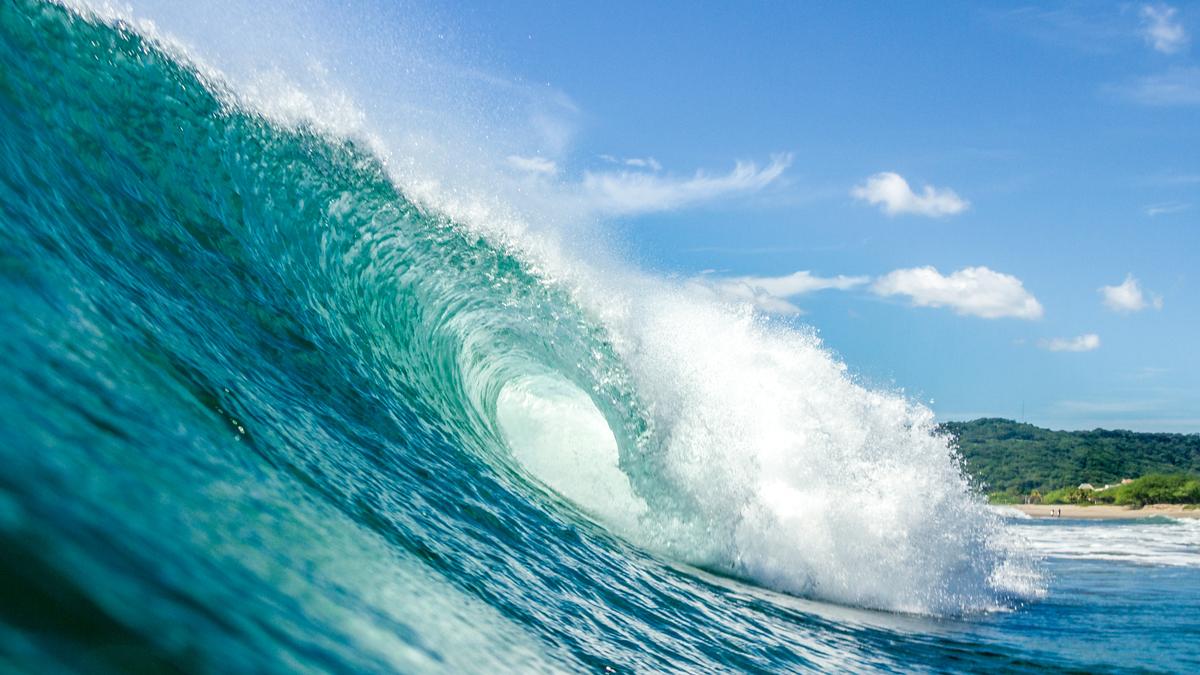
Imagine a tsunami, a colossal wave capable of traveling across entire oceans and causing immense destruction. Now, picture another special kind of wave, known as a soliton. Unlike a regular wave that spreads out and loses energy, a soliton is a solitary wave that holds its shape and speed over incredibly long distances. These powerful and mysterious waves are examples of what scientists call nonlinear wave dynamics. Understanding them is crucial for everything from predicting natural disasters to designing better communications systems.
For decades, scientists have studied these waves in enormous, hundred-metre-long water tanks called wave flumes. By generating waves in these controlled environments, they can observe how they behave.
However, even the biggest and most advanced wave flumes have a major limitation: they can’t replicate the extreme conditions that create the most powerful nonlinear waves found in nature, like the sheer force of a tsunami or the intensity of the world’s most extreme tides. ‘Nonlinear’ here means the wave’s behaviour doesn’t scale in a simple, proportionate way; instead, small changes in conditions can produce disproportionately large or unpredictable effects. The physics behind these waves is very complex, and reaching the level of nonlinearity seen in nature has been impossible to achieve in a lab.
Incredible properties
This is the challenge a team of researchers from the University of Queensland in Australia set out to surmount. But instead of going even bigger, they went much smaller.
They created a wave flume on a microscopic chip and used a unique kind of fluid to generate waves more powerful (relative to their size) than anything ever seen on the earth. Their goal was to create a platform to study the full range of nonlinear wave behaviour in a controlled, miniature environment.
“The study of how fluids move has fascinated scientists for centuries because hydrodynamics governs everything from ocean waves and the swirl of hurricanes to the flow of blood and air through our bodies,” study coauthor and ARC Future Fellow Christopher Baker said in a statement. “But a lot of the physics behind waves and turbulence has been a mystery.”
The findings were published in Science on October 23.
When cooled to just a few degrees above absolute zero, helium becomes a superfluid — a unique quantum state of matter with incredible properties. Most importantly in this context, it can flow without any friction or viscosity. This means an ultra-shallow film of superfluid helium just a few nanometres thick can move freely without getting stuck. This is impossible for any normal fluid.
The team fabricated a silicon beam about the width of a human hair on a chip. When cooled, a 6.7-nm deep film of superfluid helium could naturally coat this beam, creating a perfect wave channel.
Lilliputian paddles
The next challenge was to make waves in such a small system and see them. At one end of the silicon beam, the team built a photonic crystal cavity—a structure with nanometre-wide holes that trapped light. When the researchers shone a laser into this cavity, it heated the superfluid helium slightly.
Top-left: Scanning electron micrograph top-view of two fabricated devices on a silicon on insulator chip. Right: zoom-ins of the boxed regions. b) False colour scanning electron microscope image showing the silicon superfluid wave flume (blue) glued to a silica optical fibre taper (grey). c) Zoomed-in view showing the silicon photonic crystal cavity at the end of the device. The silicon waveguide is around 500 nm wide and 220 nm thick.
| Photo Credit:
arXiv:2504.13001v1
Superfluid helium has another strange property: it flows towards rather than away from heat, a phenomenon called the fountain effect. By rapidly changing the laser’s intensity, they could create pulses of heat that pushed the superfluid, like a Lilliputian light-powered paddle.
Second, the height of the helium film affected the light trapped in the cavity. As a wave passed by, raising or lowering the fluid’s surface, it slightly changed the light’s frequency. By monitoring the light coming out of the cavity, the researchers could precisely measure the shape and height of the waves in real-time in a very sensitive way. Thus, this all-optical system allowed the team to both generate powerful waves and observe their behaviour on a microscopic scale.
With their chip-scale wave flume up and running, the researchers were able to observe a whole host of nonlinear phenomena that had previously been stuck on paper.
One of the first things they observed was backward steepening. In a normal water wave, the crest moves faster than the trough, causing the wave to lean forward and eventually break.
In the superfluid, they saw the exact opposite. The troughs moved faster than the crests, causing the wave to lean backwards before breaking. This strange behaviour had been predicted for superfluid helium decades ago but had never been directly observed.
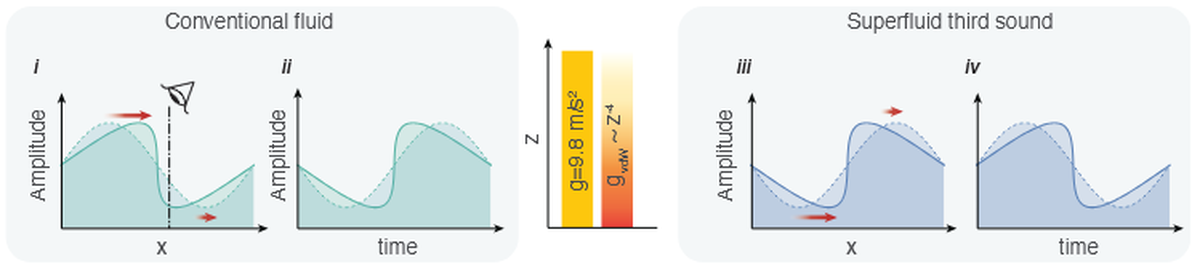
An illustration of conventional and superfluid waves in motion, and the direction in which they break as they move.
| Photo Credit:
arXiv:2504.13001v1
Solitary waves
Second, by cranking up the power of their laser paddle, they generated even more extreme waves and witnessed the formation of near-instantaneous shock fronts: where the wave’s leading edge becomes almost vertical. And then, they saw something even more spectacular: soliton fission. The powerful initial wave, instead of just breaking, split apart into a train of smaller, perfectly formed solitary waves, or solitons. The team was able to generate a train of up to 12 of these solitons from a single wave pulse.
Intriguingly, these solitons weren’t like those we normally see in water, which are peaks that rise above the surface. These were hot solitons — propagating as depressions or troughs below the average fluid depth. Read that again: below the average fluid depth. They’re called hot solitons because their troughs are slightly warmer than the surrounding superfluid. This remarkable observation confirmed another long-standing prediction about superfluid dynamics.
“Using laser light to both drive and measure the waves in our system, we have observed a range of striking phenomena,” per Dr. Baker. “We saw waves that leaned backward instead of forward, shock fronts, and solitary waves known as solitons which travelled as depressions rather than peaks. This exotic behaviour has been predicted in theory but never seen before.”
Macroscopic to microscopic
Using a microscopic platform to study waves evidently had several advantages. First, the experiments played out much faster. Phenomena that would take hours to observe in a giant water tank unfolded in just milliseconds, allowing scientists to collect vast amounts of data quickly.
Of course, one question is pertinent here: can we be sure that what happens at the microscopic scale is/will be exactly replicated at the microscopic scale, with the same forces and phenomena at play?
The short answer is ‘no’, we can’t assume that what happens at the macroscopic scale is exactly replicated at the microscopic scale — but this doesn’t mean the study’s findings aren’t applicable to the waves we see in water bodies.
At the macroscopic scale, say, in a 100-m flume, gravity and inertia dominate whereas at nanometric scales, like the 6.7-nm helium films in the study, gravity becomes negligible; instead, van der Waals forces and surface tension dominate. So although both systems can be modelled by shallow-water hydrodynamics, the effective gravitational acceleration is replaced by a van der Waals term in the corresponding equation — in this case, the Korteweg-De Vries (KdV) equation. However, the equation’s form itself doesn’t change.
Put another way, both microscopic and microscopic waves are governed by the same mechanics; it’s just that the physical constants are different and the equation has different terms that dominate.
One of these constants is the Ursell number, which dictates how hydrodynamic behaviour scales nonlinearly with depth and amplitude. This is why shrinking a system by a factor of a million doesn’t linearly scale its dynamics. Instead, the system is ‘pushed’ into an entirely different regime.
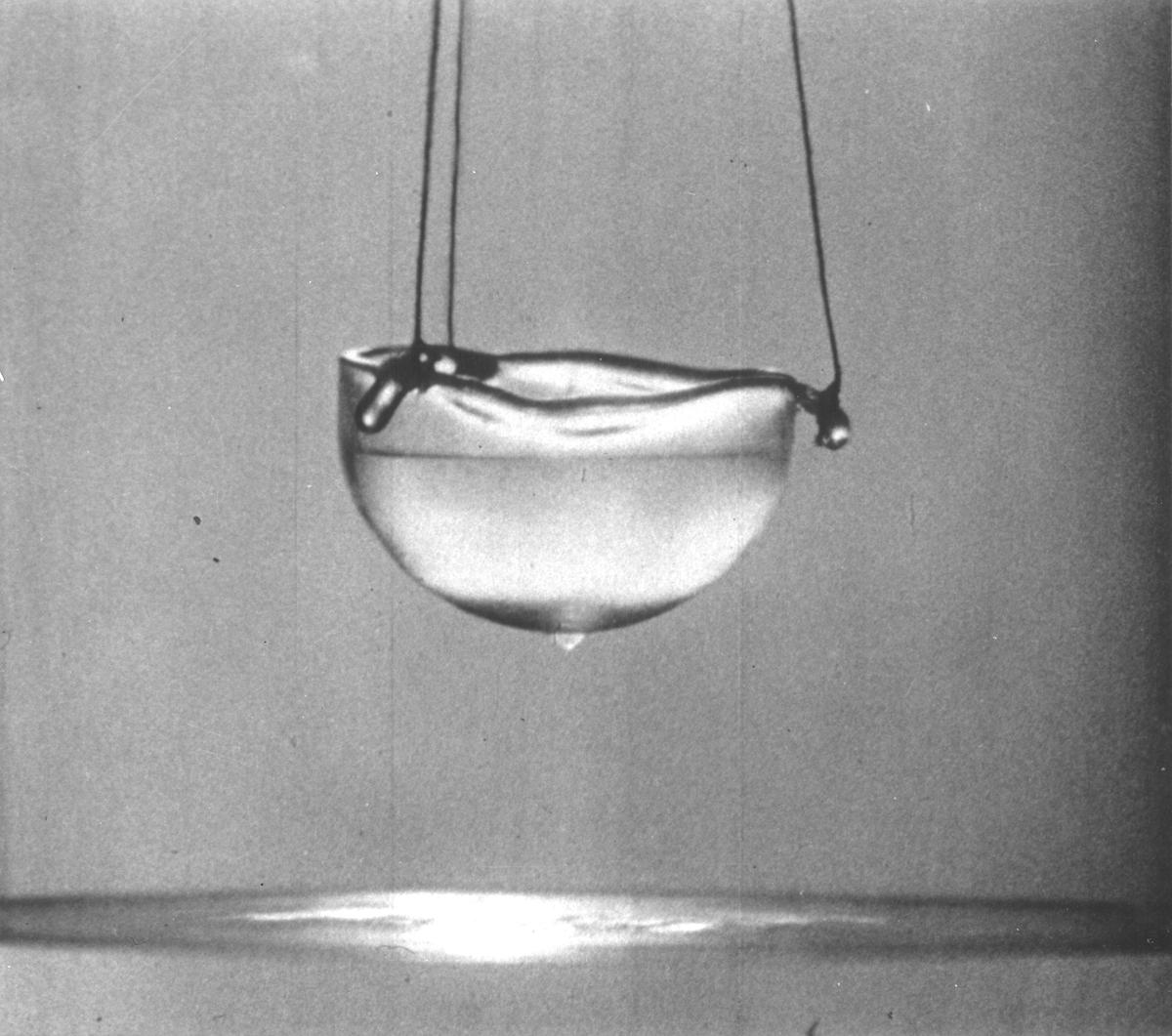
Superfluid helium can creep up the surface of the cup, climb out, and drip down from the bottom. Classical fluids can’t do this.
| Photo Credit:
Public domain
Second, at the microscale, the helium film is a quantum fluid, not a classical substance. Its viscosity vanishes, heat flow drives its motion (via the fountain effect), and strange phases of matter like quantised vortices become possible. None of these exist in classical macroscopic fluids. Similarly, the crystal cavities also modify how waves disperse, producing wave behaviour that’s impossible in natural flumes.
All this said, however, the researchers aren’t claiming that their experiment reproduces the exact same physical forces as in a macroscopic water flume but that their waves-on-a-chip setup obeys the same (KdV) hydrodynamic equation in form.
Specifically, what allows them to compare the superfluid flumes and a real oceanic flume isn’t identical forces—which don’t exist— but the mathematical equivalence of the governing equation.
In the study, the team worked in the limiting conditions where the fluid’s depth is low, a.k.a. the shallow-water limit. In this regime, the dynamics governing the waves depend on three dimensionless parameters: the Ursell number, the aspect ratio (ratio of depth to length), and the dispersion coefficients in the KdV equation. If two systems share the same three forms of these parameters, then, even if one involves gravity and the other involves van der Waals forces, their wave evolution should be dynamically similar.
Put another way, the chip experiment wasn’t meant to reproduce a tsunami in miniature but to reproduce the same mathematics of nonlinear wave evolution. And in the paper, the researchers described three things they did to prove they did so in a correct way.
First, they used a custom Euler solver, which is a full hydrodynamic model with nonlinear behaviour due to van der Waals forces, and the KdV equation to model the experiment and found that it could do so correctly.
Second, they plotted the Ursell number in their microscopic experiment and found that it curved up to cross a value of 100 million. Thus they could conclude that their experiment was hydrodynamically equivalent to, or exceeded, what they might have seen in a large flume.
Third, they observed wave steepening, shock-front formation, and soliton fission — which is the very sequence of formations that the theory predicts for waves of large amplitude in shallow water.
Finally, overall, the authors of the new study have been careful not to say “we’ve shrunk the ocean onto a chip”. Instead their paper repeatedly emphasises the differences between the two scales: that gravity is replaced by van der Waals acceleration, that dispersion is engineered using light (rather than naturally), and that the fluid is a superfluid with zero viscosity.
Toolkit to explore
The second advantage was that the system was very easy to control. The researchers could finely tune the waves’ properties by adjusting the laser power and the thickness of the superfluid film. They could also modify the chip’s design to create different channel shapes or place obstacles in the waves’ way, providing a toolkit to explore complex fluidic phenomena.
Finally, according to the study paper, the work also pushes the boundaries of optomechanics — the study of how light and mechanical motion interact. The extreme nonlinearities observed go beyond the gentle perturbations typically studied in this field, opening a new regime of nonlinear dynamics.