





In India as in many parts of the world, public money is the main funder of scientific research. Governments invest heavily in laboratories, equipment, and salaries for researchers. Yet the results of this publicly funded research are usually published in journals owned by just a handful of commercial publishers. These publishers don’t pay the authors or the peer reviewers who evaluate the work. Both contribute their time and expertise for free.
However, the publishers then charge high subscription fees for access to these journals, effectively making the public pay twice: once to fund the research and a second time to read it.
Against this backdrop, the Budapest Open Access Declaration in 2002 set out a set of bold principles. The declaration challenged the deeply entrenched practices of the scholarly publishing industry, which had long excluded vast sections of the global research community from accessing knowledge using expensive paywalls. The declaration came as the open access movement started questioning why, in a digital age in which printing and postage no longer dictated costs, access to knowledge remained had to be controlled behind expensive subscription paywalls. The declaration ignited a movement that promised to democratise access to scientific knowledge, ensuring research funded by the public would also be available to the public.
More than 20 years later, this vision of equity and inclusivity in knowledge sharing remains largely unfulfilled. Adapting to the winds of change, commercial publishers now promote open access, but again at a very high cost. Instead of subscription barriers, researchers now face towering article processing charges (APCs), often ranging from $2,000 to $10,000 per paper. Many institutions in the Global South, and even in wealthier nations, continue to be priced out of both publishing and accessing research.
In India, the government has attempted to address this inequity through the ‘One Nation, One Subscription’ (ONOS) initiative: starting from 2025, ONOS provided access to journals from 30 major international publishers to all researchers in publicly funded institutions. While the cost of this nationwide deal is substantial, especially given that over half of the global research literature is already available through open-access routes, as seen from the scholarly database Web of Science, the intent behind ONOS remains commendable. It represents a step toward broadening access beyond elite institutions.
Yet it also compels us to ask deeper questions. Should we continue paying these large sums to foreign publishers to access knowledge that our own researchers produce, again with public money? Shouldn’t that knowledge at the least be freely accessible to every citizen, empowering them with the scientific temper needed in an era rife with misinformation? Perhaps most importantly: where is the spirit of an Atmanirbhar Bharat in this enterprise?
Ultimately, while the ONOS initiative may carry significant promise, it still leaves many foundational questions unresolved. As we mark International Open Access Week, which is an annual global campaign to promote open access, the year’s theme, ‘Open Access Week 2025: Who Owns Our Knowledge?’, prompts deeper reflection.
In India, where publicly funded research drives much of science and social innovation, the assumption that the scholarly output belongs solely to commercial entities that host them merits scrutiny.
Knowledge and ownership
Copyright transfer in academic publishing is a practice where authors formally transfer the copyright ownership of a scholarly work to the publisher. This practice began to take shape after copyright laws such as the US Copyright Act 1976, which grants authors exclusive rights to their original works, thus motivating publishers to acquire and hold copyrights to control the distribution of work in journals and any subsequent commercial use.
Historically, this transfer was viewed as essential for publishers to manage permissions, reproduction, and dissemination. This was especially so in the subscription-based models, where publishers monetise articles by requiring readers to subscribe to the journals they publish.
Over time, such copyright transfer agreements became standard, necessitating authors to relinquish their exclusive rights on their work if they wanted to publish it in scholarly journals.
The landscape today is more varied. While with traditional subscription-based journals, publishers follow the requirement of complete copyright transfer, the rise of open-access publishing has changed the dynamics. Fully open-access journals generally allow authors to retain copyright but apply licenses, e.g. Creative Commons Attribution (CC-BY) permit free and broad reuse with attribution to the original creator.
But most authors sign copyright transfers due to the pressure to publish within the prevailing academic culture. This practice is evidently not conducive to serving the interests of research dissemination and reuse or the authors themselves. Recent initiatives like ‘Plan S’ advocate for authors retaining copyright to promote wider accessibility and scholarly communication without unnecessary restrictions. Authors are also encouraged to carefully review copyright transfer agreements to understand retained rights and publishing conditions.
Creative Commons licenses
Authors can publish their papers using various Creative Commons (CC) licenses to clearly define how others may reuse their work. Three licenses in particular are notable:
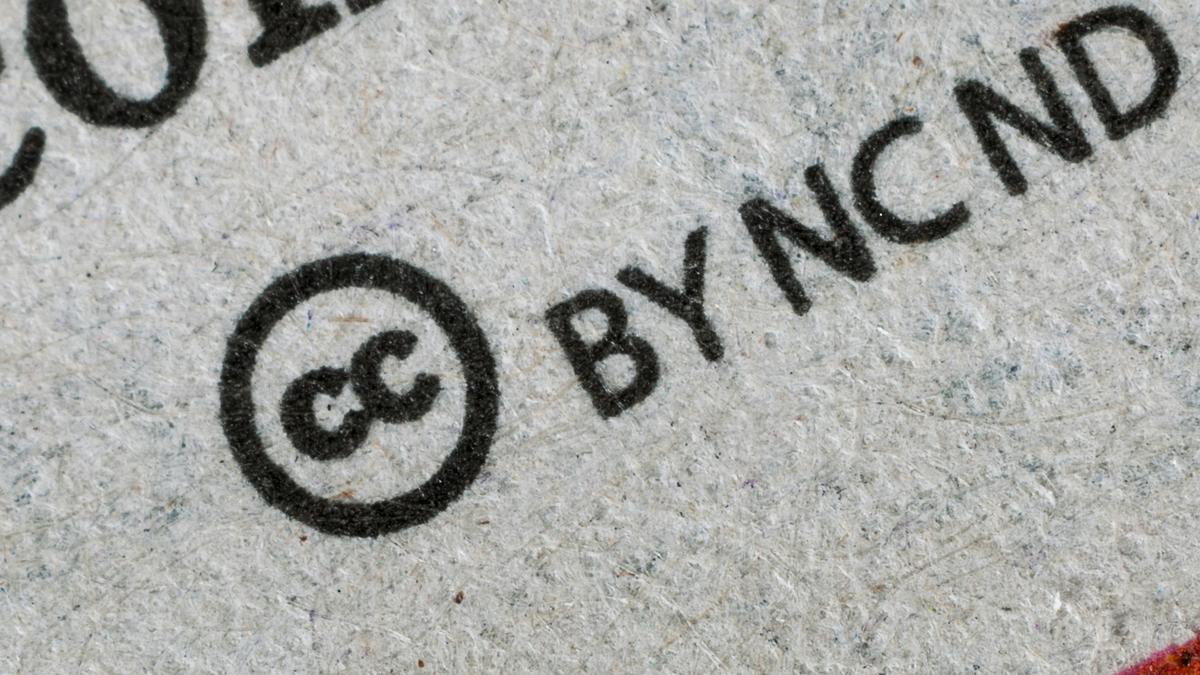
(i) CC-BY (Attribution) allows a person to share the work and reuse or even adapt it, even for commercial purposes, as long as the original author is credited; (ii) CC-BY-NC (‘Attribution-NonCommercial’) allows reuse but not for commercial purposes; and (iii) CC-BY-NC-ND (‘Attribution-NonCommercial-NoDerivatives’), the most restrictive, allows reuse but forbids both commercial use and adaptation.
Publishers often promote the use of the CC-BY-NC-ND license, but in practice, however, this license limits knowledge reuse by prohibiting translation, remixing or text mining — all actions vital for educational and technological innovation.

Retaining copyright
When authors transfer copyright to publishers as part of publication agreements, they often lose legal control over how their work is accessed, reused or shared. Large publishers like Elsevier, Wiley, and Springer typically require copyrights to be transferred for subscription-model journals, giving the publisher exclusive rights to distribute and profit from the content.
As a result, authors face legal dilemmas over archiving their own articles on institutional repositories or sharing them publicly, ultimately limiting their visibility. On the other hand, authors who retain copyright (or the ability to share their work under an open license) are empowered to share, adapt, and reuse their own scholarship without institutional or commercial restrictions.
Commercial publishers like Elsevier, Wiley, Springer, and Taylor & Francis and society publishers like the American Chemical Society use restrictive licenses in their subscription models, granting publishers legal exclusivity to monetise access. From 2024 or so, the major publishers have also been selling scholarly content to Big Tech companies to train their artificial intelligence (AI) models, often without authors’ explicit consent. Taylor & Francis’s deal with Microsoft is alone with $10 million. The global AI datasets licensing market has been valued at nearly $486 million in 2025.
Such commercial data sharing agreements mean researchers’ intellectual property is being monetised twice: first through subscriptions, then through AI partnerships — while they continue to not be compensated and being denied control over their own work.
What authors can do
Authors have three courses of action in front of them. First, they should self-archive preprint versions of their papers and accepted manuscripts in preprint and institutional repositories. Second, they should request additions to publishing contracts with journals before they submit their papers, in order to retain some rights (they can use the SPARC Author Addendum template, for instance). Third, they should advocate for institutions to develop rights-retention policies that allow them to automatically openly license the institutions’ scholarly output.
For future submissions, authors may also prefer using the CC-BY license or using institutional open access routes that ensure their papers are available for the public to access for free and to prevent unauthorised commercial exploitation.
In the spirit of Open Access Week, the question ‘who owns our knowledge?’ is not just a theme: it’s a call to reclaim intellectual sovereignty. The future of equitable scholarship depends on authors, not corporations, owning and sharing the knowledge that shapes society.
Moumita Koley is a senior research analyst at the Indian Institute of Science, Bengaluru.