




Nylon is everywhere… well, almost. You probably don’t realise it, but it surrounds us in our homes, schools, workplaces, transportation, and leisure activities. Well, we can go so far as to say that almost everyone of us begin our day — each and everyday — with nylon. This is because the bristles of the toothbrush that we use are most commonly made from nylon!
So what is nylon’s story? Where did it come from? If you were under the impression that it is a natural material, like say, cotton, wool or even wood, then nylon’s makers would be more than happy. They set out their marketing that way, right from the start.
But wait, where should this story start? Should it revolve around Wallace Carothers, the brilliant chemist and inventor, whose name is forever woven into nylon’s fabric? Or should we make it about Charles Stine and Elmer Bolton, both of whom served as directors at DuPont during that time, and made crucial contributions. Well, the story of nylon could well be the story of DuPont too, for that matter. It probably bodes well to bring in all these aspects into our story.
“Pure science work”
Over a 100 years ago, in the 1920s, the likes of General Electric and Bell Telephones had begun to have industrial research laboratories — research labs that were backed by industries. It was in such a climate that Stine, director of DuPont’s Chemical Department, asked his company in December 1926 to fund “pure science work.”
Stine’s demand for the research to be “pure” and “fundamental” went a step further from existing industrial research labs, and even seemed an idea alien to a company focussed on profits. He did, however, have his way as a slightly modified version of his proposal was approved in March 1927.
Academic scientists didn’t really flock to DuPont as a vast majority of them felt that their ability to do pure research would be crippled in an industrial setting. It was nearly a year later that Stine was able to convince Carothers, a brilliant, young chemist who was serving as organic chemistry lecturer at Harvard University.
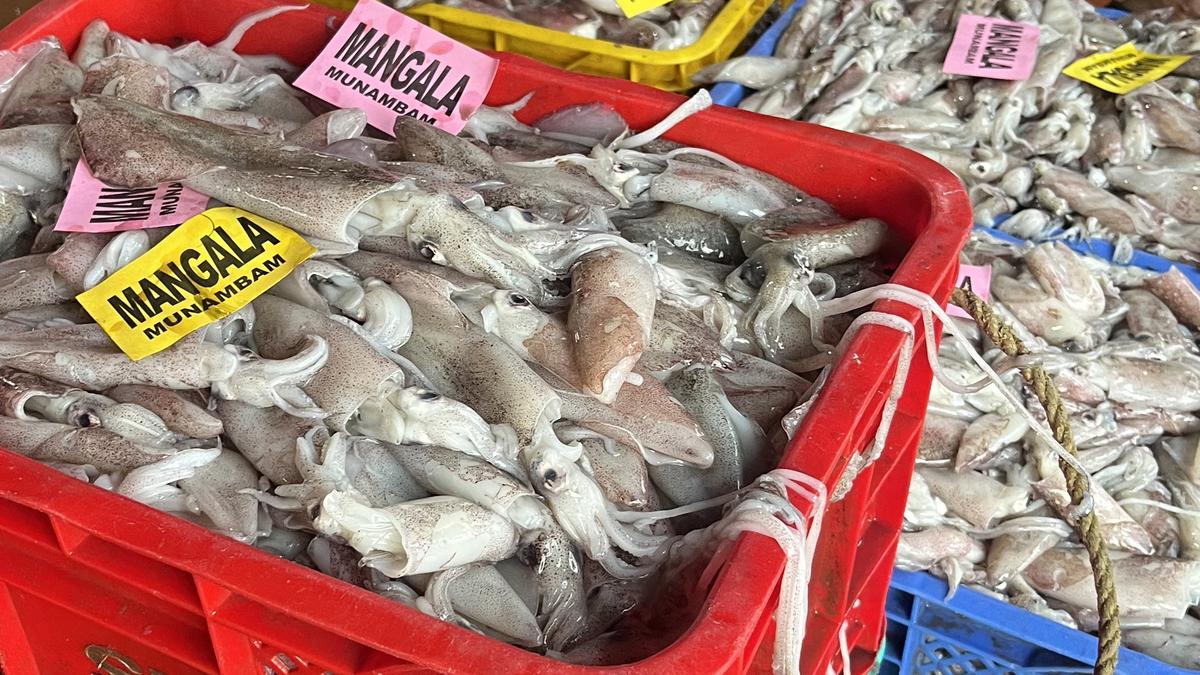
Be it toothbrush bristles or wire baskets, nylon has found its way everywhere.
| Photo Credit:
MOORTHY M
Focus on polymerisation
Carothers wished to focus on the process by which individual short molecules combine to form long-chain macromolecules and he instantly had success in his research on polymerisation. A research member of Carothers’ group produced what was the first polyester in April 1930. While fibres from this polyester could be pulled into an elastic thread four times the original length when cooled, its low melting point posed a problem.
In fact, for the next four years, low melting point and high solubility in water remained the biggest challenges confronting the creation of viable synthetic fibres. It fell upon Bolton, the new chemical director at DuPont, to cajole Carothers to focus on the problem. While Carothers agreed, he switched his attention from polyesters to polyamides.
A fibre of a polymer based on an aminoethyl ester was created by a member of Carothers’ research team on May 24, 1934. This first nylon had the elastic properties of the polyesters that they desired, without having their drawbacks. The intermediate used to produce this polymer, however, was difficult to produce, thereby creating a stumbling block.
Field down to two
In the year that followed, Carothers’ six researchers brought the field down to two options: polyamide 6,6, made from hexamethylenediamine and adipic acid, and polyamide 5,10, made from pentamethylene diamine and sebacic acid — with the number of carbon atoms in the starting materials giving the molecules their name.
While Carothers’ choice was 5,10, Bolton had his eyes on 6,6 as the intermediates for it could be more easily obtained from benzene, an easily available starting material. With Carothers’ declining mental health keeping him away from the laboratory, Bolton was able to pursue his way, with all resources turning to perfect fibre 6,6.
By 1938, DuPont started putting in place a facility that could produce nearly 12 million pounds of the synthetic fibre every year. All that was left for them to do was to give it a name and introduce it to the public.
Call it nylon
Internally, researchers had been referring to their synthetic fibre as Yarn 66, Rayon 66, or Fibre 66, during development. Some even called it Duparon, an acronym that stands for “DuPont pulls a rabbit out [of] nitrogen/nature/nozzle/naphtha.” How they finally settled on the name “nylon” hasn’t been well documented, though the reason for dropping other closely related words (nuron, nilon, etc.) was that it posed trademark conflicts and that there could be ambiguity in its pronunciation. Funnily enough, once they settled on nylon, DuPont decided against trademarking the name, hoping instead that end users would think of nylon as a generic preexisting material.
DuPont were aware that they had a miracle fibre at their disposal that practically suited a wide gamut of uses. The company, however, decided early on to focus on one specific market: ladies’ fashion.
Ever since news about Carothers’ first polyester fibre had been reported in 1931, rumours about the miracle fibre that DuPont were working on steadily made it to the newspapers. The untimely death of Carothers in 1937, coupled with another newspaper story that was based on their patent, however, turned the tide in the opposite direction.
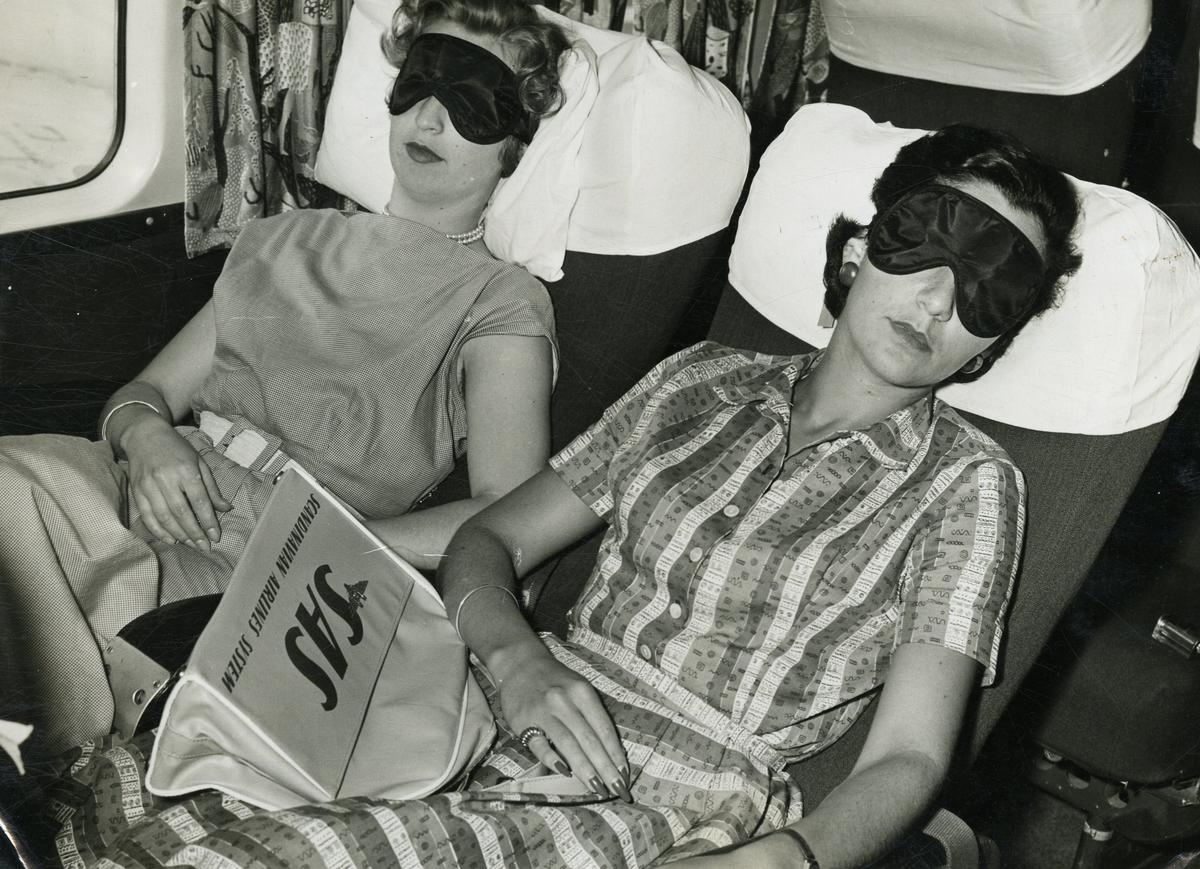
Airlines gave passengers sleeping “glasses” that were made of cool nylon over a thin steel frame.
| Photo Credit:
The Hindu Archives
DuPont decided to regain control of nylon’s publicity and it was with this in mind that the official announcement was made. On October 27, 1938, a crowd of 4,000 middle-class women specifically chosen for the announcement gathered at the site of what would go on to become the New York World’s Fair to hear about nylon.
Despite the excitement that followed the announcement, it was another 18 months before stockings made of nylon hit the U.S. market — until then its use was restricted to women who either worked or had partners working at DuPont. In 1940, DuPont’s total nylon sales figure stood at $9 million and in the year that followed they sold nylon yarn worth $25 million.
War effort
Even World War II couldn’t stymie the growth of nylon. Yes, DuPont had to shift its nylon production from catering to consumers to military production in November 1941. But as a replacement for Japanese silk, nylon went into the making of everything from parachutes and tyre chords, to fuel tanks, jackets, mosquito nettings, hammocks, and even shoe laces.
The moment the war ended, DuPont switched their efforts back to their consumers with nylon stockings returning to stores as early as September 1945. Newspapers even reported “nylon riots” as hundreds, or even thousands, of women gathered around stores, competing for limited supplies. By 1951, DuPont decided to license nylon to outside producers to keep up with the never-ending demand.
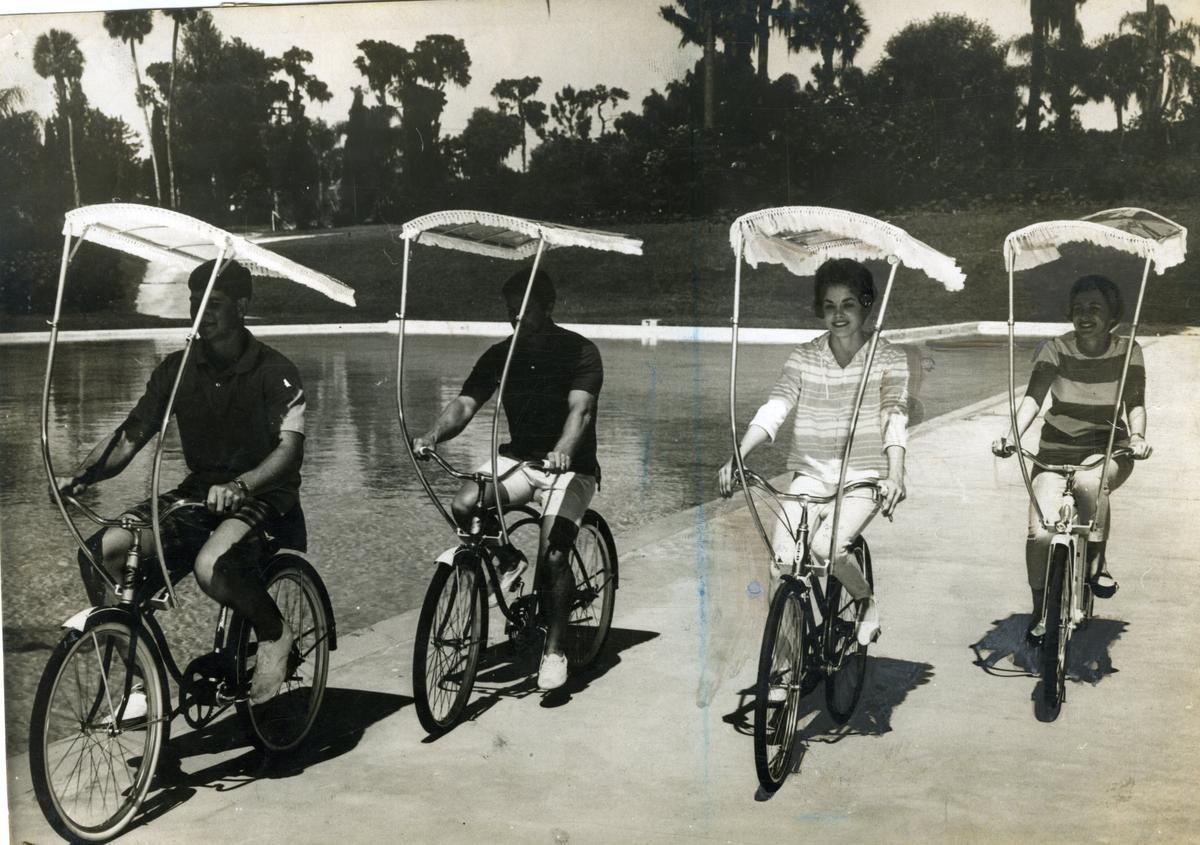
A cycle development of 1966 had frilly nylon sun shades!
| Photo Credit:
The Hindu Archives
In the 1950s, nylon and other synthetic fibres could be found in all kinds of garments, especially for women. Nylon was at the centre of a fashion revolution and synthetic fibres dominated the scene in the 1950s and 1960s. In 1965, nearly two-thirds of the world’s production of textiles came from synthetic fibres as they accounted for a whopping 63%!
Nylon might no longer enjoy that kind of popularity, but it is here to stay as it has pervaded into many walks of life. Nylon (polyamides) still accounts for about 5% of the global fibre market, and occupies a distant second place behind polyester, which accounts for nearly 60%.