


Skip to content
  • Facebook
  • X
  • Linkedin
  • WhatsApp
  • Associate Journalism
  • About Us
  • Privacy Policy
  • 033-46046046
  • editor@artifex.news
Artifex.News

Artifex.News

Stay Connected. Stay Informed.

  • Breaking News
  • World
  • Nation
  • Sports
  • Business
  • Science
  • Entertainment
  • Lifestyle
  • Toggle search form
  • Gay penguin Sphen dies in Sydney, leaving behind partner Magic
    Gay penguin Sphen dies in Sydney, leaving behind partner Magic Science
  • Fact Check: Did Veteran Bangladesh Cricketers Refuse To Play Under Female Umpire?
    Fact Check: Did Veteran Bangladesh Cricketers Refuse To Play Under Female Umpire? Sports
  • What We Know About Mohammad Shehzad, Man Who Stabbed Saif Ali Khan
    What We Know About Mohammad Shehzad, Man Who Stabbed Saif Ali Khan Nation
  • Watch: Assad regime falls in Syria after rebels enter Damascus
    Watch: Assad regime falls in Syria after rebels enter Damascus World
  • Eight Die In Bihar Amid Scorching Temperatures, Heatstroke Suspected
    Eight Die In Bihar Amid Scorching Temperatures, Heatstroke Suspected Nation
  • Markets tumble in early trade amid tensions in Middle East
    Markets tumble in early trade amid tensions in Middle East Business
  • “Main Catch Lunga”: Sanju Samson Trolled By RR Player On Catching ‘Disaster’ After Superb Effort
    “Main Catch Lunga”: Sanju Samson Trolled By RR Player On Catching ‘Disaster’ After Superb Effort Sports
  • Shreyas Iyer Breaks Silence On IPL 2025 Retention Snub, Blasts KKR For “Lack Of…”
    Shreyas Iyer Breaks Silence On IPL 2025 Retention Snub, Blasts KKR For “Lack Of…” Sports
Microbial link between arsenic in soil, lower rice yield uncovered

Microbial link between arsenic in soil, lower rice yield uncovered

Posted on October 18, 2025 By admin


Research published in Proceedings of the National Academy of Sciences recently has warned that the type of microbes in rice paddies can determine whether arsenic, a notorious carcinogen and plant toxin, builds up in rice grains and triggers drastic crop losses.

The study has identified an important balance between arsenic-methylating bacteria, which convert inorganic arsenic into the toxic organic forms, versus demethylating archaea, which can undo this process. Where the methylating bacteria dominate, rice plants absorb the compound dimethylarsinic acid (DMA) and its more toxic derivative, dimethylated monothioarsenate (DMMTA). These compounds pose health risks to humans as well as induce straighthead disease. 

“Straighthead needs to be considered as a physiological disorder rather than a disease in the absence of any infectious agent,” rice pathologist Sridhar Ranganathan, who wasn’t involved in the study, said.

“The symptoms are erect panicles with unfilled grains, often remaining green. Due to empty grains affecting the weight of the panicles, the-ear bearing tillers don’t droop down and remain green and upright, as can be seen with unaffected healthy plants bearing normally filled matured grains in which the plants droop down showing symptoms of initiation of senescence of the leaves and the grains.”

While long dismissed as a local agronomic issue, straighthead disease is now recognised as a global threat. In parts of the US and China, farmers have reported significant outbreaks, often in newly established or rotated paddies. West Bengal in India and Bangladesh have also previously reported straighthead disease.

The condition can result in up to 70% yield losses in severely affected areas. It occurs even when the total arsenic level in the soil is relatively low because the real problem is arsenic speciation, i.e. the chemical form arsenic takes in the soil and plant. The new study has found that the microbial communities that dominate in the paddies determine this speciation.

The research team, led by Peng Wang at Nanjing Agricultural University in China, analysed rice paddies of different ages in China, unearthing a surprising pattern. Soils younger than 700 years were dominated by arsenic-methylating bacteria, so the rice grown there accumulated more DMA and DMMTA and the fields were more prone to straighthead disease outbreaks. Soils older than 700 years had more demethylating archaea, which broke down DMA and reduced the compounds’ buildup.

The researchers combined these field data with controlled soil incubation tests, genetic analyses, and a global survey of 801 paddy soil microbiomes. Eventually, they identified 11 methylating microbes and six demethylating archaea whose abundance could accurately predict arsenic risk.

In the paper, the team also reported that newly cultivated paddy regions like the US, southern Europe, and northeast China showed high ratios of methylating to demethylating microbes, rendering them particularly vulnerable to straighthead outbreaks. Ancient rice-growing regions in South and Southeast Asia had stronger demethylating communities instead. When the ratio of methylating to demethylating microbes exceeded 1.5, the risk of straighthead disease was found to rise sharply.

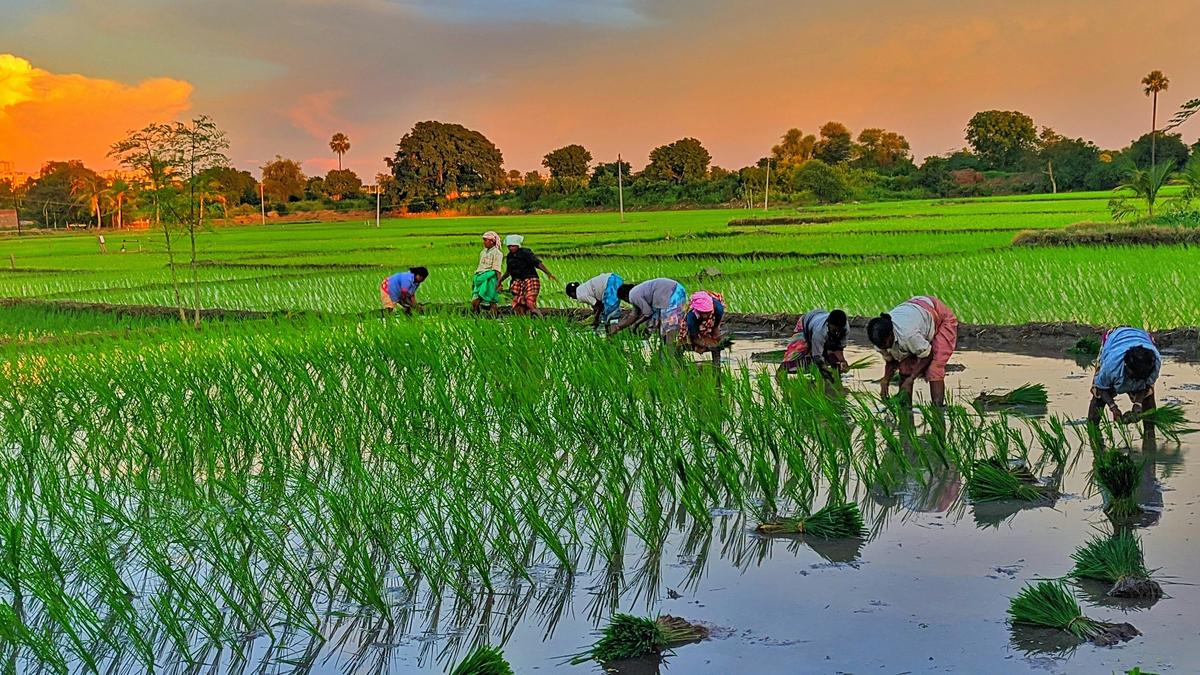
India is the world’s second-largest producer and consumer of rice. While much of the country’s rice farming occurs in old, legacy paddies with relatively balanced microbial communities, several States — particularly in East and South India — have had new or reclaimed paddy fields established in the last few decades. These fields may be at greater risk, per the new study.

Arsenic contamination in groundwater already poses a severe challenge in West Bengal, Bihar, and Assam, compounding the potential hazard.

Experts said the research also intersects with climate change. Higher temperatures and altered flooding regimes are expected to increase the soils’ arsenic content (whether from natural sources or anthropogenic), and could tip the microbial balance towards the more harmful varieties. For a country where rice contributes nearly 40% of the population’s caloric intake, the crop’s safety and productivity are crucial.

Dr. Ranganathan said that even if the crop can’t be saved in a single cropping season, agronomic interventions can mitigate risks. According to the research paper, draining the rice fields midseason can ‘suppress’ the methylating microbes by reintroducing oxygen into the soils. Silicon fertilisation has also been known to reduce rice plants’ arsenic uptake. He also said crop rotation strategies can be adjusted to avoid destabilising microbial communities.

At the policy level, the findings highlight the need to monitor arsenic speciation, and not just total arsenic levels, as part of food safety regulations. Current standards, including those of the UN Food and Agriculture Organisation’s ‘Codex Alimentarius’, focus on inorganic arsenic, leaving gaps around methylated species like DMMTA.

Ashmita Gupta is a science writer.

Published – October 18, 2025 09:06 pm IST



Source link

Science

Post navigation

Previous Post: Access Denied
Next Post: Access Denied

Related Posts

  • What is the ‘responsible quantum technologies’ movement? | Explained
    What is the ‘responsible quantum technologies’ movement? | Explained Science
  • Android phones have brought early quake warnings to 98 countries
    Android phones have brought early quake warnings to 98 countries Science
  • Russia reports coolant leak in backup line at space station and says crew not in danger
    Russia reports coolant leak in backup line at space station and says crew not in danger Science
  • Horseshoe crabs, living fossils of the sea, draw endangered species petition
    Horseshoe crabs, living fossils of the sea, draw endangered species petition Science
  • NCBS to collaborate with various organisations on forest research and conservation
    NCBS to collaborate with various organisations on forest research and conservation Science
  • NIMHANS to arrange first-in-the-world mind and thoughts museum
    NIMHANS to arrange first-in-the-world mind and thoughts museum Science

More Related Articles

New mRNA vaccine fights brain cancer in children by triggering attack from within New mRNA vaccine fights brain cancer in children by triggering attack from within Science
What is the legal framework for space missions like the Chandrayaan 3 and Aditya L-1? | Explained What is the legal framework for space missions like the Chandrayaan 3 and Aditya L-1? | Explained Science
SpaDeX Mission | Two satellites just 50 feet away for an exciting handshake says ISRO SpaDeX Mission | Two satellites just 50 feet away for an exciting handshake says ISRO Science
JNCASR researchers develop photocatalyst to convert carbon dioxide to ethylene JNCASR researchers develop photocatalyst to convert carbon dioxide to ethylene Science
Kashmir’s saffron growers experiment with indoor farming as climate pressures mount Kashmir’s saffron growers experiment with indoor farming as climate pressures mount Science
The Science Quiz | The great women of mathematics The Science Quiz | The great women of mathematics Science
SiteLock

Archives

  • October 2025
  • September 2025
  • August 2025
  • July 2025
  • June 2025
  • May 2025
  • April 2025
  • March 2025
  • February 2025
  • January 2025
  • December 2024
  • November 2024
  • October 2024
  • September 2024
  • August 2024
  • July 2024
  • June 2024
  • May 2024
  • April 2024
  • March 2024
  • February 2024
  • January 2024
  • December 2023
  • November 2023
  • October 2023
  • September 2023
  • August 2023
  • July 2023
  • June 2023
  • May 2023
  • April 2023
  • March 2023
  • February 2023
  • January 2023
  • December 2022
  • November 2022
  • October 2022
  • September 2022
  • August 2022
  • July 2022
  • June 2022
  • May 2022

Categories

  • Business
  • Nation
  • Science
  • Sports
  • World

Recent Posts

  • Pakistan and Afghanistan agree to immediate ceasefire during talks, mediator Qatar says
  • Passenger bus crash in northeastern Brazil leaves 17 dead
  • What are the new PF withdrawal guidelines? | Explained
  • Employees’ Union protests Emirates NBD’s takeover of RBL Bank for ₹26,850 crore, says it’s an onslaught of foreign capital on Indian banking
  • Amir Khan Muttaqi: Taliban’s diplomatic front

Recent Comments

  1. dfb{{98991*97996}}xca on UP Teacher Who Asked Students To Slap Muslim Classmate
  2. "dfbzzzzzzzzbbbccccdddeeexca".replace("z","o") on UP Teacher Who Asked Students To Slap Muslim Classmate
  3. 1}}"}}'}}1%>"%>'%> on UP Teacher Who Asked Students To Slap Muslim Classmate
  4. bfg6520<s1﹥s2ʺs3ʹhjl6520 on UP Teacher Who Asked Students To Slap Muslim Classmate
  5. pHqghUme9356321 on UP Teacher Who Asked Students To Slap Muslim Classmate
  • Access Denied Sports
  • “Least I Can Do For You”: Ravichandran Ashwin’s Interaction With Janhvi Kapoor’s Parody Account Goes Viral
    “Least I Can Do For You”: Ravichandran Ashwin’s Interaction With Janhvi Kapoor’s Parody Account Goes Viral Sports
  • RuPay Launch In Maldives, New Airport At Runway To Boost Ties With India
    RuPay Launch In Maldives, New Airport At Runway To Boost Ties With India World
  • Bharat Biotech Co-Founder Dr Krishna Ella Honoured By Johns Hopkins Bloomberg School of Public Health
    Bharat Biotech Co-Founder Dr Krishna Ella Honoured By Johns Hopkins Bloomberg School of Public Health Nation
  • Indian Envoy To Canada Says Khalistan Issue A Big Red Line
    Indian Envoy To Canada Says Khalistan Issue A Big Red Line Nation
  • Tinkesh Kaushik Becomes World’s 1st Triple Amputee To Reach Everest Base Camp
    Tinkesh Kaushik Becomes World’s 1st Triple Amputee To Reach Everest Base Camp Nation
  • England vs South Africa, Cricket World Cup 2023 Fantasy Cricket Tips And Fantasy XI
    England vs South Africa, Cricket World Cup 2023 Fantasy Cricket Tips And Fantasy XI Sports
  • Kolkata Rape-Murder Case Accused Sanjay Roy Mother-In-Law Says Hang Him
    Kolkata Rape-Murder Case Accused Sanjay Roy Mother-In-Law Says Hang Him Nation

Editor-in-Chief:
Mohammad Ariff,
MSW, MAJMC, BSW, DTL, CTS, CNM, CCR, CAL, RSL, ASOC.
editor@artifex.news

Associate Editors:
1. Zenellis R. Tuba,
zenelis@artifex.news
2. Haris Daniyel
daniyel@artifex.news

Photograher:
Rohan Das
rohan@artifex.news

Artifex.News offers Online Paid Internships to college students from India and Abroad. Interns will get a PRESS CARD and other online offers.
Send your CV (Subjectline: Paid Internship) to internship@artifex.news

Links:
Associate Journalism
About Us
Privacy Policy

News Links:
Breaking News
World
Nation
Sports
Business
Entertainment
Lifestyle

Registered Office:
72/A, Elliot Road, Kolkata - 700016
Tel: 033-22277777, 033-22172217
Email: office@artifex.news

Editorial Office / News Desk:
No. 13, Mezzanine Floor, Esplanade Metro Rail Station,
12 J. L. Nehru Road, Kolkata - 700069.
(Entry from Gate No. 5)
Tel: 033-46011099, 033-46046046
Email: editor@artifex.news

Copyright © 2023 Artifex.News Newsportal designed by Artifex Infotech.