
Skip to content
  • Facebook
  • X
  • Linkedin
  • WhatsApp
  • Associate Journalism
  • About Us
  • Privacy Policy
  • 033-46046046
  • editor@artifex.news
Artifex.News

Artifex.News

Stay Connected. Stay Informed.

  • Breaking News
  • World
  • Nation
  • Sports
  • Business
  • Science
  • Entertainment
  • Lifestyle
  • Toggle search form
  • “I Cheat A Little…”: Anushka Sharma Shares ‘Cooking’ Story Featuring Virat Kohli
    “I Cheat A Little…”: Anushka Sharma Shares ‘Cooking’ Story Featuring Virat Kohli Sports
  • 40 Killed, Homes Torched As Gunmen Raid Mining Community In Northcentral Nigeria
    40 Killed, Homes Torched As Gunmen Raid Mining Community In Northcentral Nigeria World
  • “Willing To Get All Out For…”: Rohit Sharma Reveals Audacious Move That Earned India Win vs Bangladesh
    “Willing To Get All Out For…”: Rohit Sharma Reveals Audacious Move That Earned India Win vs Bangladesh Sports
  • Soaps, powder, coffee, diapers, biscuits, ghee, oil to be cheaper as cos extend GST 2.0 benefits
    Soaps, powder, coffee, diapers, biscuits, ghee, oil to be cheaper as cos extend GST 2.0 benefits Business
  • Access Denied Sports
  • Netanyahu’s Approach To Gaza War “Hurting Israel More Than Helping”: Biden
    Netanyahu’s Approach To Gaza War “Hurting Israel More Than Helping”: Biden World
  • Access Denied Sports
  • Ashok Gehlot On Probe Agency Raids In Rajasthan
    Ashok Gehlot On Probe Agency Raids In Rajasthan Nation
How linguists figured Hindi, Greek, English all come from a single ancient language

How linguists figured Hindi, Greek, English all come from a single ancient language

Posted on October 8, 2025 By admin


If you have studied almost any European language, you will have noticed words that felt oddly familiar. French mort (dead) recalls English murder. German Hund (dog) is a dead ringer for hound. Czech sestra resembles English sister. No prizes for guessing the meaning of Albanian kau (it’s actually ox).

You might have wondered: could these words be in some way related?

Of course, words can look similar for various reasons. Unrelated languages borrow from one another: consider English igloo, from Inuktikut iglu (house), or wok from Cantonese 鑊 wòk (frying pan). And there are plenty of sheer coincidences: Thai ไฟ fai resembles its English translation fire for no particular reason at all.

But the preceding sets of words actually are related to one another. They are cognate, which means they share a common origin in descent from a single ancestral language.

This now-extinct tongue was probably spoken somewhere in Eurasia as many as 8,000 years ago. Long predating the advent of writing systems, its words – and its name, if it had one – were never written down. Lacking such direct knowledge, linguists have therefore developed methods for reconstructing aspects of its structure, and refer to it using the label Proto-Indo-European – or PIE.

But how do we know Proto-Indo-European must have existed?

Shared ancestry of language

Our modern-day awareness of the shared ancestry of Indo-European languages first took shape in the Renaissance and early colonial periods.

India-based European scholars such as Gaston Coeurdoux and William Jones were already familiar with the ties among European languages.

But they were astonished to find echoes of Latin, Greek and German in Sanskrit words such as mā́tṛ (mother), bhrā́tṛ (brother) and dúhitṛ (daughter).

Such words could not plausibly be borrowings, given these languages’ lack of historical contact. Sheer coincidence was obviously out of the question.

Even more striking was the systematic nature of the correspondences. Sanskrit bh- matched Germanic b- not only in bhrā́tṛ (brother) but also in bhar (bear). Meanwhile, Sanskrit p- aligned with Latin and Greek p-, but with Germanic f-.

There could be only one explanation for such regular correspondences. The languages must have descended from a single common ancestor, whose ancient breakup led to their distinct evolutionary pathways.

Philologists from the 19th century, such as Rasmus Rask, Franz Bopp and August Schleicher, later systematised these observations. They showed that, by comparing and reverse-engineering the changes each descendant language’s words had undergone, the words of the lost ancestral language could be reconstructed.

These insights not only laid the foundations of modern-day historical linguistics, but also went on to influence Darwin’s conception of biological evolution.

Forming a family

Like a biological genus, the Indo-European languages became understood as forming a family. At their root was the PIE ancestor, while the descendant languages branched out (like species) to form a tree.

The Indo-European family includes Indo-Aryan languages such as Sanskrit and Hindi; Iranian languages (including Persian and Kurdish); Hellenic (including Greek and Ancient Macedonian); Italic (including Latin, Spanish and Italian); Germanic (including English, Dutch and German); Balto-Slavic (including Russian and Lithuanian) and Celtic languages (including Welsh and Breton), as well as Armenian and Albanian.

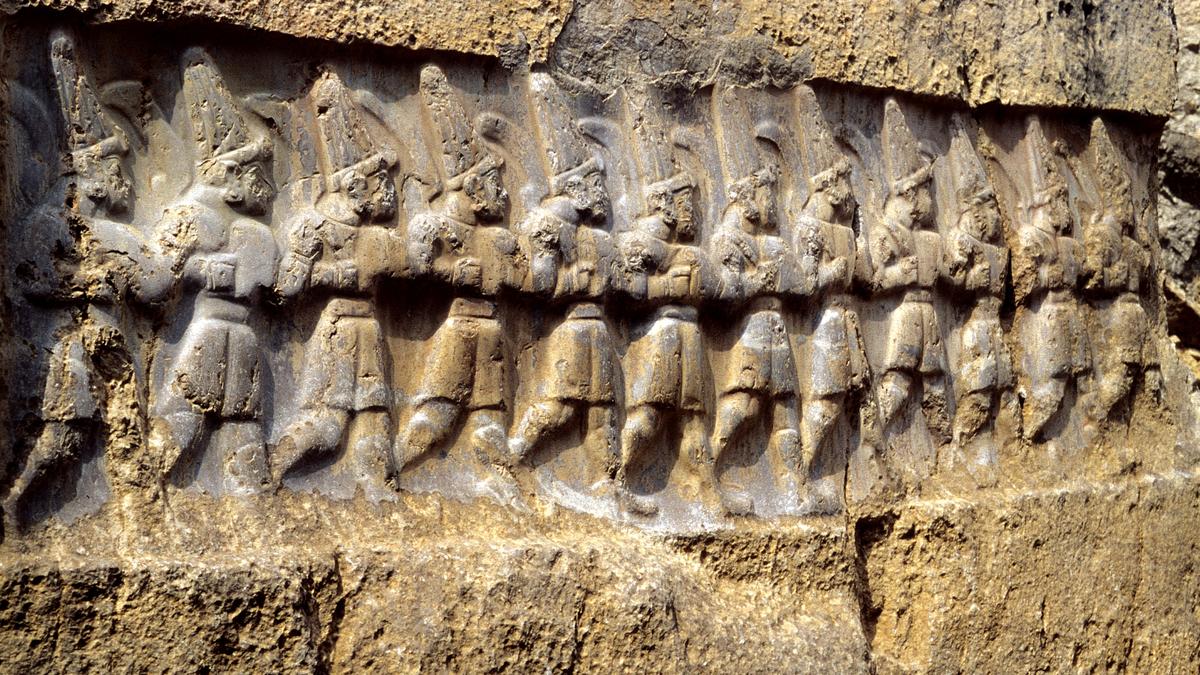
Extinct branches – attested only through written records – include Anatolian (Hittite) and Tocharian. Languages like Phrygian, Dardanian and Thracian seem likely to have been Indo-European, but are not as well attested in historical records.

But not all Indian or European languages are Indo-European!

Non-Indo-European languages of India include Dravidian languages such as Tamil and Telugu, while European languages outside the family include Basque, Georgian, Maltese and Finnish. Compare with the above table the quite different Finnish words jalka (foot), isä (father) and viisi (five).

Learning about those who spoke PIE

Reconstructed PIE vocabulary has also yielded insights into the lives of its speakers: what their culture may have been like, where they might have lived, and what may have fuelled their language’s diversification and expansion.

Roots such as *rēg-, (tribal) king, and *pelə-, fortified high place, suggest a martial, hierarchical society.

Speakers knew grain agriculture (*agro, field; *grə-no, grain), animal domestication (*ghaido, goat; *gwou, cattle), vehicular transport (*wogh-no, wagon; *aks-lo, axle), metalworking (*arg-, shine or silver; *ajes, copper or bronze), trade (*wes-no buy; *k(a)mb-yo, exchange) and religion (*deiw-os, god; *meldh, pray).

From such evidence, scholars such as V. Gordon Childe linked Proto-Indo-European to the Late Neolithic/Early Bronze Age Kurgan culture of the Pontic-Caspian steppe (today’s Ukraine and southern Russia).

More recent studies have (somewhat controversially) employed phylogenetic methods derived from evolutionary biology to argue for a PIE origin in Anatolia (modern-day Turkey), suggesting that agriculture was most probably the engine of Indo-European expansion.

Alas, spoken languages do not fossilise well. The actual words, ideas and identities of Proto-Indo-European speakers vanished into the air many millennia ago.

Yet patterns in their descendant languages preserve enough structure to enable us to manage at least a shadowy glimpse of them. The theories and methods pioneered through this work will continue to fuel research into the reconstruction of human ethnolinguistic prehistories worldwide for many years to come.

Mark W. Post is senior lecturer in linguistics, University of Sydney. This article is republished from The Conversation.

Published – October 08, 2025 10:17 am IST


Source link

Science

Post navigation

Previous Post: Access Denied
Next Post: Access Denied

Related Posts

  • A computer science conundrum that could transform healthcare
    A computer science conundrum that could transform healthcare Science
  • Two biogeographic hotspots in India yield two new plant discoveries
    Two biogeographic hotspots in India yield two new plant discoveries Science
  • AlphaGeometry and the threat of AI’s takeover of mathematics | Explained
    AlphaGeometry and the threat of AI’s takeover of mathematics | Explained Science
  • Landmark study offers new insights into what protects against dengue
    Landmark study offers new insights into what protects against dengue Science
  • Italy to host main control centre for EU satellite constellation
    Italy to host main control centre for EU satellite constellation Science
  • Science for all newsletter Scientists cause one beam of light to cast a shadow against another
    Science for all newsletter Scientists cause one beam of light to cast a shadow against another Science

More Related Articles

NASA announces further delays in Artemis moon missions NASA announces further delays in Artemis moon missions Science
Eye care diagnosis from a distance Eye care diagnosis from a distance Science
CSIR-IICT scientists identify microalgae as a potential protein supplement CSIR-IICT scientists identify microalgae as a potential protein supplement Science
Richness of human milk  – The Hindu Richness of human milk  – The Hindu Science
Germany moves to fast-track geothermal energy projects Germany moves to fast-track geothermal energy projects Science
Superfast lasers open a shortcut to hard drives of the future Superfast lasers open a shortcut to hard drives of the future Science
SiteLock

Archives

  • October 2025
  • September 2025
  • August 2025
  • July 2025
  • June 2025
  • May 2025
  • April 2025
  • March 2025
  • February 2025
  • January 2025
  • December 2024
  • November 2024
  • October 2024
  • September 2024
  • August 2024
  • July 2024
  • June 2024
  • May 2024
  • April 2024
  • March 2024
  • February 2024
  • January 2024
  • December 2023
  • November 2023
  • October 2023
  • September 2023
  • August 2023
  • July 2023
  • June 2023
  • May 2023
  • April 2023
  • March 2023
  • February 2023
  • January 2023
  • December 2022
  • November 2022
  • October 2022
  • September 2022
  • August 2022
  • July 2022
  • June 2022
  • May 2022

Categories

  • Business
  • Nation
  • Science
  • Sports
  • World

Recent Posts

  • Rupee falls 3 paise to 88.78 against U.S. dollar in early trade
  • Access Denied
  • Access Denied
  • EU wants key sectors to use made-in-Europe AI
  • Access Denied

Recent Comments

  1. dfb{{98991*97996}}xca on UP Teacher Who Asked Students To Slap Muslim Classmate
  2. "dfbzzzzzzzzbbbccccdddeeexca".replace("z","o") on UP Teacher Who Asked Students To Slap Muslim Classmate
  3. 1}}"}}'}}1%>"%>'%> on UP Teacher Who Asked Students To Slap Muslim Classmate
  4. bfg6520<s1﹥s2ʺs3ʹhjl6520 on UP Teacher Who Asked Students To Slap Muslim Classmate
  5. pHqghUme9356321 on UP Teacher Who Asked Students To Slap Muslim Classmate
  • Satellite photos show Israel hit Iran former nuclear weapons test building, missile facilities, researchers say
    Satellite photos show Israel hit Iran former nuclear weapons test building, missile facilities, researchers say World
  • Nathan Lyon Reveals Hilarious ‘Roger Federer’ Motivation For Virat Kohli During 2014 Test Series
    Nathan Lyon Reveals Hilarious ‘Roger Federer’ Motivation For Virat Kohli During 2014 Test Series Sports
  • Access Denied
    Access Denied Nation
  • Delhi Maximum Temperature At 31.6 Degree Celsius
    Delhi Maximum Temperature At 31.6 Degree Celsius Nation
  • Trinamool On Amit Shah’s Ambedkar Remark
    Trinamool On Amit Shah’s Ambedkar Remark Nation
  • ICC Punish Rashid Khan For ‘Dangerous’ Behaviour Towards Afghanistan Teammate In T20 World Cup
    ICC Punish Rashid Khan For ‘Dangerous’ Behaviour Towards Afghanistan Teammate In T20 World Cup Sports
  • Teacher Slaps 9-Year-Old Girl, She Suffers Brain Injury, Ends Up On Ventilator
    Teacher Slaps 9-Year-Old Girl, She Suffers Brain Injury, Ends Up On Ventilator Nation
  • India versus Pakistan – ‘Play Like Virat Kohli, Can’t Become Chanderpaul’: Pakistan Great’s Advice To India For Tackling Shaheen Afridi
    India versus Pakistan – ‘Play Like Virat Kohli, Can’t Become Chanderpaul’: Pakistan Great’s Advice To India For Tackling Shaheen Afridi Sports

Editor-in-Chief:
Mohammad Ariff,
MSW, MAJMC, BSW, DTL, CTS, CNM, CCR, CAL, RSL, ASOC.
editor@artifex.news

Associate Editors:
1. Zenellis R. Tuba,
zenelis@artifex.news
2. Haris Daniyel
daniyel@artifex.news

Photograher:
Rohan Das
rohan@artifex.news

Artifex.News offers Online Paid Internships to college students from India and Abroad. Interns will get a PRESS CARD and other online offers.
Send your CV (Subjectline: Paid Internship) to internship@artifex.news

Links:
Associate Journalism
About Us
Privacy Policy

News Links:
Breaking News
World
Nation
Sports
Business
Entertainment
Lifestyle

Registered Office:
72/A, Elliot Road, Kolkata - 700016
Tel: 033-22277777, 033-22172217
Email: office@artifex.news

Editorial Office / News Desk:
No. 13, Mezzanine Floor, Esplanade Metro Rail Station,
12 J. L. Nehru Road, Kolkata - 700069.
(Entry from Gate No. 5)
Tel: 033-46011099, 033-46046046
Email: editor@artifex.news

Copyright © 2023 Artifex.News Newsportal designed by Artifex Infotech.