




Skip to content
  • Facebook
  • X
  • Linkedin
  • WhatsApp
  • Associate Journalism
  • About Us
  • Privacy Policy
  • 033-46046046
  • editor@artifex.news
Artifex.News

Artifex.News

Stay Connected. Stay Informed.

  • Breaking News
  • World
  • Nation
  • Sports
  • Business
  • Science
  • Entertainment
  • Lifestyle
  • Toggle search form
  • Biden levies new sanctions against Russian energy sector; up to Trump to keep them
    Biden levies new sanctions against Russian energy sector; up to Trump to keep them World
  • PM Modi On What India Aims To Achieve With Grand Show At G20 Summit
    PM Modi On What India Aims To Achieve With Grand Show At G20 Summit Nation
  • Why This New Arunachal Tunnel Is Strategically Crucial For Indian Forces
    Why This New Arunachal Tunnel Is Strategically Crucial For Indian Forces Nation
  • Israel’s Netanyahu Meets Elon Musk In US, Urges To Fight Anti-Semitism
    Israel’s Netanyahu Meets Elon Musk In US, Urges To Fight Anti-Semitism World
  • Will Quad Survive Beyond November? Biden’s Gesture. PM Modi By His Side
    Will Quad Survive Beyond November? Biden’s Gesture. PM Modi By His Side World
  • Ruthless Men in Blue demolish listless Islanders
    Ruthless Men in Blue demolish listless Islanders Sports
  • U-19 Asia Cup: Suryavanshi disappoints as India lose to Pakistan by 43 runs
    U-19 Asia Cup: Suryavanshi disappoints as India lose to Pakistan by 43 runs Sports
  • Real Madrid vs Stuttgart Live Streaming UEFA Champions League Live Telecast: When And Where To Watch
    Real Madrid vs Stuttgart Live Streaming UEFA Champions League Live Telecast: When And Where To Watch Sports
Entanglement breakthrough brings quantum computers closer

Entanglement breakthrough brings quantum computers closer

Posted on September 24, 2025 By admin


Quantum entanglement — once dismissed by Albert Einstein as “spooky action at a distance” — has long captured the public imagination and puzzled even seasoned scientists.

But for today’s quantum practitioners, the reality is rather more mundane: entanglement is a kind of connection between particles that is the quintessential feature of quantum computers.

Though these devices are still in their infancy, entanglement is what will allow them to do things classical computers cannot, such as better simulating natural quantum systems like molecules, pharmaceuticals or catalysts.

In new research published today in Science, my colleagues and I have demonstrated quantum entanglement between two atomic nuclei separated by about 20 nanometres.

This may not seem like much. But the method we used is a practical and conceptual breakthrough that may help to build quantum computers using one of the most precise and reliable systems for storing quantum information.

Balancing control with noise

The challenge facing quantum computer engineers is to balance two opposing needs.

The fragile computing elements must be shielded from external interference and noise. But at the same time, there must be a way to interact with them to carry out meaningful computations.

This is why there are so many different types of hardware still in the race to be the first operating quantum computer.

Some types are very good for performing fast operations, but suffer from noise. Others are well shielded from noise, but difficult to operate and scale up.

Getting nuclei to talk to each other

My team has been working on a platform that – until today – could be placed in the second camp. We have implanted phosphorus atoms in silicon chips, and used the spin of the atoms’ cores to encode quantum information.

To build a useful quantum computer, we will need to work with lots of atomic nuclei at the same time. But until now, the only way to work with multiple atomic nuclei was to place them very close together inside a solid, where they could be surrounded by a single electron.

We usually think of an electron being far smaller than the nucleus of an atom. However, quantum physics tells us it can “spread out” in space, so it can interact with multiple atomic nuclei at the same time.

Even so, the range over which a single electron can spread is quite limited. Moreover, adding more nuclei to the same electron makes it very challenging to control each nucleus individually.

Electronic ‘telephones’

We could say that, until now, nuclei were like people placed in soundproof rooms. They can talk to each other as long as they are all in the same room, and the conversations are really clear.

But they can’t hear anything from the outside, and there’s only so many people who can fit inside the room. Therefore, this mode of conversation can’t be scaled up.

In our new work, it’s as if we gave people telephones to communicate to other rooms. Each room is still nice and quiet on the inside, but now we can have conversations between many more people, even if they are far away.

The “telephones” are electrons. By their ability to spread out in space, two electrons can “touch” each other at quite some distance.

And if each electron is directly coupled to an atomic nucleus, the nuclei can communicate via the interaction between the electrons.

We used the electron channel to create quantum entanglement between the nuclei by means of a method called the “geometric gate”, which we used a few years ago to carry out high-precision quantum operations with atoms in silicon.

Now – for the first time in silicon – we showed this method can scale up beyond pairs of nuclei that are attached to the same electron.

Fitting in with integrated circuits

In our experiment, the phosphorus nuclei were separated by 20 nanometres. If this seems like still a small distance, it is: there are fewer than 40 silicon atoms between the two phosphorus ones.

But this is also the scale at which everyday silicon transistors are fabricated. Creating quantum entanglement on the 20-nanometre scale means we can integrate our long-lived, well-shielded nuclear spin qubits into the existing architecture of standard silicon chips like the ones in our phones and computers.

In the future, we envisage pushing the entanglement distance even further, because the electrons can be physically moved, or squeezed into more elongated shapes.

Our latest breakthrough means that the progress in electron-based quantum devices can be applied to the construction of quantum computers that use long-lived nuclear spins to perform reliable computations.

Andrea Morello is professor, quantum nanosystems, UNSW Sydney. This article has been republished from The Conversation.

Published – September 24, 2025 06:00 am IST



Source link

Science

Post navigation

Previous Post: Super Typhoon lashes Hong Kong with hurricane-force winds and heavy rain
Next Post: Access Denied

Related Posts

  • First-ever phase-three clinical trial for dengue vaccine initiated in India
    First-ever phase-three clinical trial for dengue vaccine initiated in India Science
  • The many firsts of the near-Mir mission
    The many firsts of the near-Mir mission Science
  • What is the legal framework for space missions like the Chandrayaan 3 and Aditya L-1? | Explained
    What is the legal framework for space missions like the Chandrayaan 3 and Aditya L-1? | Explained Science
  • ‘Underwhelming Indian genomics research, and gatekeeping’
    ‘Underwhelming Indian genomics research, and gatekeeping’ Science
  • ‘Amphibious mouse’ among 27 new species discovered in Peru’s Amazon
    ‘Amphibious mouse’ among 27 new species discovered in Peru’s Amazon Science
  • Scientists urge caution about mystery Mars rock found by NASA rover
    Scientists urge caution about mystery Mars rock found by NASA rover Science

More Related Articles

Realisation about fragility of earth common among astronauts upon return: Rakesh Sharma Realisation about fragility of earth common among astronauts upon return: Rakesh Sharma Science
X chromosome revival in older women ups autoimmune disease risk X chromosome revival in older women ups autoimmune disease risk Science
Why does the ‘brain-eating amoeba’ eat the brain? Why does the ‘brain-eating amoeba’ eat the brain? Science
World Ocean Day 2024: Understand the Indian Ocean and you’ll understand much about earth World Ocean Day 2024: Understand the Indian Ocean and you’ll understand much about earth Science
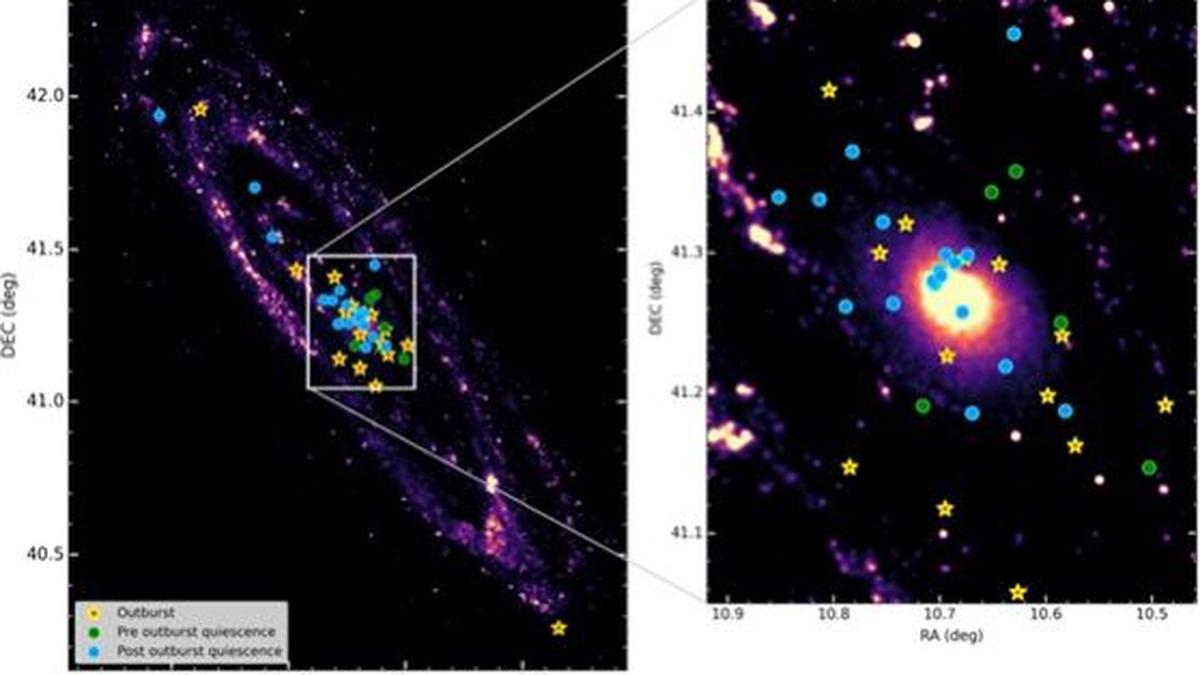
In a first, Indian Institute of Astrophysics astronomers spot ultraviolet emissions from novae in Andromeda galaxy In a first, Indian Institute of Astrophysics astronomers spot ultraviolet emissions from novae in Andromeda galaxy Science
Chunk of India’s forests ‘missing’ after 27-year-delay to file reports | Analysis Chunk of India’s forests ‘missing’ after 27-year-delay to file reports | Analysis Science
SiteLock

Archives

  • September 2025
  • August 2025
  • July 2025
  • June 2025
  • May 2025
  • April 2025
  • March 2025
  • February 2025
  • January 2025
  • December 2024
  • November 2024
  • October 2024
  • September 2024
  • August 2024
  • July 2024
  • June 2024
  • May 2024
  • April 2024
  • March 2024
  • February 2024
  • January 2024
  • December 2023
  • November 2023
  • October 2023
  • September 2023
  • August 2023
  • July 2023
  • June 2023
  • May 2023
  • April 2023
  • March 2023
  • February 2023
  • January 2023
  • December 2022
  • November 2022
  • October 2022
  • September 2022
  • August 2022
  • July 2022
  • June 2022
  • May 2022

Categories

  • Business
  • Nation
  • Science
  • Sports
  • World

Recent Posts

  • Access Denied
  • Access Denied
  • Stock markets fall in early trade on relentless foreign fund outflows, H-1B visa fee concerns
  • Rupee recovers 15 paise from all-time low to 88.60 against U.S. dollar in early trade
  • Access Denied

Recent Comments

  1. dfb{{98991*97996}}xca on UP Teacher Who Asked Students To Slap Muslim Classmate
  2. "dfbzzzzzzzzbbbccccdddeeexca".replace("z","o") on UP Teacher Who Asked Students To Slap Muslim Classmate
  3. 1}}"}}'}}1%>"%>'%> on UP Teacher Who Asked Students To Slap Muslim Classmate
  4. bfg6520<s1﹥s2ʺs3ʹhjl6520 on UP Teacher Who Asked Students To Slap Muslim Classmate
  5. pHqghUme9356321 on UP Teacher Who Asked Students To Slap Muslim Classmate
  • Wealth Of World’s Top 1% Grew By  Trillion Over The Past Decade: Oxfam
    Wealth Of World’s Top 1% Grew By $42 Trillion Over The Past Decade: Oxfam World
  • NATO Vows Ukraine Backing After Russian Missile ‘Intimidation’
    NATO Vows Ukraine Backing After Russian Missile ‘Intimidation’ World
  • Man Who Lost Wife To Mumbai BMW Dash
    Man Who Lost Wife To Mumbai BMW Dash Nation
  • Private US moon lander still working after breaking leg and falling, but not for long
    Private US moon lander still working after breaking leg and falling, but not for long Science
  • Market investors become poorer by ₹5.29 lakh crore amid massive correction in stocks
    Market investors become poorer by ₹5.29 lakh crore amid massive correction in stocks Business
  • Trump’s Washington D.C. takeover begins as National Guard troops arrive
    Trump’s Washington D.C. takeover begins as National Guard troops arrive World
  • “Want To Earn My Spot”: Suryakumar Yadav Expresses Desire To Play Test Cricket For India
    “Want To Earn My Spot”: Suryakumar Yadav Expresses Desire To Play Test Cricket For India Sports
  • Access Denied
    Access Denied Nation

Editor-in-Chief:
Mohammad Ariff,
MSW, MAJMC, BSW, DTL, CTS, CNM, CCR, CAL, RSL, ASOC.
editor@artifex.news

Associate Editors:
1. Zenellis R. Tuba,
zenelis@artifex.news
2. Haris Daniyel
daniyel@artifex.news

Photograher:
Rohan Das
rohan@artifex.news

Artifex.News offers Online Paid Internships to college students from India and Abroad. Interns will get a PRESS CARD and other online offers.
Send your CV (Subjectline: Paid Internship) to internship@artifex.news

Links:
Associate Journalism
About Us
Privacy Policy

News Links:
Breaking News
World
Nation
Sports
Business
Entertainment
Lifestyle

Registered Office:
72/A, Elliot Road, Kolkata - 700016
Tel: 033-22277777, 033-22172217
Email: office@artifex.news

Editorial Office / News Desk:
No. 13, Mezzanine Floor, Esplanade Metro Rail Station,
12 J. L. Nehru Road, Kolkata - 700069.
(Entry from Gate No. 5)
Tel: 033-46011099, 033-46046046
Email: editor@artifex.news

Copyright © 2023 Artifex.News Newsportal designed by Artifex Infotech.