

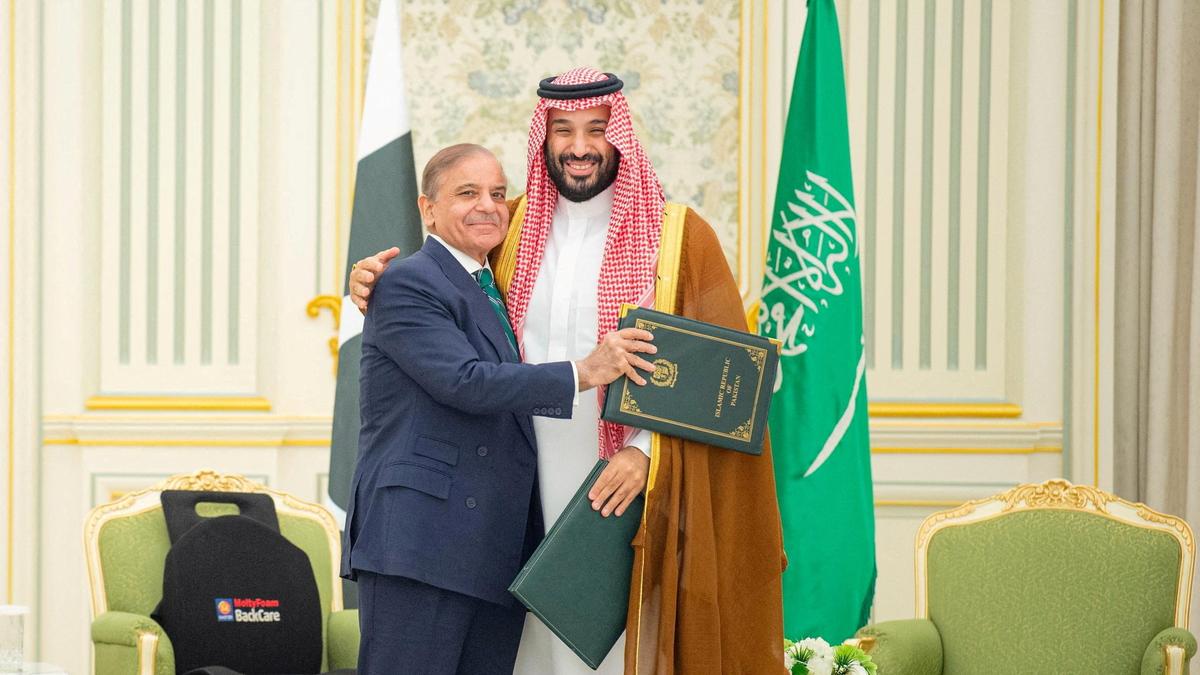
The story so far: Saudi Arabia and Pakistan have signed a mutual defence pact. The agreement formalises decades of informal military cooperation. Its timing, coming days after Israel’s bombing of Qatar and amid doubts over U.S. security guarantees to the Gulf monarchies, signals a shifting regional order. With Israel’s war in Gaza, Iran-backed Houthis flexing their military power, and America’s retrenchment, Saudi Arabia is hedging its bets — and Pakistan, strapped for cash but rich in military manpower, is seizing the chance to present itself as a security provider.
Also Read | The Saudi-Pakistan pact is a dodgy insurance policy
What are the terms of the agreement?
The official text released in Riyadh and Islamabad declares that “any aggression against either country shall be considered an aggression against both.” This principle of collective defence effectively commits each side to respond to threats to the other. The two countries will establish permanent coordination mechanisms, including a joint military committee, intelligence-sharing arrangements, and expanded training programmes.
Editorial | Shifting sands: On the defence agreement between Saudi Arabia, Pakistan
Pakistan has stationed military personnel in Saudi Arabia for decades. The mutual defence agreement takes the partnership into a formal treaty framework. Saudi Arabia had reportedly provided generous financial assistance to Pakistan’s nuclear programme. In his 2024 book War, American journalist Bob Woodward writes about a conversation Saudi Crown Prince Mohammed bin Salman had with U.S. Republican Senator Lindsey Graham, which speaks of the close cooperation the countries have had. When MBS, as the Crown Prince is widely known, told Mr. Graham that Saudi Arabia planned to enrich uranium, the U.S. Senator asked whether the Saudis were planning to build a bomb with the uranium. “I don’t need uranium to make a bomb. I will just buy one from Pakistan,” MBS told Mr. Graham. While MBS’s comments clearly show the close cooperation between the two countries, the agreement does not spell out whether Pakistan’s nuclear capabilities extend to Saudi defence (though Pakistan’s Defence Minister Khawaja Asif has said Saudi Arabia could access Pakistan’s nuclear capabilities). But the symbolism is clear: Saudi Arabia is no longer satisfied with existing security ties and is letting Pakistan play a larger role in the Persian Gulf.
Why was the agreement signed now?
The timing is as significant as the content. Saudi officials said talks with Pakistan had been going on for more than a year. But its announcement — barely a week after Israel attacked Qatar — underscores how the Gulf’s security environment is changing. Qatar is home to the Al-Udeid airbase, the largest U.S. military base in West Asia. As such a heavily defended ally came under Israeli attack without consequence, Riyadh seems to have concluded that it cannot rely solely on U.S. security guarantees.
This sense of vulnerability is not new. In 2019, when Iran’s allies attacked Saudi oil installations, the U.S. looked away. The U.S. doesn’t want to get entangled in West Asia’s conflicts any more as its strategic focus is shifting to East Asia. Moreover, Saudi’s calculus is further complicated by two other factors — the Gaza war and the Houthis. The October 7, 2023 Hamas attack in Israel, and Israel’s devastating response in Gaza, derailed Saudi Arabia’s plans to normalise ties with Israel under the U.S.-brokered Abraham Accords. Since then, Israel’s war in Gaza has spilled over into the region, deepening the insecurity of Gulf kingdoms. The Houthis in Yemen have also steadily expanded their military capabilities. Their missile and drone strikes had disrupted Saudi oil facilities and shipping in the Red Sea. While there is a tenuous ceasefire between Saudi Arabia and the Houthis now, the Saudis continue to look at the Houthis as a challenge. The Saudis, the U.S. and Israel have repeatedly bombed Houthis, but they still remain a force in Yemen, controlling almost half of the country, including its capital Sanaa. Against this backdrop, Pakistan offers a practical option. It is a Muslim-majority country, and has long experience in providing security services to the kingdom. In return, Pakistan needs Saudi financial support to stabilise its battered economy.
What about West Asia’s security landscape?
The U.S.’s pre-October 7 plan was to bring Israel and the Gulf kingdoms closer. But Israel’s attacks in Gaza, Syria, Lebanon, Yemen, Iran and Qatar have alarmed Arab states. Post-October 7, Riyadh has said it would normalise ties with Israel only if Tel Aviv commits itself to the creation of a Palestinian state based on the 1967 border. Israel, on the other hand, says there won’t be a Palestinian state. This means that the further expansion of the Abraham Accords is in doubt. By turning to Pakistan, Saudi Arabia is signalling to both Washington and Tel Aviv that it is diversifying its security alliances.
The risks, however, are substantial. Pakistan could be dragged into Saudi Arabia’s regional rivalries with Iran or into the conflict in Yemen. For Saudi Arabia, the deal could entangle it in South Asian instability, particularly if tensions between India and Pakistan flare up again. The pact does not resolve Riyadh’s core vulnerabilities, such as Iranian missile strikes or Houthi drones, but it does provide a hedge at a time when America’s reliability is under doubt and Israel’s behaviour is destabilising the region.
How does India view the pact?
For India, the Saudi-Pakistan defence pact introduces complications on multiple fronts. Over the past decade, New Delhi has invested heavily in its relations with Riyadh, deepening energy ties, expanding trade, and securing cooperation on counter-terrorism. Roughly 2.6 million Indian expatriates work in the kingdom. India has also sought to balance these ties with its growing strategic partnership with Israel. But Indian policy in West Asia clearly has a pro-Israeli tilt. Now that Israeli-Saudi normalisation is not happening and Israel’s unchecked militarism poses security threats to Gulf kingdoms, Saudi Arabia seems to have overlooked India’s concerns by formalising the defence pact with Pakistan. If India can have a pro-Israel tilt, Riyadh can have a pro-Pakistan tilt is what the Saudis seem to be conveying.
As Arab monarchies diversify their alliances, they may be less sensitive to India’s concerns. If Pakistan successfully positions itself as a credible security provider to the Gulf, India’s influence in the region could come under question. At the same time, New Delhi must reckon with the broader structural shift: U.S. dominance in West Asia is no longer assured. Regional powers are recalibrating, and security arrangements once taken for granted are being reconfigured. India’s interests — ensuring energy security, protecting its diaspora, and preventing extremist spillovers — are best served by stability and balance in the Gulf.
New Delhi’s best course lies in maintaining balance — deepening economic and political ties with Riyadh, while continuing to engage with other Gulf states, Iran, and beyond.
Published – September 21, 2025 02:00 am IST