





Vijay Bind, 48, is binge-drinking tea at a chai shop on Durgaganj Road in Bhadohi, Uttar Pradesh. He asks the man behind the counter for three successive cups, which he downs quickly. He looks tense. Two other men, around the same age, join him. “My factory owner has asked me to come after a week,” Bind tells them.
Naveen Kumar, one of the two who has joined Bind, says, “This is the third time within a month that this has happened to us also. My cash is running out. If this continues for two more weeks, I will have to ask the sahukaar (village moneylender) for money.”
At the tea shop, another group of men in their 40s discuss lay-offs from carpet factories located nearby and their uncertain life ahead. The worry in Bhadohi, a town in eastern Uttar Pradesh and the headquarters of the district by the same name, extends to many engaged in the handmade carpet sector.
“My employer says that all his current orders have been cancelled, so he cannot pay wages. This is a sudden shock; no one knows how to cope with it,” says Kailash, who works in the sector as a yarn spinner and dyer.
Uttar Pradesh contributed to over 60% of India’s handmade carpet exports in 2024-25, as per the Carpet Export Promotion Council (CEPC), which operates under the Union Ministry of Textiles. A CEPC report states that 58.6% of India’s handmade carpet exports go to the United States. Bhadohi and its adjoining districts — Mirzapur to the south and Varanasi to the east — are the centres of the handmade carpet craft and its trade. When the U.S. imposed a 50% tariff on India’s exports to the country in August, this belt was plunged into uncertainty.
“The sudden and steep tariff hike is leading to cancellations or renegotiations of the current U.S. orders. This has severely disrupted the sector, with production being cut,” says Aslam Mahboob, a factory owner in Bhadohi. The disruption has caused economic stress among factory owners, craftspeople, and workers supporting the ecosystem. Those across the Bhadohi belt are fearful that the tariffs may lead to a loss of centuries of craft knowledge.
Livelihood losses
Carpet weaving has been an art and craft form in Bhadohi since the Mughal period. The Ain-i-Akbari, a 16th-century chronicle of the administration under Emperor Akbar, written by his court historian, Abu’l Fazl, mentions the manufacturing of carpets in the region. The Mughals, known for their love of finery, encouraged the development of the carpet industry in the region.
There are now roughly 1,200 carpet exporters in Bhadohi registered with the Textiles Ministry. The Indian handmade carpet export industry stands at over ₹17,000 crore, according to the CEPC. Up to 22 lakh rural artisans are engaged in the value chain across Bhadohi, as per the district website.
Mehboob says a handmade carpet is a luxury product, with prices starting at ₹5,000 for a foot-long piece and going into lakhs, depending on the quality of raw materials, craftsmanship, and design. Hence, developed countries in the West are its largest market. At his factory, filled with rolled-up and packed carpets, a couple of workers finish off a black-and-white woollen piece, snipping the loose ends of threads off. The wool is sourced from New Zealand and comes to Panipat, Haryana, from where it is brought into Uttar Pradesh.
Vineet Rai, another carpet manufacturer, says he was forced to let go of all but two of the 40 employees at his factory in the last week of August. “Many among them had been working for years, but we didn’t have any other option, as production stopped with the tariff impact,” he says. The two whom he retained are not artisans. They are responsible for the unit’s maintenance. He produces silk carpets, the threads for which come from Karnataka.
A closed carpet yarn spinning unit in Bhadohi, Uttar Pradesh.
| Photo Credit:
Sandeep Saxena
Rai calls this “a socio-economic emergency”, which he says is “no longer a sectoral” issue. “The loss of orders will force thousands from rural areas to migrate permanently in search of jobs. Once they leave, many will not return, leading to the collapse of traditional carpet-weaving clusters. This will wipe out generations-old craft skills, weaken rural economies, and deepen poverty,” he says.
However, in Bhadohi, poverty is already everywhere: from the unpainted homes to the filth along the streets. Many of the artisans are daily wage workers paid between ₹400 and ₹600, with some employed on a monthly salary between ₹12,000 and ₹18,000. There are also professionals who serve the industry by providing carding and spinning services on a contract basis, typically on a per-square-foot or per-yard basis. “The real sufferers will be the artisans who have no other way of earning,” says Rai.
The tea-drinking Bind echoes Rai, “There is no industry in our area other than the one on carpets. If it closes, I will be forced to look for a job in a city. But no one wants to leave their hometown.” He worries that he will have to leave his family to venture alone into the great unknown.
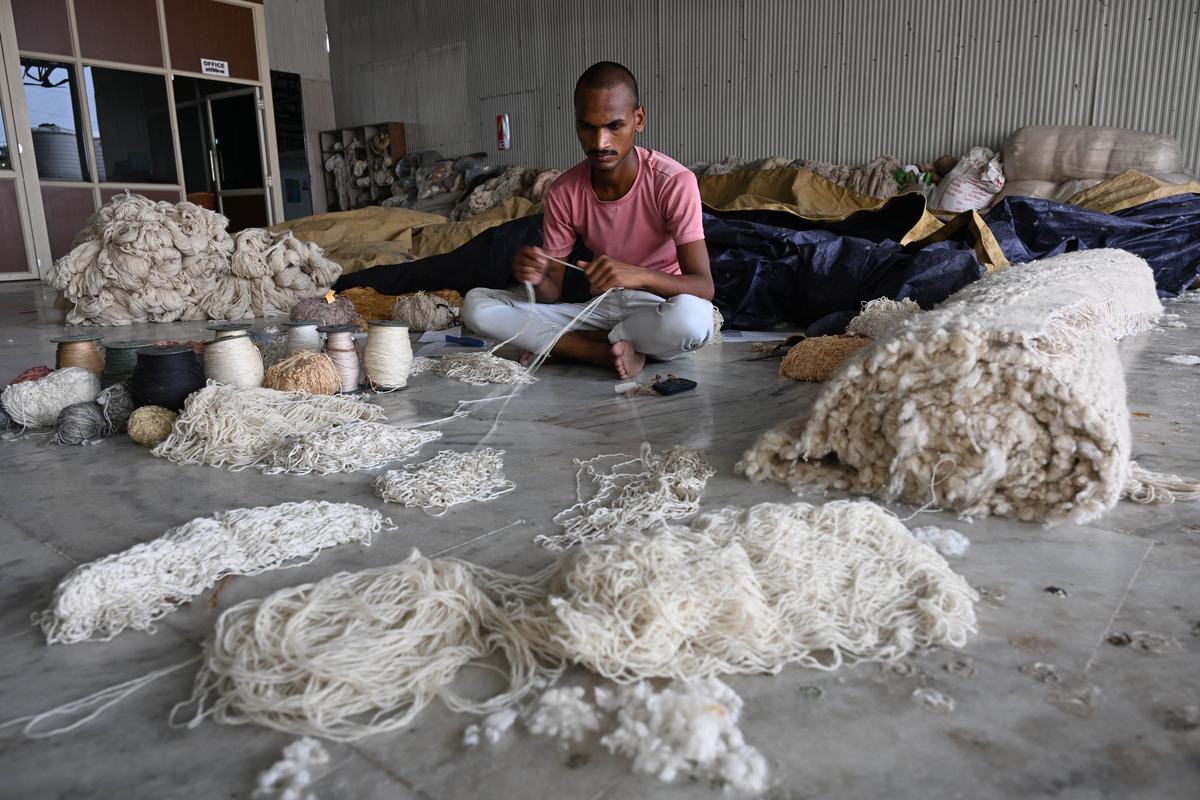
There are several processes involved in the making of a handcrafted carpet, and each worker has a specific skill.
| Photo Credit:
Sandeep Saxena
Prem Chandra, 55, who is employed at a factory in Bhadohi, explains that because there are several processes in carpet making, the sector provides employment to many people with different skills. “First, sorting and scouring are done, when the raw wool is sorted to remove impurities and then washed. The clean wool is carded and spun into yarn and then dyed, often by hand in small batches using traditional methods to achieve specific colours,” he says. Then the yarn is dried in the sun and wound into balls, ready for the weaving process to begin.
A design is mapped on a graph from a drawing, followed by warp thread columns being stretched vertically on the loom and knot tying. Weft threads are inserted, along with a rod that creates loops. Once the carpet is made, there are other processes like washing and shearing to even out the pile height. A carpet takes roughly three months to make, with finishing being a 10- to 15-day process.
Market run
In the second half of the 20th century, the carpet industry in Bhadohi grew and evolved, with weavers experimenting with new designs, materials, and techniques. The introduction of power looms made it possible to produce carpets on a larger scale. Though not hand-knotted, these are still considered handmade because of the skill involved, with each thread tied on the loom.
Hand-tufted carpets are made by punching yarn through a canvas with a tufting gun, then securing it with glued backing. Hand-knotted rugs are more durable, valuable, and time-consuming to produce, whereas hand-tufted rugs are faster, less expensive, and more prone to shedding. In the Bhadohi region, most carpets are hand-knotted with wool and silk.
“The impact of globalisation in the 1990s played a key role in reaching newer markets such as the United States and Germany. This also led to design innovations,” says Mehboob, who is part of the committee that runs the CEPC office in Bhadohi. The office, frequented by international customers and their local representatives, is situated in the ‘Carpet City’ spread over 7.5 acres. Bhadohi is just 45 kilometres from Varanasi, which is on the tourism circuit, and hence well connected by road, rail, and air.
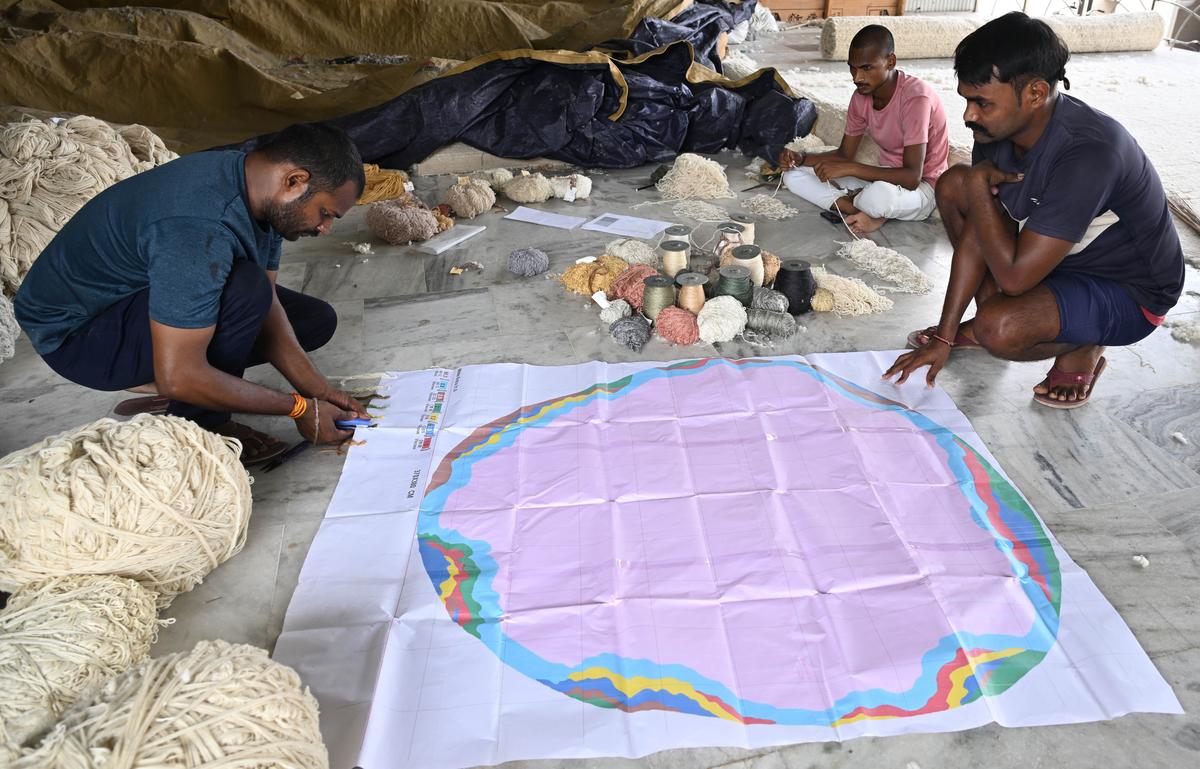
A worker putting yarn samples on the carpet design map.
| Photo Credit:
Sandeep Saxena
Each year in October, an expo is held in the Carpet City, where at least 400 international buyers arrive to sample and order carpets, say officials. This year, they are banking on a bailout package from the Indian government, so they can continue to offer the U.S. competitive prices.
Anticipating the shock, Kuldeep Raj Wattal, the CEPC chairperson, wrote to the Textile Ministry on August 13 saying, “A bailout package equivalent to 25% of the annual U.S. export value is requested to provide a financial cushion for exporters. This will help mitigate immediate losses and prevent lay-offs.”
Factory owners and CEPC representatives have also written to Uttar Pradesh Chief Minister Yogi Adityanath for State-level intervention. “We met the Micro, Small and Medium Enterprises (MSME) Minister. A team from the government is coming to Bhadohi on September 12 to assess the impact and possible solutions,” says Mehboob.
Alok Ranjan, a former Chief Secretary of Uttar Pradesh, who worked with the industry closely and follows it, hopes the “government will take steps to financially compensate the carpet industry”. He also feels exporters will need to look for new markets abroad.
The industry was already finding it difficult to cope because of a clause in the Income Tax Act, which mandates payments to the MSMEs within 45 days for them to qualify for tax benefits. But international buyers typically take three to six months for payment under global trade terms. Mehboob says the Act must be amended to allow export houses to claim benefits.
“We need a helping hand to tide us over this turbulent phase. Within this short span, U.S.-based companies are shifting orders to countries such as Pakistan and Turkey. It took years for the Indian carpet sector to build the trust of customers. Once they move to another country, it will be difficult to get them back,” adds Mehboob.