





In the race to make quantum computers practical, scientists have found themselves drawn to some of the strangest ideas in physics. Few are stranger — but also more promising — than the notion of using particles that are their own antiparticles to store and manipulate information. This is the concept behind Majorana particles.
In the 1930s, the Italian physicist Ettore Majorana proposed a particle that, unlike the electron or proton, would be indistinguishable from its antimatter counterpart. In most cases, matter and antimatter are exact opposites. If you bring them together, they annihilate in a flash of energy. But a Majorana particle is a perfect mirror of itself: if you turn it inside out and reverse every charge and property, you get the very same thing you started with. This isn’t true for electrons or protons.
For decades, this symmetry seemed the stuff of theory alone. High-energy physicists searched for Majoranas in cosmic rays and particle accelerators but revealed nothing conclusive. Then, more recently, condensed matter physicists found a loophole: certain “quasiparticles” inside specially designed materials behave mathematically like Majoranas. These quasiparticles aren’t elementary particles from nature’s catalogue but collective excitations — like ripples in an electron sea — that follow the same unusual rules. They may emerge, for example, at the ends of tiny superconducting wires cooled to near absolute zero, under the influence of a magnetic field.
The fact that these Majorana-like modes could exist in a tabletop experiment electrified the quantum computing community. That excitement wasn’t because they are rare, beautiful oddities (indeed they are) but because of the prospect that they might solve one of quantum computing’s hardest, most stubborn problems: keeping quantum information stable.
First line of defence
What plagues a quantum computer? A qubit, the quantum analogue of the bit in your laptop or smartphone, can exist in a superposition, or a blend, of ‘0’ and ‘1’ at the same time. This strange property, along with entanglement between multiple qubits, is what gives quantum computers their potential power. But a qubit’s state is almost absurdly delicate. If a qubit interacts with the surrounding world, like say some stray heat or light, its superposition can “collapse”, forcing the qubit into a definite 0 or 1 and erasing the information it held.
This process, called decoherence, is relentless. In today’s most advanced superconducting quantum chips, qubits can last microseconds to milliseconds before decohering. That may sound long, but for a computer that must carry out thousands or millions of operations in sequence, it is too brief. To cope, engineers use quantum error correction, which encodes one logical qubit into a bundle of many physical qubits. The redundancy allows the computer to detect and fix errors on the fly, but it comes at a cost: hundreds or thousands of physical qubits may be needed to sustain just one logical qubit.
This is the bottleneck. If there were a way to make qubits inherently more resistant to errors and protect their quantum state at the hardware level, the whole enterprise would become far more efficient.
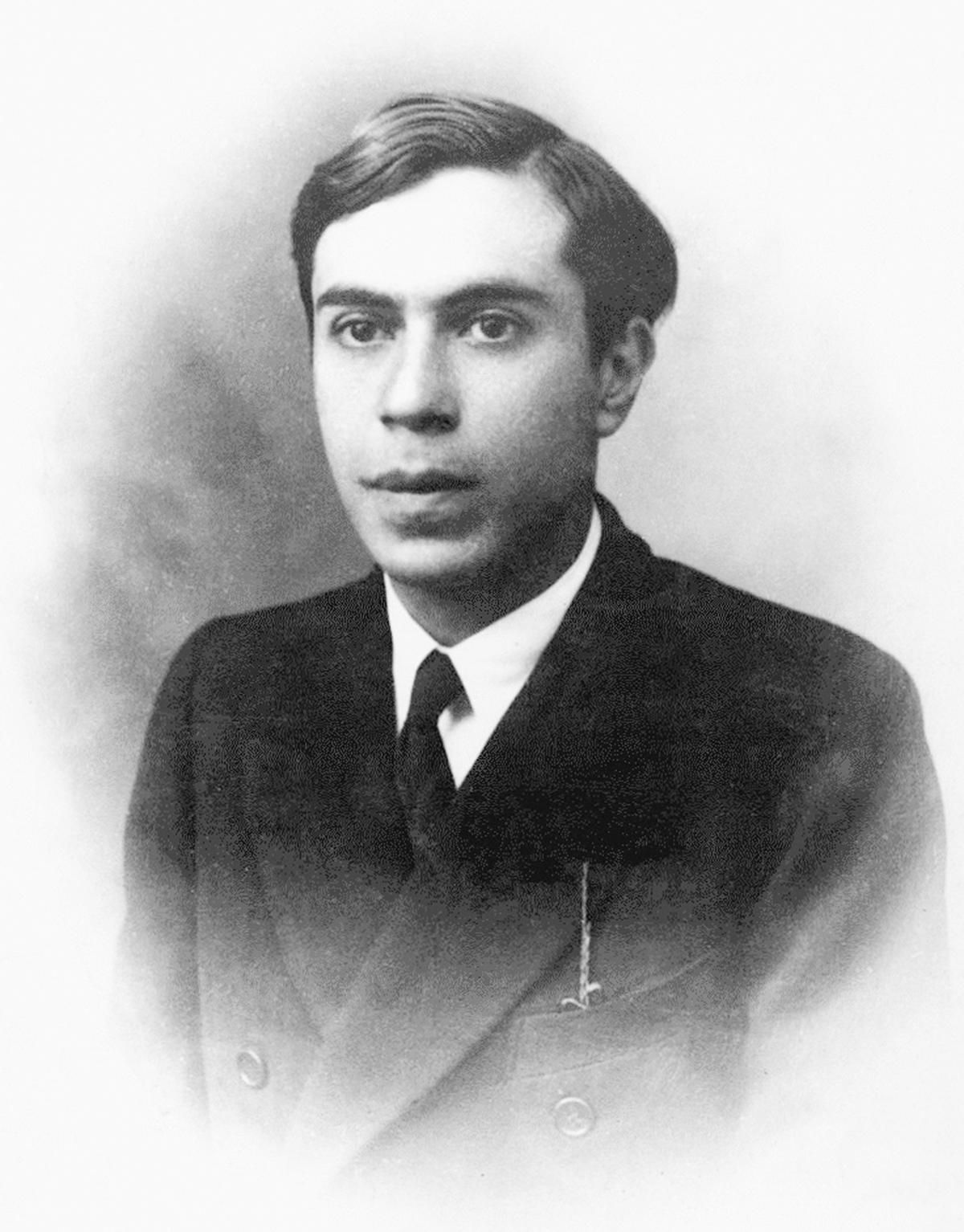
In the 1930s, the Italian physicist Ettore Majorana (pictured here c. 1930s) proposed a particle that, unlike the electron or proton, would be indistinguishable from its antimatter counterpart.
| Photo Credit:
Public domain
This is where Majoranas offer a radically different approach. Imagine a qubit not as something stored in a single, fragile object but as a property that two widely separated pieces share. This is possible with Majorana modes. In certain superconductors, electrons form bound pairs but in the right conditions, the quantum state of one electron can, in effect, be split in two. Each half behaves like a Majorana mode.
Crucially, these two halves can be placed far apart along the same nanowire or in different regions of a device. Together they define a single qubit, but the information about whether that qubit is in state 0, 1 or a superposition of both is stored in the combined state of both Majoranas. If a disturbance affects one of them — say, a bit of local noise or a defect in the material — it can’t by itself destroy the encoded information. Both halves will have to be disrupted in a correlated way, and that is far less likely.
This nonlocal encoding is the first line of defence. It’s as if you wrote the first half of a secret in one notebook kept in Paris and the second half in another locked away in Tokyo. Stealing one notebook doesn’t reveal the secret: you must have both.

Weaving braids
The protection doesn’t end there. Majorana modes also belong to a rare class of quantum objects called non-Abelian anyons. To appreciate what this means, it helps to step back and think about how particles normally behave when you exchange their positions.
In our everyday world, swapping two identical oranges changes nothing at all. In the quantum world, identical particles fall into two well-known categories. Bosons (e.g. photons) don’t change their overall wavefunction when swapped. Fermions (e.g. electrons) change only by a minus sign, a mathematical quirk that still leaves most observable properties untouched.
Non-Abelian anyons are different. If you exchange, or “braid”, two of them, the joint quantum state changes in a much deeper way. The swap doesn’t just multiply the state by a constant; it transforms it into an entirely new state. What’s more, the order in which you do these swaps matters. Swap particle A with particle B, then swap B with C, and you end up with a different final state than if you had swapped B with C first, then A with B.
This is alien to ordinary intuition. Imagine three dancers on a stage who change the choreography of their whole performance based on the sequence in which they pass each other, not just on whether they pass.
The fact that Majorana modes are non-Abelian opens up a new way to perform quantum computation. In a suitable device, you can physically move these modes around each other, tracing out paths in space and time. This process is called braiding, because if you draw the paths, they look like strands in a braid.
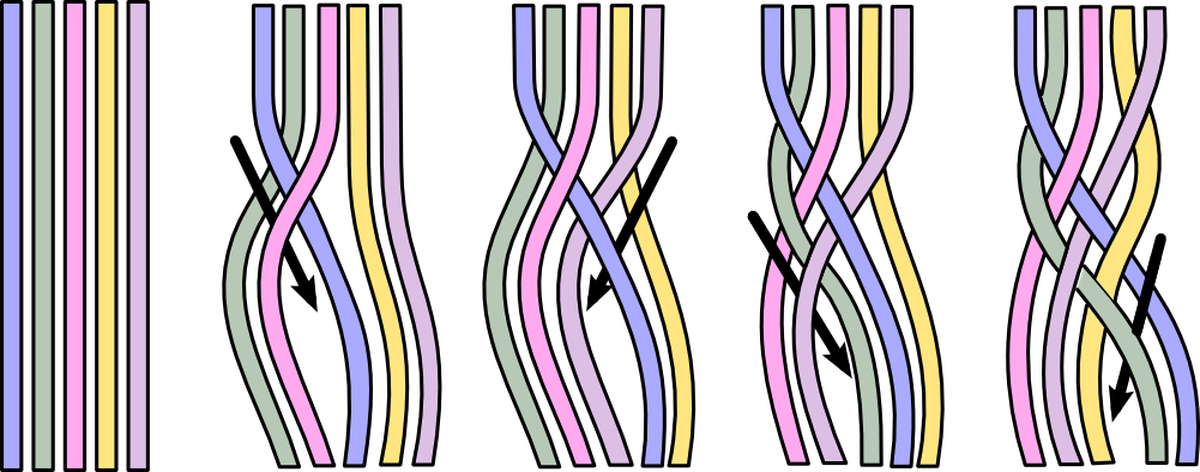
A method to braid five strands.
| Photo Credit:
Stilfehler (CC BY-SA)
Each braid corresponds to a specific transformation of the quantum state shared by the Majoranas. The beauty is that the outcome depends only on the topology of the braid — the abstract over-and-under pattern — and not on the exact physical details of the motion. You could move them slowly or quickly, take a detour around an impurity in the material or shake them gently as you go. The result would be the same as long as the braiding pattern itself is preserved.
This property makes computations built from braiding topologically protected. In practical terms, that means small errors in timing, position or environmental noise are unlikely to derail the computation. Nature itself ‘rounds off’ the imperfections, the way a knot remains a knot no matter how you twist the rope, until you actually untie it.
Pushing the frontiers
In principle, a topological quantum computer could be programmed simply by moving its Majorana modes through a prescribed sequence of braids, each one implementing a logical operation. The machine’s robustness would come not from layers upon layers of error-correcting qubits but from the fundamental physics of the particles themselves.
Contrast this with today’s leading quantum computing platforms: superconducting qubits, trapped ions, and spin qubits in semiconductors. In all these systems, operations must be controlled with exquisite precision and any environmental disturbance must be suppressed as much as possible. The qubit states are localised, so an unwanted jolt or fluctuation at that location can flip or randomise the qubit. The protection comes entirely from engineering discipline and active error correction, both of which require enormous complexity.

With Majorana-based topological qubits, the hope is that much of that complexity is unnecessary. Because the information is stored nonlocally and manipulated by braiding, the qubit’s essential properties are shielded from small-scale noise. This doesn’t make them invincible — there are still ways errors can creep in, such as through quasiparticle poisoning or imperfect isolation — but the baseline stability could be orders of magnitude better.
The catch is that the promise is still mostly theoretical. Experiments over the last decade have produced tantalising signals consistent with the presence of Majorana modes — in nanowires made of materials like indium antimonide, coupled to superconductors, under a magnetic field. Measurements of the electrical conductance at the wire’s ends have shown patterns that fit the predictions for Majoranas. But sceptics point out that other, more mundane effects can mimic these patterns.
The ultimate proof would be to demonstrate braiding: to move the modes around each other and show that the system’s quantum state changes in exactly the way non-Abelian statistics predict. This is a delicate task. The modes have to be moved without losing their identity, kept well-isolated from ordinary electron states, and manipulated in two dimensions, even though most current devices are effectively one-dimensional wires. Researchers are currently designing more complex geometries to make braiding feasible.
If successful, Majorana-based qubits could change the economics of quantum computing. Instead of needing a million physical qubits to get a few thousand logical ones, a machine might operate with far fewer qubits, each naturally robust. The hardware could be simpler, the error-correction overhead smaller, and the computations faster and more reliable. This wouldn’t just accelerate the arrival of practical quantum computers, it could also open the door to computations that are currently out of reach because of noise and instability.
It’s also worth noting that the pursuit of Majoranas has already pushed the frontiers of condensed matter physics. In trying to coax these particles into existence, researchers have learned to grow cleaner nanowires, make better superconducting contacts, and control materials at the atomic scale. Even if the ultimate prize remains elusive, the technological by-products are likely to feed into other areas, from quantum sensing to new kinds of electronics.