
Skip to content
  • Facebook
  • X
  • Linkedin
  • WhatsApp
  • YouTube
  • Associate Journalism
  • About Us
  • Privacy Policy
  • 033-46046046
  • editor@artifex.news
Artifex.News

Artifex.News

Stay Connected. Stay Informed.

  • Breaking News
  • World
  • Nation
  • Sports
  • Business
  • Science
  • Entertainment
  • Lifestyle
  • Toggle search form
  • Access Denied Business
  • Mattia Zaccagni Rescues Italy Leaving Croatia In Euro 2024 Limbo
    Mattia Zaccagni Rescues Italy Leaving Croatia In Euro 2024 Limbo Sports
  • Access Denied
    Access Denied Nation
  • DRDO successfully flight-tests indigenous third-generation MPATGM with top-attack capability
    DRDO successfully flight-tests indigenous third-generation MPATGM with top-attack capability Science
  • “Not This Time Aussies”: Social Media Goes Crazy As Afghanistan Stun Australia In T20 World Cup
    “Not This Time Aussies”: Social Media Goes Crazy As Afghanistan Stun Australia In T20 World Cup Sports
  • Possible Modi third term said to likely see focus on economic reforms
    Possible Modi third term said to likely see focus on economic reforms Business
  • Opinion: Blog | Asha Bhosle Is Gone, But Her 'Bad Girl' Anthems Live On World
  • Trump says he’s awarding former New York Mayor Rudy Giuliani the Presidential Medal of Freedom
    Trump says he’s awarding former New York Mayor Rudy Giuliani the Presidential Medal of Freedom World
What is IADT-1, the Gaganyaan test ISRO conducted on August 24? | Explained

What is IADT-1, the Gaganyaan test ISRO conducted on August 24? | Explained

Posted on August 26, 2025 By admin


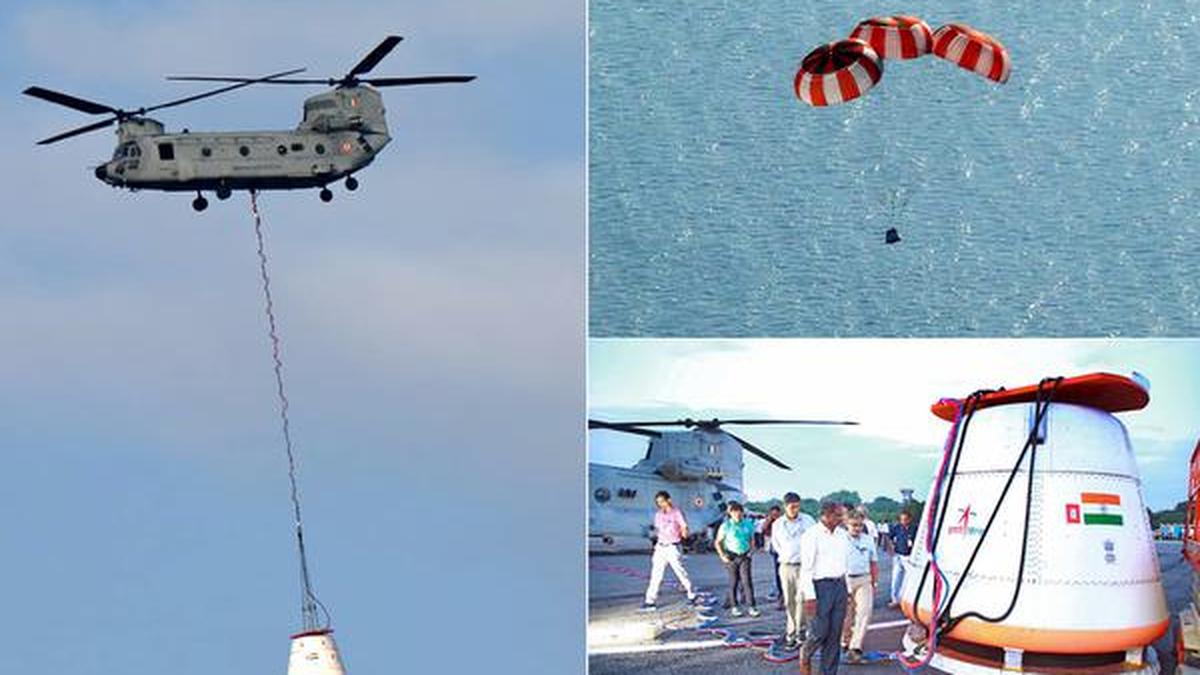
The story so far: On August 24, the Indian Space Research Organisation (ISRO) successfully carried out its first Integrated Air Drop Test (IADT-1), a crucial milestone in the preparation for the country’s maiden human spaceflight mission, Gaganyaan. A dummy crew capsule weighing nearly five tonnes was dropped from a helicopter to test whether its parachute system could slow it safely for splashdown.

What is IADT-1?

The IADT is designed to evaluate the parachute-based deceleration system that will bring the Gaganyaan crew module down safely after reentry. In IADT-1, the parachutes were expected to deploy in a precise sequence after the module was released from a height of about 3 km.

Although the capsule was uncrewed and the drop was conducted from a helicopter, the test simulated the last stages of an actual space mission. In the real scenario, the capsule will first be slowed by atmospheric drag and its heat shields, followed by smaller drogue parachutes and finally the three 25-m main parachutes. The aim was to ensure the capsule slowed to around 8 m/s before splashdown.

How and why was the test carried out?

For IADT-1, an Indian Air Force Chinook helicopter lifted a 4.8-tonne dummy crew module into the air. At the designated altitude, the helicopter released the capsule. From then on, automated systems triggered the sequential deployment of parachutes.

ISRO reported that the touchdown conditions matched expectations, demonstrating that the design worked in real-world conditions. The exercise involved extensive modelling, instrumentation, and coordination among multiple agencies. Aside from the Air Force, the Defence Research and Development Organisation (DRDO) contributed to materials and safety systems. The Indian Navy and Coast Guard prepared for post-splashdown recovery. Vikram Sarabhai Space Centre Director A. Rajarajan has said that his centre was responsible for nearly “90%” of the IADT-1 activities.

In a crewed space mission, ascent, descent, and recovery are the riskiest phases. Even after a successful launch and orbital stay, astronauts’ survival hinges on whether the capsule can decelerate safely for re-entry and landing. A failure in parachute deployment could lead to catastrophe. Testing on the ground is thus indispensable.

Where does IADT-1 lie on the roadmap?

Gaganyaan’s ultimate objective is to send Indian astronauts to low-earth orbit on a human-rated LVM3 rocket. But before that happens, ISRO must conduct a series of tests to validate safety systems. Unlike previous satellite or planetary missions, human spaceflight requires human-rating of every system. This involves engineering redundancies, fault detection, and life support.

The Crew Escape System tests are to demonstrate whether astronauts can be pulled away from the rocket in case of launch failure. The first such test vehicle flight, TV-D1, took place in October 2023. TV-D2, scheduled next, will attempt a more complex abort scenario.

The uncrewed Gaganyaan-1 (G1) mission will launch a crew module aboard the LVM3 to orbit. The module will house ‘Vyommitra’, a humanoid robot designed to mimic astronaut operations. The recent IADT-1 success will pave the way for TV-D2 and G1.

Further drop tests and subsystem trials, including more IADTs and subsystem checks, will continue in parallel, refining the systems before astronauts are cleared to fly. In all, by the time the first human flight (H1) has happened, ISRO will have conducted several thousand tests.

Some of the critical systems under development include the environmental control and life support system (ECLSS) for oxygen, temperature, waste management, and fire safety; the integrated vehicle health management system (IVHMS), capable of autonomously detecting faults and triggering abort actions; and the strengthened LVM3 rocket, modified to meet the reliability standards necessary to carry humans.

India has also had to indigenise many technologies that were unavailable from abroad, from escape motors to specialised composites. Each subsystem has to pass hundreds of tests before being certified.

What are India’s long-term goals?

Gaganyaan is not an end in itself but the foundation of a broader human spaceflight roadmap. The Indian government has announced plans to establish the Bharatiya Antariksh Station (BAS) by 2035 and to achieve an Indian crewed lunar landing by 2040. These goals will demand repeated flights, extended orbital missions, and deep-space technology.

In this regard, while schedules may slip — IADT-1 was originally planned for April 2024, e.g. — each milestone will build capability for more ambitious tests. For example, according to ISRO, the TV-D2 mission “will demonstrate Gaganyaan Crew Escape System by simulating an abort scenario. The crew module will separate and descend using thrusters and parachutes before sea splashdown, followed by recovery operations.”

In tandem, ISRO is currently operating its SpaDeX mission in its extended phase, after the mission’s twin satellites successfully demonstrated in-orbit docking in May 2025. This technology will be an important part of the Gaganyaan, Chandrayaan-4, and BAS missions.

H1 is currently scheduled for 2027 but is likely to be delayed further.

Published – August 26, 2025 02:15 pm IST



Source link

Science

Post navigation

Previous Post: Access Denied
Next Post: Access Denied

Related Posts

  • ISRO releases images of Sun captured by Aditya-L1 during May solar storm
    ISRO releases images of Sun captured by Aditya-L1 during May solar storm Science
  • Dozens of viruses detected in Chinese fur farm animals
    Dozens of viruses detected in Chinese fur farm animals Science
  • Science Quiz | What computers need to compute: Logic gates
    Science Quiz | What computers need to compute: Logic gates Science
  • ‘Green-beard’ genes could explain how altruism arose in nature
    ‘Green-beard’ genes could explain how altruism arose in nature Science
  • Science quiz: The discovery of Epimetheus
    Science quiz: The discovery of Epimetheus Science
  • Congress accuses PM Modi of ‘hogging’ the limelight after the success of Chandrayaan-3 mission
    Congress accuses PM Modi of ‘hogging’ the limelight after the success of Chandrayaan-3 mission Science

More Related Articles

Before and after satellite images of Wayanad landslip Before and after satellite images of Wayanad landslip Science
Shorebird from Australia spotted over 7,400 km away on island in Andamans: Expert Shorebird from Australia spotted over 7,400 km away on island in Andamans: Expert Science
Why does spicy food make our nose run? Why does spicy food make our nose run? Science
Study Abroad: How 2025 taught Indian students to carefully scrutinise options and choose Study Abroad: How 2025 taught Indian students to carefully scrutinise options and choose Science
What hinders Indian pharma companies from making drugs for rare diseases What hinders Indian pharma companies from making drugs for rare diseases Science
Sci-Five | The Hindu Science Quiz: On Ozone Sci-Five | The Hindu Science Quiz: On Ozone Science
SiteLock

Archives

  • May 2026
  • April 2026
  • March 2026
  • February 2026
  • January 2026
  • December 2025
  • November 2025
  • October 2025
  • September 2025
  • August 2025
  • July 2025
  • June 2025
  • May 2025
  • April 2025
  • March 2025
  • February 2025
  • January 2025
  • December 2024
  • November 2024
  • October 2024
  • September 2024
  • August 2024
  • July 2024
  • June 2024
  • May 2024
  • April 2024
  • March 2024
  • February 2024
  • January 2024
  • December 2023
  • November 2023
  • October 2023
  • September 2023
  • August 2023
  • July 2023
  • June 2023
  • May 2023
  • April 2023
  • March 2023
  • February 2023
  • January 2023
  • December 2022
  • November 2022
  • October 2022
  • September 2022
  • August 2022
  • July 2022
  • June 2022
  • May 2022

Categories

  • Business
  • Nation
  • Science
  • Sports
  • World

Recent Posts

  • Three Indian-origin men in Canada convicted of couple’s murder
  • Union Minister Sanjay Kumar’s son booked under POCSO; files extortion counter-complaint
  • Pakistan security forces kill 5 terrorists in Khyber Pakhtunkhwa
  • Fadnavis asks officials to fast-track water conservation works amid El Niño concerns
  • Labour reforms: Government fully operationalises four new codes by publishing rules

Recent Comments

  1. JasonCobby on UP Teacher Who Asked Students To Slap Muslim Classmate
  2. Jamesnep on UP Teacher Who Asked Students To Slap Muslim Classmate
  3. CalebKar on UP Teacher Who Asked Students To Slap Muslim Classmate
  4. Alvinadubs on UP Teacher Who Asked Students To Slap Muslim Classmate
  5. CharlesVOX on UP Teacher Who Asked Students To Slap Muslim Classmate
  • Access Denied Business
  • Access Denied Business
  • Access Denied Sports
  • Paris Olympics: Antim Panghal Wants To Live Up To Country’s Expectations
    Paris Olympics: Antim Panghal Wants To Live Up To Country’s Expectations Sports
  • Typhoon Makes Landfall On Japanese Island Of Kyushu: Weather Office
    Typhoon Makes Landfall On Japanese Island Of Kyushu: Weather Office World
  • U.S. lifts Caribbean airspace restrictions after Venezuela strike
    U.S. lifts Caribbean airspace restrictions after Venezuela strike World
  • Access Denied
    Access Denied Nation
  • China Tops List As Most Expensive Place To Raise Children
    China Tops List As Most Expensive Place To Raise Children World

Editor-in-Chief:
Mohammad Ariff,
MSW, MAJMC, BSW, DTL, CTS, CNM, CCR, CAL, RSL, ASOC.
editor@artifex.news

Associate Editors:
1. Zenellis R. Tuba,
zenelis@artifex.news
2. Haris Daniyel
daniyel@artifex.news

Photograher:
Rohan Das
rohan@artifex.news

Artifex.News offers Online Paid Internships to college students from India and Abroad. Interns will get a PRESS CARD and other online offers.
Send your CV (Subjectline: Paid Internship) to internship@artifex.news

Links:
Associate Journalism
About Us
Privacy Policy

News Links:
Breaking News
World
Nation
Sports
Business
Entertainment
Lifestyle

Registered Office:
72/A, Elliot Road, Kolkata - 700016
Tel: 033-22277777, 033-22172217
Email: office@artifex.news

Editorial Office / News Desk:
No. 13, Mezzanine Floor, Esplanade Metro Rail Station,
12 J. L. Nehru Road, Kolkata - 700069.
(Entry from Gate No. 5)
Tel: 033-46011099, 033-46046046
Email: editor@artifex.news

Copyright © 2023 Artifex.News Newsportal designed by Artifex Infotech.