




Skip to content
  • Facebook
  • X
  • Linkedin
  • WhatsApp
  • Associate Journalism
  • About Us
  • Privacy Policy
  • 033-46046046
  • editor@artifex.news
Artifex.News

Artifex.News

Stay Connected. Stay Informed.

  • Breaking News
  • World
  • Nation
  • Sports
  • Business
  • Science
  • Entertainment
  • Lifestyle
  • Toggle search form
  • Poll Body’s Police Complaint Over Viral ‘EVM Hack’ Clip
    Poll Body’s Police Complaint Over Viral ‘EVM Hack’ Clip Nation
  • Ex PM Manmohan Singh Dies At Age Of 92
    Ex PM Manmohan Singh Dies At Age Of 92 Nation
  • Lakshya Sen Working On Net Game Ahead Of Paris Olympics 2024
    Lakshya Sen Working On Net Game Ahead Of Paris Olympics 2024 Sports
  • Congress suggests relief in income tax for the middle class, MSP for farmers, and income support for the poor in upcoming Union budget
    Congress suggests relief in income tax for the middle class, MSP for farmers, and income support for the poor in upcoming Union budget Business
  • UK Burglar Involved In Theft Worth Over A Million Dollars Caught By Apple AirTag
    UK Burglar Involved In Theft Worth Over A Million Dollars Caught By Apple AirTag World
  • Israel pummels Gaza as troops push into central Rafah
    Israel pummels Gaza as troops push into central Rafah World
  • Netanyahu Welcomes Former Opponent Gideon Saar Back To Government
    Netanyahu Welcomes Former Opponent Gideon Saar Back To Government World
  • India Add Five More Gold Medals In ISSF Junior World Championship
    India Add Five More Gold Medals In ISSF Junior World Championship Sports
How India’s youth can challenge U.S. tariffs 

How India’s youth can challenge U.S. tariffs 

Posted on August 20, 2025 By admin


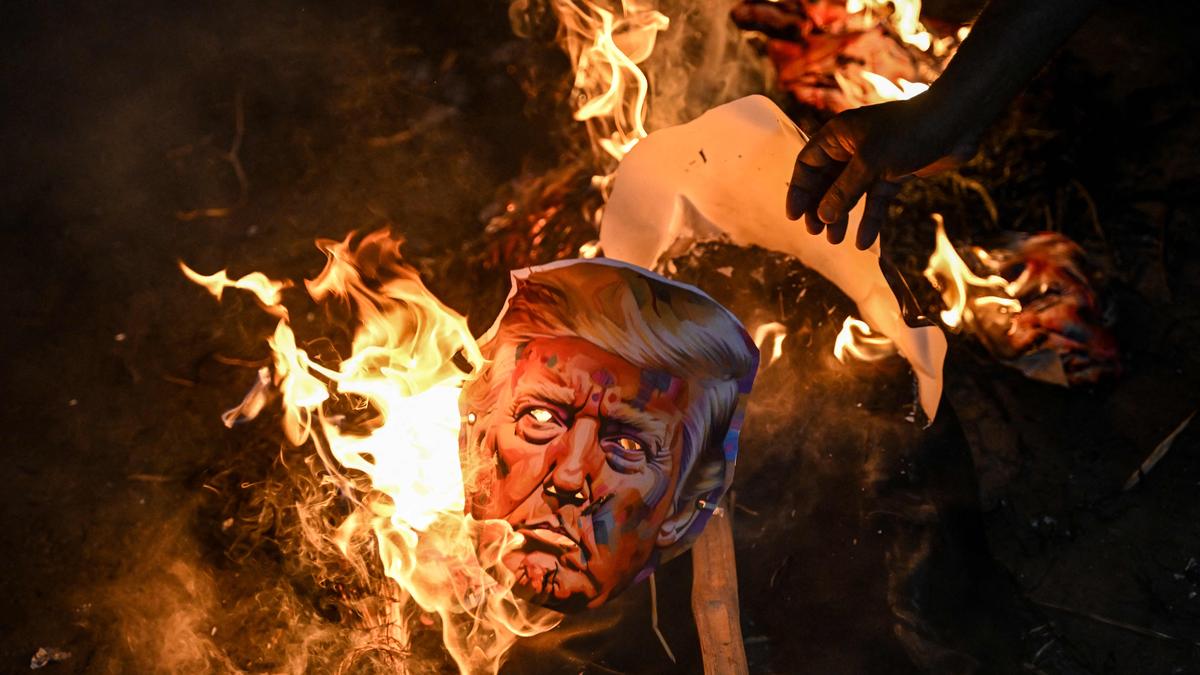
In early August, U.S. President Donald Trump announced that imports from India to the U.S. will be charged tariffs at 50%. This includes a 25% penalty for India’s oil purchases from Russia. The U.S. tariffs bring challenges to the Indian economy. What are the policy options for India?

Tariffs are the taxes levied on imports from other countries. The average tariff imposed by the U.S., the world’s largest export market, was 2 to 3% for two decades until 2024. All that has changed with President Trump announcing a steep hike in U.S. tariffs on April 2 this year.

If the 50% tariff rate imposed on India takes effect, a shirt that an Indian firm sells for $10 will cost as much as $15 for the U.S. consumer. The tariffs on goods from India are higher than the tariffs the U.S. has imposed on India’s export competitors (Table 1). Therefore, a similar shirt shipped from Vietnam or Bangladesh will cost $12 or less, making Indian products uncompetitive. When Mr. Trump launched the tariff war in April this year, his fury was directed mainly at China, which was charged with tariffs of 145%. But subsequently, the two countries agreed to cool off their animosities, and the U.S. tariffs on China have now come down to 30%. Astonishingly, India, a close U.S. ally, is now the country (with Brazil) threatened with the highest U.S. tariffs.

For India, the dollars it earns by selling textiles, pharmaceuticals, software services, and other products to the U.S. are critical for bridging the country’s external trade deficit. Mr. Trump’s tariffs may lead to job and income losses in India, at least in the short run. At the same time, in exchange for reducing tariffs, the U.S. is seeking greater access for its agricultural products, especially dairy, in the Indian market. This will in turn have adverse impacts on Indian farmers.

Nature of China’s influence

The unfolding tariff war shows that low wages alone will not give a lasting competitive advantage to a country in the export market. China’s strengths emerge from its enormous scale, massive infrastructure, and growing technological capabilities. China has established an unassailable lead in several industries. Its shares in global exports are 36.3% in textiles and clothing and 24.9% in machine and electrical equipment. The corresponding shares for India are 4.4% and 0.9% respectively (Table 2).

China’s vice-like grip over large parts of the global production network and exclusive access to some critical materials such as rare earths may have quickened the melting of ice between it and the U.S. Moreover, further uncertainty and tariff escalations with other countries may derail plans by global companies to diversify their investments away from China and do more business with India and Vietnam.

If left with low wages as its only bargaining chip, India will remain on the periphery of global business, ever to be pushed by lower-cost suppliers and by the whims of tariff administrators of rich countries. Despite their early starts, India’s IT and pharmaceutical industries tread unsteadily in low-value activities due to their underinvestment in research and development.

From producer to consumer

A significant source of demand for export-driven economic growth in China and other developing countries over the last few decades has been consumers in high-income countries in the West. However, the purchasing capabilities of developed countries have been going downhill for a while due to their ageing populations and growing inequalities. With rising tariffs and protectionism, the markets in the West will also be less open.

This means that future economic growth must be built around the demand from the home markets of countries such as India and China. The populations of these countries will have to transform themselves from being low-cost producers to producers and consumers simultaneously — from being servers left with only crumbs from growth to diners who occupy the high table of capitalist progress. Such a transformation can occur only with sweeping economic changes. Wages and incomes must rise quickly in India. High-value-adding economic activities based on technology and knowledge must replace growth extracted exploitatively from labour.

The role of young India

Those who doubt Indians’ ability to partake in growth derived from skills and talent need only to look at the record of Indians in the U.S. over the past half-century. The immigration to the U.S. of engineers, doctors, and other professionals, most of them trained in India’s public universities, has grown steadily since the 1970s. Approximately, a third of the graduates from Indian Institutes of Technology (IITs) migrated abroad, most of them to the U.S., through the 1970s and 1980s. The population of Indian immigrants in the U.S. rose from 0.3 million in 1982 to 1.3 million in 2000 and 3.2 million in 2023. Although still only 1% of the U.S. population, Indian immigrants have a disproportionately higher representation in higher education and research and as entrepreneurs and corporate leaders. The ‘brain circulation’ they set in has contributed to the U.S.’s continued global dominance in technology and innovation.

Today, one out of every five young people in the world lives in India. At a time when the youth population is declining not only in high-income countries but also in China, the multitude of its young will be India’s trump card (Chart 1). Indians in the age group between 15 to 29 years and enrolled in secondary schools or colleges number approximately to 120 million, which is as big as the population of Japan. If accompanied by appropriate policy interventions to enhance their skills and training, these young Indians could become the movers and shakers in the emerging knowledge economy.

The U.S. administration will be wise enough not to underestimate India’s strategic importance by factoring in only the relatively small size of its goods trade. If young Indians are turned away from the U.S. due to visa and job restrictions, the U.S. will be the bigger loser in the long run.

As the battle on trade and tariffs rages on, India’s best defence will be its young people, their sheer numbers and the promise they hold. The home market they generate will be large enough to compensate for any dip in export earnings, provided jobs and incomes expand fast. Greater public expenditures on health and education, and a renewed focus by domestic businesses on innovation will be critical for unleashing the strengths of India’s young as a shield against growing global turbulences.

Jayan Jose Thomas is a Professor of Economics at the Indian Institute of Technology (IIT) Delhi

Published – August 20, 2025 08:30 am IST


Source link

Business

Post navigation

Previous Post: Trump imposed tariffs on India to end Russia-Ukraine war, says White House
Next Post: Access Denied

Related Posts

  • Sensex climbs 640 points; Nifty tops 22,300-level in early trade
    Sensex climbs 640 points; Nifty tops 22,300-level in early trade Business
  • Punitive U.S. tariffs could cause Kerala economy to regress into COVID-19 era, says State Finance Minister
    Punitive U.S. tariffs could cause Kerala economy to regress into COVID-19 era, says State Finance Minister Business
  • India’s aviation market growth needs to be matched with capacity; open for partnerships: Emirates CCO
    India’s aviation market growth needs to be matched with capacity; open for partnerships: Emirates CCO Business
  • Google blocks man’s email account over nude childhood photo; Gujarat HC issues notice to firm
    Google blocks man’s email account over nude childhood photo; Gujarat HC issues notice to firm Business
  • Life insurers’ new premium slump second month in a row, down 22% in December to ₹30,218.71 crore
    Life insurers’ new premium slump second month in a row, down 22% in December to ₹30,218.71 crore Business
  • Explained | Decoding the OCCRP’s Adani report
    Explained | Decoding the OCCRP’s Adani report Business

More Related Articles

What is the Unified Lending Interface by the RBI? | Explained What is the Unified Lending Interface by the RBI? | Explained Business
Stock Markets give up initial gains dragged by sharp fall in Kotak Bank, unabated foreign fund outflows Stock Markets give up initial gains dragged by sharp fall in Kotak Bank, unabated foreign fund outflows Business
Indian economy, financial system remain robust despite global economy facing heightened risks: FSR Indian economy, financial system remain robust despite global economy facing heightened risks: FSR Business
NCLAT chairperson calls for developing robust mechanism to regulate digital markets NCLAT chairperson calls for developing robust mechanism to regulate digital markets Business
Gold declines ₹150; silver climbs ₹300 Gold declines ₹150; silver climbs ₹300 Business
Aurobindo Pharma arm’s injectable facility gets product nod from U.S. FDA  Aurobindo Pharma arm’s injectable facility gets product nod from U.S. FDA  Business
SiteLock

Archives

  • August 2025
  • July 2025
  • June 2025
  • May 2025
  • March 2025
  • February 2025
  • January 2025
  • December 2024
  • November 2024
  • October 2024
  • September 2024
  • August 2024
  • July 2024
  • June 2024
  • May 2024
  • April 2024
  • March 2024
  • February 2024
  • January 2024
  • December 2023
  • November 2023
  • October 2023
  • September 2023
  • August 2023
  • July 2023
  • June 2023
  • May 2023
  • April 2023
  • March 2023
  • February 2023
  • January 2023
  • December 2022
  • November 2022
  • October 2022
  • September 2022
  • August 2022
  • July 2022
  • June 2022
  • May 2022

Categories

  • Business
  • Nation
  • Science
  • Sports
  • World

Recent Posts

  • Conflict, poverty, climate change fuel Nigeria’s worsening malnutrition crisis
  • Russia welcomes Wang Yi’s visit and the positive turn in India-China ties
  • Access Denied
  • With real money gaming ban, govt. breaks off from self-regulation attempts
  • Access Denied

Recent Comments

  1. dfb{{98991*97996}}xca on UP Teacher Who Asked Students To Slap Muslim Classmate
  2. "dfbzzzzzzzzbbbccccdddeeexca".replace("z","o") on UP Teacher Who Asked Students To Slap Muslim Classmate
  3. 1}}"}}'}}1%>"%>'%> on UP Teacher Who Asked Students To Slap Muslim Classmate
  4. bfg6520<s1﹥s2ʺs3ʹhjl6520 on UP Teacher Who Asked Students To Slap Muslim Classmate
  5. pHqghUme9356321 on UP Teacher Who Asked Students To Slap Muslim Classmate
  • Mumbai Indians Look To Put Run-Out Controversy Behind Against Gujarat Giants
    Mumbai Indians Look To Put Run-Out Controversy Behind Against Gujarat Giants Sports
  • PM Modi To NDTV On 2024 Polls
    PM Modi To NDTV On 2024 Polls Nation
  • Artist Abramovic turns from the extreme to silence
    Artist Abramovic turns from the extreme to silence World
  • England pace legend Stuart Broad unveils ‘Pavilion End’ named after him at Trent Bridge
    England pace legend Stuart Broad unveils ‘Pavilion End’ named after him at Trent Bridge Sports
  • Mamata Banerjee’s Lollipop Reply To ‘Occupy Bengal’ Claim From Bangladesh
    Mamata Banerjee’s Lollipop Reply To ‘Occupy Bengal’ Claim From Bangladesh Nation
  • Indian Student Shot Dead At Chicago Petrol Pump Where He Worked
    Indian Student Shot Dead At Chicago Petrol Pump Where He Worked World
  • Donald Trump Inauguration Day: When and where to watch
    Donald Trump Inauguration Day: When and where to watch World
  • Over 2,000 people buried in Papua New Guinea landslide
    Over 2,000 people buried in Papua New Guinea landslide World

Editor-in-Chief:
Mohammad Ariff,
MSW, MAJMC, BSW, DTL, CTS, CNM, CCR, CAL, RSL, ASOC.
editor@artifex.news

Associate Editors:
1. Zenellis R. Tuba,
zenelis@artifex.news
2. Haris Daniyel
daniyel@artifex.news

Photograher:
Rohan Das
rohan@artifex.news

Artifex.News offers Online Paid Internships to college students from India and Abroad. Interns will get a PRESS CARD and other online offers.
Send your CV (Subjectline: Paid Internship) to internship@artifex.news

Links:
Associate Journalism
About Us
Privacy Policy

News Links:
Breaking News
World
Nation
Sports
Business
Entertainment
Lifestyle

Registered Office:
72/A, Elliot Road, Kolkata - 700016
Tel: 033-22277777, 033-22172217
Email: office@artifex.news

Editorial Office / News Desk:
No. 13, Mezzanine Floor, Esplanade Metro Rail Station,
12 J. L. Nehru Road, Kolkata - 700069.
(Entry from Gate No. 5)
Tel: 033-46011099, 033-46046046
Email: editor@artifex.news

Copyright © 2023 Artifex.News Newsportal designed by Artifex Infotech.