


Skip to content
  • Facebook
  • X
  • Linkedin
  • WhatsApp
  • Associate Journalism
  • About Us
  • Privacy Policy
  • 033-46046046
  • editor@artifex.news
Artifex.News

Artifex.News

Stay Connected. Stay Informed.

  • Breaking News
  • World
  • Nation
  • Sports
  • Business
  • Science
  • Entertainment
  • Lifestyle
  • Toggle search form
  • Netanyahu promises ‘victory’ despite ‘painful losses’ in Gaza World
  • Policeman Injured, Tear Gas Shells Fired As Cops, Farmers Clash In Haryana Nation
  • Hoax Bomb Threat Mails Sent To Ahmedabad Schools Traced To Pakistan Nation
  • “Had A Chat With Myself, Didn’t Deserve To Be Trolled”: Riyan Parag On Social Media Hate, Abuse Sports
  • “I Am Indebted To MS Dhoni”: R Ashwin’s Humble Praise For Legendary Captain Ahead Of IPL 2024 Sports
  • Former Australia Star Praises Washington Sundar, Nitish Reddy’s Partnership In Boxing Day Test Sports
  • Karnataka Senior Cop On Maoist Vikram Gowda Encounter Nation
  • Hungary ‘projects’ new tales for children in old filmstrips World

Rubies and emeralds get their colours from a common metal

Posted on February 5, 2025 By admin


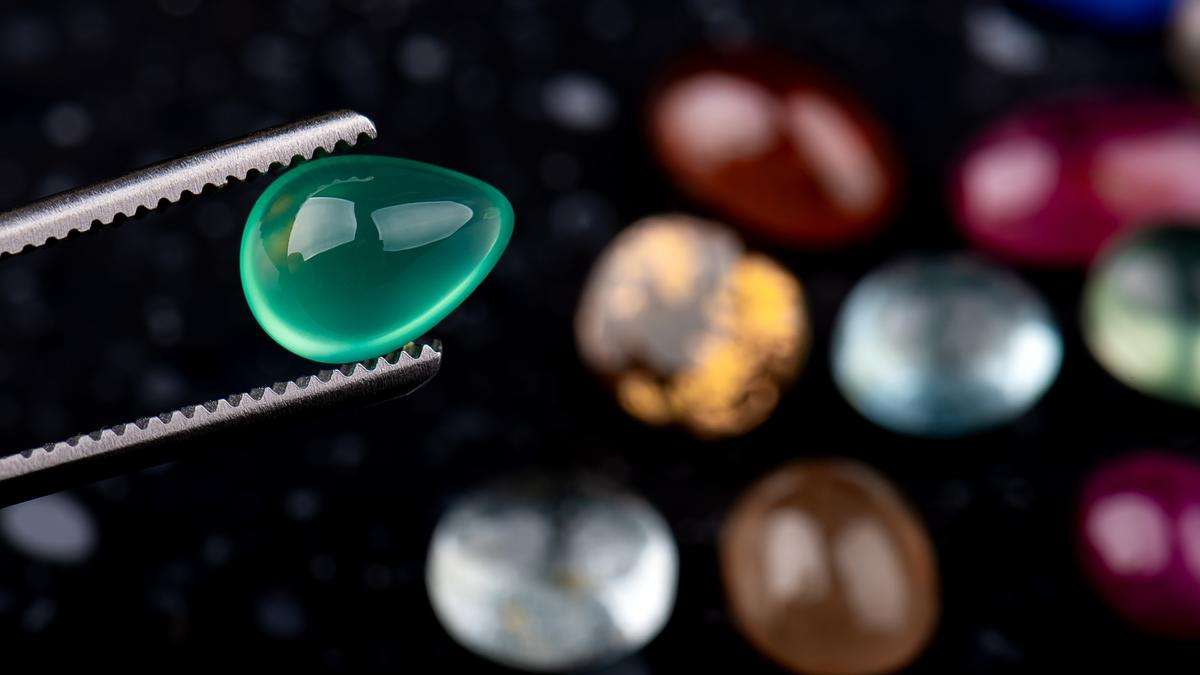
The colours of rubies and emeralds are so striking that they define shades of red and green – ruby red and emerald green. But have you ever wondered how they get those colours?

I am an inorganic chemist. Researchers in my field work to understand the chemistry of all the elements that make up the periodic table. Many inorganic chemists focus on the transition metals – the elements in the middle of the periodic table. The transition metals include most of the metals you are familiar with, like iron (Fe) and gold (Au).

One feature of compounds made with transition metals is their intense colour. There are many examples in nature, including gemstones and paint pigments. Even the colour of blood comes from the protein haemoglobin, which contains iron.

Investigating the colours of compounds containing transition metals leads you into some really amazing science – that’s part of what drew me to study this field.

Rubies and emeralds are great examples of how a small amount of a transition metal – in this case, chromium – can create a beautiful colour in what would otherwise be a fairly boring-looking mineral.

Minerals and crystals

Rubies appear red because they absorb blue and green light. 

Both rubies and emeralds are minerals, which is a type of rock with a consistent chemical composition and a highly ordered structure at the atomic level.

When this highly ordered structure extends in all three dimensions, the mineral becomes a crystal.

With a theory developed by physicists in the 1920s called crystal field theory, scientists can explain why rubies and emeralds have the colours they do. Crystal field theory makes predictions about how a transition metal ion’s structure is affected by the other atoms surrounding it.

Rubies are mainly made up of the mineral corundum, which is composed of the elements aluminium and oxygen in a regular, repeating array. Each aluminium ion is surrounded by six oxygen ions.

Emeralds are mainly made up of the mineral beryl, which is made from the elements beryllium, aluminium, silicon and oxygen. Beryl’s crystal structure is more complicated than corundum’s because of the additional elements in the formula, but each aluminium ion is again surrounded by six oxygen ions.

Pure corundum and beryl are colourless. The brilliant colours of rubies and emeralds come from the presence of very small amounts of chromium. The chromium replaces about 1% of the aluminium in the corundum or beryl crystal when a ruby or emerald forms underground at a high temperature and pressure.

But how can one element – chromium – create the red colour of a ruby and green colour of an emerald?

Colour science

Rubies and emeralds have the colours they do because, like many substances, they absorb some colours of light. Most visible light, like sunlight, is composed of all the colours of the rainbow: red, orange, yellow, green, blue, indigo and violet. These colours make up the visible light spectrum, which is easy to remember as ROY G BIV.

One of the main reasons why objects have a colour is because they absorb one or more of these visible colours of light. If a substance absorbs, for instance, red light, it means that the red light gets trapped in the substance and the other colours reflect back to your eyes. The colour you see is the sum of the remaining light, which will be in the green-to-blue range. If a substance absorbs blue, it will look red or orange to you.

Unlike the colourless aluminium ion, the chromium ion absorbs blue and green light when surrounded by the oxygen ions. The red light is reflected back, so that’s what you see in rubies.

In an emerald, even though the chromium is surrounded by six oxygen ions, there is a weaker interaction between the chromium and the surrounding oxygen ions. That’s due to the presence of silicon and beryllium in the beryl crystal. They cause the emerald to absorb blue and red light, leaving the green for you to see.

The ability to tune the properties of transition metals like chromium through changing what is surrounding it is a core strategy in my field of inorganic chemistry. Doing so can help scientists understand the basic science of metal-containing compounds and the design of chemical compounds for specific purposes.

You can take delight in the amazing colours of the gemstones, but through chemistry, you can also see how nature creates those colours using an endless variety of complex structures made with the elements in the periodic table.

Daniel Freedman is the Dean of the College of Science, Technology, Engineering, Mathematics & Management, University of Wisconsin-Stout.This article is republished from The Conversation.

Published – February 05, 2025 02:36 pm IST



Source link

Science Tags:chromium, emeralds, minerals that give colour to common metal, Rubies, science news

Post navigation

Previous Post: Zomato CEO Deepinder Goyal’s hiring update on Chief of Staff post, says ‘Nobody paid anything to work with us’
Next Post: Astronomers spot asteroid that may be heading for the earth

Related Posts

  • Blue Origin pushes back first launch of giant New Glenn rocket Science
  • Researchers find bacteria that can clean up pesticides from soil to enhance crop yield Science
  • Early prediction of preeclampsia using a blood-derived biomarker Science
  • Ganga Hospital Chairman ranked among top 2% of world scientists Science
  • Could the key to how good we are at maths be hidden in our brains? Science
  • Sci-Five | The Hindu Science Quiz: On Indian Scientists Science

More Related Articles

The Science Quiz: Know your gut beyond digestion Science
SpaceX’s Starbase rocket testing facility is changing the landscape of south Texas Science
Data Point | Fly Me to the Moon: A Glimpse into India’s Space Achievements Science
The Science Quiz | Unearthing the science of archaeology Science
Is there an emerging threat of drug-resistant fungal infections? The jock itch case study Science
U.K. to rejoin Europe’s Horizon science programme Science
SiteLock

Archives

  • February 2025
  • January 2025
  • December 2024
  • November 2024
  • October 2024
  • September 2024
  • August 2024
  • July 2024
  • June 2024
  • May 2024
  • April 2024
  • March 2024
  • February 2024
  • January 2024
  • December 2023
  • November 2023
  • October 2023
  • September 2023
  • August 2023
  • July 2023
  • June 2023
  • May 2023
  • April 2023
  • March 2023
  • February 2023
  • January 2023
  • December 2022
  • November 2022
  • October 2022
  • September 2022
  • August 2022
  • July 2022
  • June 2022
  • May 2022

Categories

  • Business
  • Nation
  • Science
  • Sports
  • World

Recent Posts

  • Mohammad Rizwan Bashed For Huge Blunder In Tri-Series Final: “Mind-Boggling Decision To…”
  • The Hindu Morning Digest, February 16, 2025
  • The Hindu Morning Digest, February 16, 2025
  • Air Force Official On New Delhi Station Stampede
  • Australia to put two-year ban on foreigners buying existing homes amid housing crunch

Recent Comments

  1. dfb{{98991*97996}}xca on UP Teacher Who Asked Students To Slap Muslim Classmate
  2. "dfbzzzzzzzzbbbccccdddeeexca".replace("z","o") on UP Teacher Who Asked Students To Slap Muslim Classmate
  3. 1}}"}}'}}1%>"%>'%> on UP Teacher Who Asked Students To Slap Muslim Classmate
  4. bfg6520<s1﹥s2ʺs3ʹhjl6520 on UP Teacher Who Asked Students To Slap Muslim Classmate
  5. pHqghUme9356321 on UP Teacher Who Asked Students To Slap Muslim Classmate
  • Top Kerala news Developments today Nation
  • Screaming Delta Passenger Jumps Behind Check-In Counter, Dodges Police World
  • Benjamin Netanyahu Warns As Iran, Hezbollah Vow Revenge World
  • Drop Jasprit Bumrah Or Mohammed Siraj: Ex-India Star Advocates For This Pacer vs Bangladesh Sports
  • Missing Man’s Body Found In UP, Deep Cuts On Neck, Private Parts: Cops Nation
  • Union Budget 2025: A much-needed fillip to shipbuilding Business
  • Violent Attack On Cows In Bengaluru Sparks Outrage, Chief Minister Orders Probe Nation
  • Prajwal Revanna Not Given Political Clearance For Germany Visit: Centre Nation

Editor-in-Chief:
Mohammad Ariff,
MSW, MAJMC, BSW, DTL, CTS, CNM, CCR, CAL, RSL, ASOC.
editor@artifex.news

Associate Editors:
1. Zenellis R. Tuba,
zenelis@artifex.news
2. Haris Daniyel
daniyel@artifex.news

Photograher:
Rohan Das
rohan@artifex.news

Artifex.News offers Online Paid Internships to college students from India and Abroad. Interns will get a PRESS CARD and other online offers.
Send your CV (Subjectline: Paid Internship) to internship@artifex.news

Links:
Associate Journalism
About Us
Privacy Policy

News Links:
Breaking News
World
Nation
Sports
Business
Entertainment
Lifestyle

Registered Office:
72/A, Elliot Road, Kolkata - 700016
Tel: 033-22277777, 033-22172217
Email: office@artifex.news

Editorial Office / News Desk:
No. 13, Mezzanine Floor, Esplanade Metro Rail Station,
12 J. L. Nehru Road, Kolkata - 700069.
(Entry from Gate No. 5)
Tel: 033-46011099, 033-46046046
Email: editor@artifex.news

Copyright © 2023 Artifex.News Newsportal designed by Artifex Infotech.