



Skip to content
  • Facebook
  • X
  • Linkedin
  • WhatsApp
  • Associate Journalism
  • About Us
  • Privacy Policy
  • 033-46046046
  • editor@artifex.news
Artifex.News

Artifex.News

Stay Connected. Stay Informed.

  • Breaking News
  • World
  • Nation
  • Sports
  • Business
  • Science
  • Entertainment
  • Lifestyle
  • Toggle search form
  • WHO Felicitates India For Eliminating Trachoma As Public Health Problem Nation
  • SRH SWOT Analysis, IPL 2024: Can Pat Cummins Change SunRisers Hyderabad’s Fortunes In 2024? Sports
  • India defeat to New zealand in second Test opens up race for WTC final spot Sports
  • Hamas claims responsibility for deadly bomb attack on Tel Aviv World
  • Can we make black holes reveal themselves in echoes of light? Science
  • 14 Killed After Heavy Overnight Rain Triggers Floods In Uttarakhand, Kedarnath Yatra Halted Nation
  • KKR performing so well only because of Gambhir: Ramandeep Sports
  • Constitution Debate To End Impasse? Key Details In Big BJP, Congress Face-Off Nation

The kind of jobs needed for the ‘Viksit Bharat’ goal

Posted on February 3, 2025 By admin


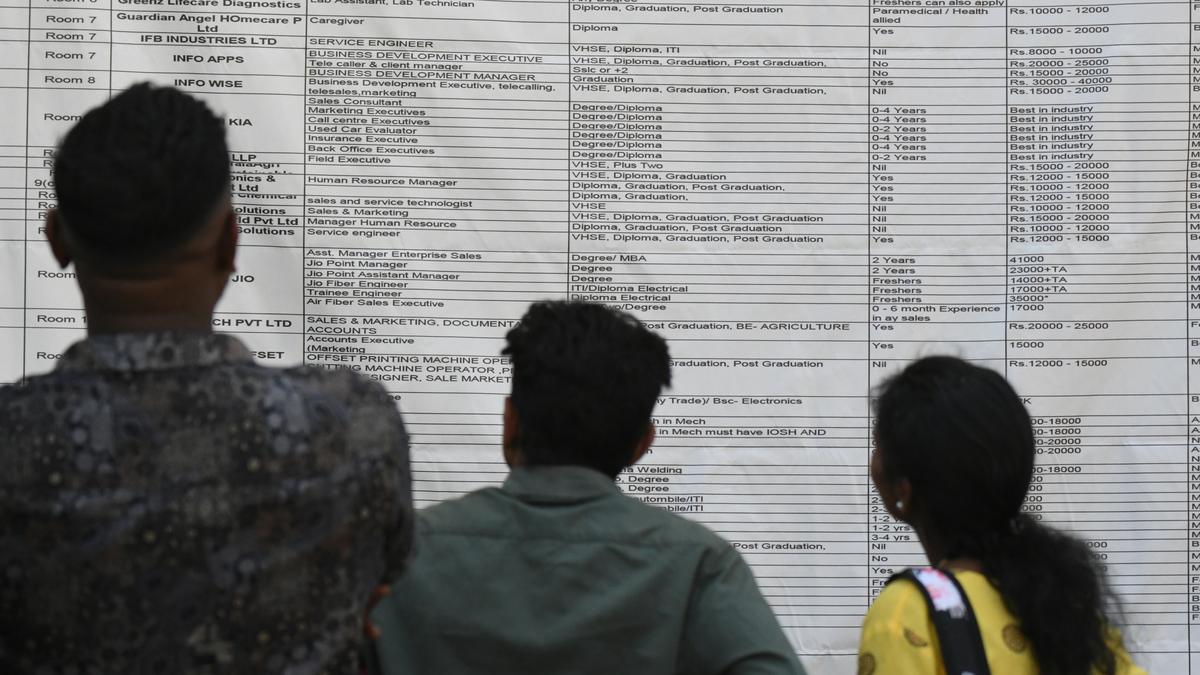
At a job fair in Kochi, Kerala, in 2023
| Photo Credit: The Hindu/THULASI KAKKAT

The Union Budget has been presented, and this is the right time to outline the three kinds of jobs this writer believes India must create. Beyond reviving private consumption in urban areas, we must continue to strengthen long-term job creation and real wage growth across India.

The 2024 Budget had introduced Employment Linked Incentives (ELI) under the Prime Minister’s five-scheme initiative, designed to create over four crore jobs over five years with a central outlay of ₹2 lakh crore. The Prime Minister’s internship scheme saw significant traction in 2024, with 6.21 lakh applications for 1.27 lakh opportunities. The outcomes on the rest four — beyond a draft Cabinet note on ELI and meetings by DPIIT with the Ministry of Labour and CII, remain to be seen. But there must be more deliberation on the kind of jobs we wish to create for a Viksit Bharat.

Impact of climate change

First, climate-resilience. India was the seventh most-affected country by climate change in 2019, having suffered an income loss of $159 billion in 2021, and according to the Reserve Bank of India, will face adaptation costs of nearly $1 trillion by 2030. The impact on agricultural and labour productivity and also livelihoods requires exponentially higher levels of funding for building rural and urban adaptation capabilities and the rejuvenation of local ecosystems to boost job creation.

To meet the net-zero targets by 2070, the Government must create and incentivise jobs which are “climate-resilient” by maximising all “co-benefits” (IPCC). This could mean providing three to four state-subsidised e-rickshaws in about 6,00,000 villages to create about two million jobs (focused on women drivers), also improving last-mile mobility. Or, there can be new ways to enable private investment in compressed biogas plants to bridge the gap of 82 plants set-up versus the target of 5,000 set (for FY23-24) in 2018. Or, even accelerating achieving the 500GW non-fossil energy capacity target to create over one million jobs, with stronger support for decentralised and rooftop solar which can be seven times more labour-intensive (CEEW).

On AI resilience

Second, Artificial Intelligence (AI)-resilience. With the rise of generative AI, numerous jobs now have 50-plus% automation potential. Scenarios by McKinsey Global Institute show that 50% of automation adoption in India can happen in the next 10 years. India’s IT and business services, which comprised 70-plus% of services exports (Economic Survey 2021), hope to create millions of skilled talent exports. But their employment potential can be limited in the gen AI-era as labour gets costlier relative to capital. With the launch of metaGPT simulating software companies, AI writing 25% of Google’s code, and layoffs due to chatbots even in India, new jobs will also need to prioritise physical engagement and utilise our human ‘creativity’, which this writer terms as AI-resilience. This can take the form of larger education and health budgets to plug the deficit of millions of healthcare professionals and teachers across states or dedicated financing for the National Rural Livelihood Mission to facilitate global and urban market linkages of local products, crafts, and knowledge of farmers and artisans in rural India.

Being aspiration-centric

Third, being aspiration centric. Despite their growing engagement with the startup culture, rural youth continue to have low confidence due to deeper insecurities from poor foundational education (this includes English) and resource-deprived upbringing. This can reinforce dependency on government jobs and ‘coaching’ to ‘crack’ entrance exams. As their aspirations are shaped by their socio-economic backgrounds, digital media, and interaction of the ‘Samaaj, Sarkaar, and Bazaar’, the slow growth of non-farm jobs warrants off-farm job-creation which responds to these dynamic aspirations.

This can take the form of rapid infrastructure development such as building around 70,000 integrated pack-houses, plugging the 95-plus% infrastructure gap, to create over two million jobs. Or, boosting productivity and value-addition for high import/export-share items and tech-enabled local manufacturing of agri-inputs. Greater use of tech, social media, and rebranding the ‘rural’ can also help make off-farm jobs aspirational for India’s youth. One clear avenue is accelerating the ‘National Mission on Edible Oils – Oilseeds’ to reduce India’s 57% import-dependence of edible-oil back to the pre-WTO levels with the revitalised rural processing of native oilseeds like soybean, sunflower (about 40% of edible-oil imports), and boosting retail of in-vogue cold-pressed oils. Enabling creation of many such large-scale businesses with private-public partnerships and investments, can address economic aspirations of our disheartened youth protesting examination leaks and low recruitment vacancies.

While tax relief may temporarily boost urban consumer demand, amidst growing household indebtedness and suboptimal private investment trends, the Centre can demonstrate greater commitment for long-term structural reforms which create these climate-resilient, AI-resilient and aspiration-centric jobs. Many opportunities exist as we embark towards our shared vision of a Viksit Bharat.

Saubhagya Raizada is an independent policy researcher based in Delhi and has a Masters in Public Policy from the Blavatnik School of Government, University of Oxford

Published – February 04, 2025 12:08 am IST


Source link

Business Tags:adaptation costs, Employment Linked Incentives under the Prime Minister’s five-scheme initiative, impact on agricultural and labour productivity, jobs and automation potential, National Mission on Edible Oils – Oilseeds, National Rural Livelihood Mission, off-farm jobs aspirational for India’s youth, Prime Minister's Internship Scheme, private investment in compressed biogas plants, rebranding the rural, rejuvenation of local ecosystems to boost job creation., Reserve Bank of India, reviving private consumption in urban areas, rise of generative AI, rural and urban adaptation capabilities, rural youth and poor foundational education, Union Budget and kinds of jobs for India

Post navigation

Previous Post: Amid global tumult, Rupee breaches 87 against dollar
Next Post: Some wind behind the sails of India’s shipping industry

Related Posts

  • Public sector Oil Marketing Companies (OMCs) have slashed the price of 19 kg commercial LPG gas cylinders by ₹158. The new prices will be effective from today. In Delhi, the retail price of the 19 kg commercial LPG cylinder will be ₹1,522 Business
  • Indian firms flock to AI notetakers for online meetings Business
  • Stock Market Today: Sensex, Nifty climb in early trade in special trading session Business
  • Rupee falls 17 paise to 83.23 against U.S. dollar Business
  • Union Budget 2024: Stock markets crash during Union Budget presentation Business
  • ‘Debt market in India remains undercapitalised; risky borrowers unable to tap market’ Business

More Related Articles

STT, PIT spikes lift net direct tax receipts 22.5% Business
Hostel accommodation to attract 12% GST: AAR Business
Electric two-wheeler adoption in India rising, 13% share expected by 2026-27: Jefferies report Business
Rupee falls 11 paise to close at all-time low of 83.62 against U.S. dollar Business
Granules shares gain over 5% on U.S. FDA nod for ADHD generic capsules Business
Rupee falls 8 paise to 83.95 against U.S. dollar in early trade Business
SiteLock

Archives

  • February 2025
  • January 2025
  • December 2024
  • November 2024
  • October 2024
  • September 2024
  • August 2024
  • July 2024
  • June 2024
  • May 2024
  • April 2024
  • March 2024
  • February 2024
  • January 2024
  • December 2023
  • November 2023
  • October 2023
  • September 2023
  • August 2023
  • July 2023
  • June 2023
  • May 2023
  • April 2023
  • March 2023
  • February 2023
  • January 2023
  • December 2022
  • November 2022
  • October 2022
  • September 2022
  • August 2022
  • July 2022
  • June 2022
  • May 2022

Categories

  • Business
  • Nation
  • Science
  • Sports
  • World

Recent Posts

  • Mohammad Rizwan Bashed For Huge Blunder In Tri-Series Final: “Mind-Boggling Decision To…”
  • The Hindu Morning Digest, February 16, 2025
  • The Hindu Morning Digest, February 16, 2025
  • Air Force Official On New Delhi Station Stampede
  • Australia to put two-year ban on foreigners buying existing homes amid housing crunch

Recent Comments

  1. dfb{{98991*97996}}xca on UP Teacher Who Asked Students To Slap Muslim Classmate
  2. "dfbzzzzzzzzbbbccccdddeeexca".replace("z","o") on UP Teacher Who Asked Students To Slap Muslim Classmate
  3. 1}}"}}'}}1%>"%>'%> on UP Teacher Who Asked Students To Slap Muslim Classmate
  4. bfg6520<s1﹥s2ʺs3ʹhjl6520 on UP Teacher Who Asked Students To Slap Muslim Classmate
  5. pHqghUme9356321 on UP Teacher Who Asked Students To Slap Muslim Classmate
  • Lebanon’s Hezbollah says it launched rocket targeting Mossad base near Tel Aviv World
  • Ukraine says Russia attacked its critical infrastructure with 19 drones World
  • Bill Clinton hospitalised with fever but in good spirits, spokesperson says World
  • PMI signals factory activity eased a tad in July; price pressures mount Business
  • PM Modi On Cricket’s Inclusion In 2028 Olympics Nation
  • Bangladesh Pacer Gives Fiery Send-Off To Virat Kohli During Super 8 Game – Watch Sports
  • Virat Kohli, Anushka Sharma Spotted Strolling In Melbourne Ahead Of Boxing Day Test – Watch Sports
  • 4 Arrested For Trafficking Indians To Ukraine War Zone Nation

Editor-in-Chief:
Mohammad Ariff,
MSW, MAJMC, BSW, DTL, CTS, CNM, CCR, CAL, RSL, ASOC.
editor@artifex.news

Associate Editors:
1. Zenellis R. Tuba,
zenelis@artifex.news
2. Haris Daniyel
daniyel@artifex.news

Photograher:
Rohan Das
rohan@artifex.news

Artifex.News offers Online Paid Internships to college students from India and Abroad. Interns will get a PRESS CARD and other online offers.
Send your CV (Subjectline: Paid Internship) to internship@artifex.news

Links:
Associate Journalism
About Us
Privacy Policy

News Links:
Breaking News
World
Nation
Sports
Business
Entertainment
Lifestyle

Registered Office:
72/A, Elliot Road, Kolkata - 700016
Tel: 033-22277777, 033-22172217
Email: office@artifex.news

Editorial Office / News Desk:
No. 13, Mezzanine Floor, Esplanade Metro Rail Station,
12 J. L. Nehru Road, Kolkata - 700069.
(Entry from Gate No. 5)
Tel: 033-46011099, 033-46046046
Email: editor@artifex.news

Copyright © 2023 Artifex.News Newsportal designed by Artifex Infotech.