





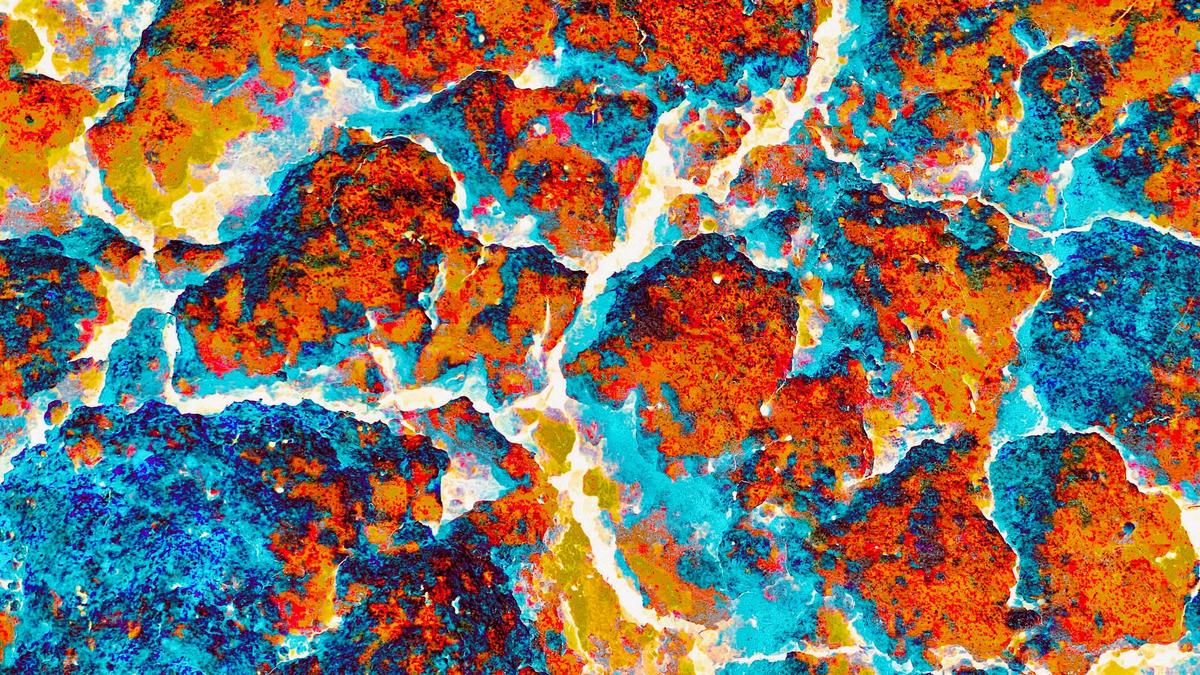
Cracks in paint coatings could soon become a thing of the past. In a new study, researchers from the Raman Research Institute (RRI) in Bengaluru have found a way to delay the onset of cracks after studying them in great detail.
As playful as this sounds, the technique has potential applications in diagnosing diseases and checking whether food has spoiled.
In general, cracks are ubiquitous, even a part of life. They adorn old flower vases, the outer surfaces of buildings that have suffered both hot summers and chill winters, streams of cooling lava, the ground when it has become sapped of moisture, even the scaly heads of reptiles like crocodiles. But how often do we stop and take a closer look?
Cracks may appear simple but they’re formed as the result of a complex phenomenon. In older studies, scientists have found that new cracks always meet an older one at 90o — except in a very thin layer of drying paint, where they prefer an angle of 120o instead. Perhaps you’d like to pick up a magnifying glass, a protractor, and go take a look.
From clay to chicken nuggets
In the new study, researchers Vaibhav Parmar, a PhD student, and professor Ranjini Bandyopadhyay of the Soft Condensed Matter group at RRI examined how the elasticity of clay changed as it dried, slowly changing from a flowing liquid to a thick yet soft solid to a brittle sheet. A more elastic solid will more readily return to its original shape after it is distorted in some way.
The duo discovered a relationship between the elasticity of clay and how quickly cracks emerged in it. Using this relationship, they concluded that they could predict when cracks would develop based on the initial thickness of the sample and its elasticity.
The beauty of an equation is if its left-hand side equals its right-hand side, the reverse is true as well. That is, the researchers found they could delay the onset of cracks by tuning the elasticity. They were able to do the latter by mixing different additives into the clay.
When it was common salt, the cracks emerged faster than when they added a food additive called tetrasodium pyrophosphate (TSPP). TSPP is found in foodstuffs like chicken nuggets, marshmallows, and meat and egg alternatives, and as a thickening agent in toothpastes. Indeed, the duo hit a eureka moment when TSPP was found to significantly delay the birth of cracks in clay.
Their findings were published in a paper in the journal Physics of Fluids in November 2024.
Here a crack, there a crack
An immediate application of their findings is a way to make paint coatings resistant to cracks. Manufacturers generally add clay to their paints and coating liquids to give them a thicker consistency. The new study suggests they can improve their products’ crack-resistance by adding clay of a certain elasticity to the liquid at the time of their manufacture itself.
In fact, the findings could apply almost anywhere that cracks make an appearance.

“Just like clay, milk and blood are made of tiny particles in a liquid, and they behave in similar ways when they dry,” Kirti Chandra Sahu, a professor in the Department of Chemical Engineering at IIT Hyderabad, said. “The same principles about how cracks form could help study drying patterns in these materials. For example, crack patterns could reveal structural changes in protein networks, like in milk or clot formation in blood.”
Clay, milk, blood, and paint are all colloids: a mixture in which small insoluble particles of one type are dispersed in a liquid of another type. Sahu, who wasn’t involved in the RRI study, asserted that its findings could be applied to all colloids beset by cracks.
“Adulterants might affect the milk’s properties, creating unique drying patterns or crack formations. The study’s approach could help identify [the] changes by comparing the drying patterns of pure and adulterated milk,” he said. “It’s a smart and straightforward method to test milk quality.”
“Blood from patients with conditions like anaemia … displays distinct differences in red blood cell count, shape, and rigidity compared to the blood of healthy individuals,” Bandyopadhyay, one of the study’s coauthors, said. “Any change in red blood cell characteristics will change the crack patterns left behind on a substrate after a drop of blood has dried completely.”
‘Significant potential’
She added that a machine-learning model that has been taught to distinguish between various crack patterns in dried blood could also discriminate between the blood of a person before and after intense exercise “with 95% accuracy”.
Yet another potential application of the findings is in the study of how old paintings have been restored over time. Like drying clay, such paintings develop a network of fine cracks over time called the craquelure. By understanding how environmental and mechanical factors affect the craquelure, experts could better conserve valuable works of art.

With so many applications, Sahu said the study seems to deepen our understanding of material properties. “This research advances our understanding by linking the internal structure, mechanical properties, and cracking behaviour of aging colloidal materials,” he said, adding that the findings “have significant potential for … enhancing our understanding of the behaviour of soft materials”.
The duo at RRI also has more work planned. The paint applied on a building undergoes significant changes in temperature and humidity every day. The researchers intend to perform controlled experiments in which they vary these parameters and study how the formation of cracks changes accordingly.
“We [also] want to confirm the validity of the proposed relationship experimentally in other materials, such as in cornstarch, toothpaste and ketchup,” Bandyopadhyay said.
Unnati Ashar is a freelance journalist.
Published – February 03, 2025 05:30 am IST