



Considering the ten earlier Budgets of the BJP-led government led by Prime Minister Narendra Modi, there is nothing much that the farmers and agricultural workers of India can expect from the coming Union Budget 2025 (eleventh) except more vicious attacks on their livelihood, made under the smokescreen of high-sounding phrases about their welfare.
Dismal record
To put it bluntly, it is now crystal clear that all the earlier Budgets of the Modi regime have fattened a handful of crony domestic corporates and international finance capital and have squeezed all sections of the working people, farmers and agricultural workers in particular.
Union Budget 2025: Facts related to the Budget as FM Nirmala Sitharaman aims to make history with 8th consecutive presentation
The ascension of the aggressive Donald Trump to the U.S. Presidency will further increase the imperialist pressures on all sectors of the Indian economy, including agriculture.
The last Union Budget of July 2024 had slashed food subsidy by ₹7,082 crore and fertilizer subsidy by a whopping ₹24,894 crore! The Mahatma Gandhi National Rural Employment Guarantee Act (MGNREGA) allotment of ₹86,000 crore was less than the amount actually spent the previous year. Overall allocations for agriculture and the allied sectors declined from 5.44% in 2019 to 3.15% in 2024.
All these disastrous steps are being taken despite the National Crime Records Bureau’s (NCRB) data, which tells us that 1,00,474 farmers and agricultural workers committed suicide in the eight years of the Modi regime, between 2015 and 2022. Similarly, the Global Hunger Index 2024 reveals that India ranks towards the bottom — 105th out of 127 countries. These figures are a stark and tragic indication of India’s agrarian crisis.
Two pro-corporate dangers
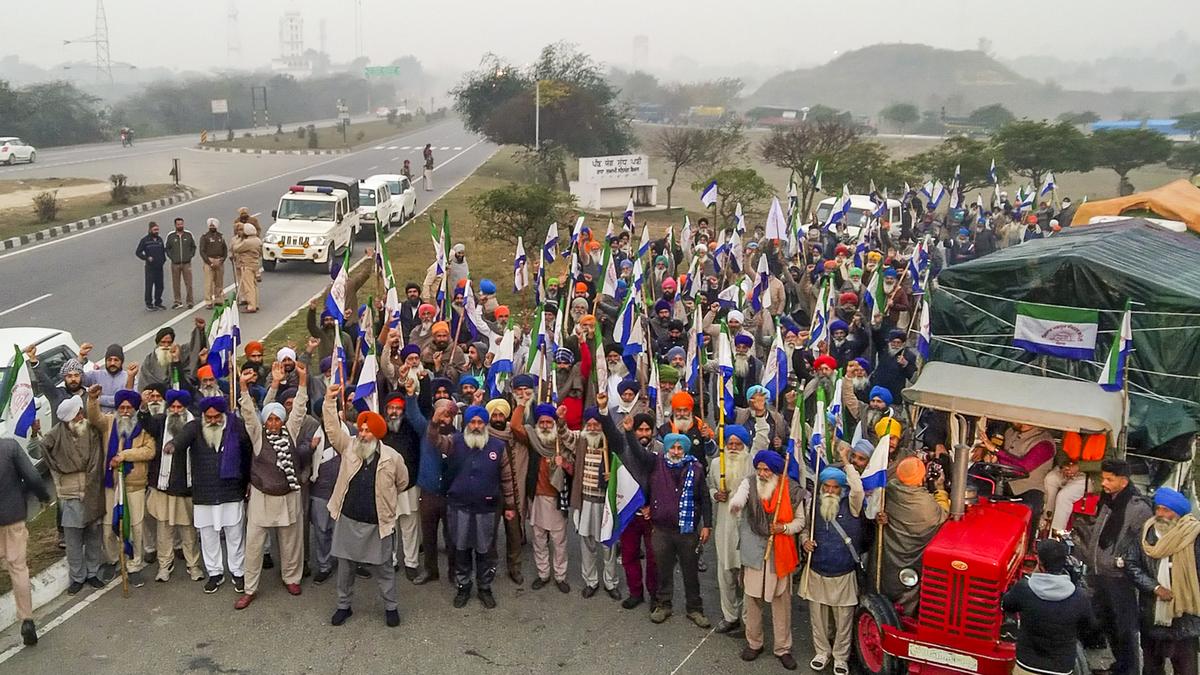
As an ominous curtain raiser to the 2025 Budget, the Modi regime on November 25, 2024 unveiled the Draft “National Policy Framework on Agricultural Marketing (NPFAM)”. The NPFAM aims to smuggle in through the back door some key pro-corporate provisions of the three controversial Farm Laws, which the Central Government was forced to repeal after the iconic year-long farmers’ struggle led by the Samyukta Kisan Morcha (SKM) in 2020-21. There have already been large countrywide farmers’ protests against the NPFAM in December and January. The primary demand of farmers is that the NPFAM must be withdrawn forthwith.
Union Budget 2025: When and where to watch
The Central Government has decided to notify and implement the four hated Labour Codes from April 2025. Taking advantage of the COVID-19 pandemic, these anti-worker and pro-corporate Labour Codes were rammed through Parliament in September 2020, just after the three Farm Laws. However, owing to stiff resistance of the working class, they could not be implemented for the past five years. A massive struggle, including a general strike called by the Central Trade Unions (CTU), is on the cards against the Labour Codes implementation. They must be repealed, like the Farm Laws.
Demand for MSP and loan waiver
The first and most vital issue for farmers in the country today is statutory Minimum Support Price (MSP) at the rate of C2+50%, which is one and a half times the comprehensive cost of production, as recommended by the Dr. M.S. Swaminathan-headed National Commission on Farmers in 2006. The violation of this recommendation is one of the principal reasons for indebtedness, farm suicides and distress land sales. Most farmers do not get any MSP at all, and are at the mercy of private traders who fleece them mercilessly. They cannot even recover their production costs. MSP was a promise made by Narendra Modi and the Bharatiya Janata Party (BJP) manifesto in 2014. Now, they maintain a deafening silence on this. But, unless that is done, it is going to be impossible even to begin to resolve the agrarian crisis. They will have to make Budgetary provisions to implement this.
Explained | Will a hike in MSP help farmers
The second issue is the rising cost of production. The rates of all agricultural inputs are rising rapidly. Farmers’ demand from this year’s Budget is that the government bring down the prices of fertilizers, seeds, insecticides, diesel, water and electricity. If farmers are to be given MSP at C2+50%, the cost of production must be substantially reduced.
The government can bring down these prices by imposing strict controls through the Budget on the corporates who are now the main producers of these inputs. Earlier, most of these inputs were produced by the public sector. The Budget must support public sector companies in the production of fertilizers, seeds, and insecticides. This government talks of self-reliance, but does nothing to improve self-reliance. This is apparent in the case of fertilizers. The Budget must also sharply increase subsidies for inputs and outlays on agriculture and allied sectors.
The third demand from this Budget is a complete one-time loan waiver by the Central Government for all poor and middle farmers and agricultural workers. Unless this is done, farm suicides and land alienation cannot be prevented. Partial loan waivers were given by the Central Government in 1990 and 2008. The Modi regime has written off loans of its crony corporate friends worth ₹14.46 lakh crore in the last ten years. But not a single paisa of farm loans has been waived, in spite of the alarming and rising farm suicides.
The pro-corporate credit policy of the neo-liberal era, which is heavily tilted against poor and middle farmers and agricultural workers, must be radically overhauled. That is the only way to eliminate the dependence of the peasantry on usurious private money-lenders. Loan waiver, bringing down the cost of production, and ensuring MSP at a rate of C2+50% must be done together. If done, the bulk of the crisis in the farm sector can be dealt with.
Crop insurance, irrigation, power
The fourth issue is relevant in the context of climate change. In the light of regular droughts, floods, unseasonal rains and hailstorms, there must be a comprehensive crop insurance scheme, which is totally different from the bankrupt Pradhan Mantri Fasal Bima Yojana (PMFBY). Several States have opted out of it. Some States have begun their own schemes. This is because PMFBY is clearly working in the interests of insurance companies and not farmers. Budgetary provision must be made for a comprehensive insurance scheme that helps farmers.
The fifth point is the question of irrigation and power. Public sector investment in irrigation and power has been cut sharply in the last decade. These sectors are being handed over to private companies and hence, the cost of water and power is rising. The private sector cannot invest the monies a government can, for example, in building dams and canals. The question of irrigation must be addressed by the Union Government. A number of irrigation projects are incomplete nationwide. If they are completed, a large section of land will come under irrigation. Hence, the Budget must make provisions to complete these irrigation projects.
In the power sector too, without public investment, it will be difficult to ensure steady and cheap supply of electricity. Power production is now largely under the control of monopoly corporate houses such as Adani, Ambani, Tata, etc. Smart meters are going to create havoc for all consumers, both rural and urban. Working class struggles are opposing privatisation of power.
MGNREGA and land issues
The sixth issue is about the expansion of MGNREGA. Ever since the Modi Government came to power, it has been trying to starve MGNREGA of funds. The average number of work days per year has come down to just 45, instead of the mandatory 100. The government must increase MGNREGA wages to ₹600 and the number of work days to at least 200. It is a lifeline for rural and agricultural workers and this will help to increase their purchasing power.
The seventh point, which is crucial, is the question of land. The BJP government has in practice changed the slogan of ‘Land to the Tiller’ to ‘Land to the Corporates’. In total violation of the Land Acquisition Act, 2013, there is massive acquisition of farm lands by corporate houses. Tribal lands are being taken over by the government and given to the corporates for mining and industry without giving any compensation. Land acquisition must be done only when strictly necessary for public purposes and that too, strictly under the 2013 Act. Radical land reforms must be initiated and completed. The Forest Rights Act (FRA) must be stringently implemented and forest land vested in the names of the tribals who are cultivating it for generations. Women must be given equal share in land and property ownership. Associate modes of production such as cooperatives and collectives must be seriously explored.
Where will the resources come from?
The question is always asked: where will the resources come for all this? The Union Government must impose wealth tax and inheritance tax, which it has consistently refused to do. As per the Forbes List of Billionaires, the number of billionaires in India has increased from 109 in 2014 to 200 in 2025. Their combined wealth is now $ 1.1 trillion. The Oxfam Report on Inequality in India, aptly titled “Survival of the Richest”, says that one percent of the richest Indians own 40.1% of the nation’s wealth, while the lower 50% of the population owns only 3%. India has today become one of the most unequal societies in the world.
The government has also greatly reduced corporate tax. This must be reversed. India is a country with one of the least rates of corporate taxes. Every year, the country is losing ₹1.45 lakh crore owing to cut in corporate taxes. In a shocking development, the Union Government in the 2024-25 Budget is now earning more revenues from income tax (30.9%) than from corporate tax (26.5%). It is reducing income tax across the board, instead of providing relief to the middle class and making the rich pay more. Basically, direct taxes must be increased and indirect taxes reduced. Tax evasion must be stopped by stringent methods.
Farmers want that this government must make a radical and comprehensive break from all its earlier Budgets. This is, of course, a tall order. But unless that is done, the agrarian crisis and farmers’ unrest are not going to subside. And one day, they will boil over!
(Ashok Dhawale is a CPI(M) Polit Bureau memberand the national president of All India Kisan Sabha)
Published – January 31, 2025 12:06 pm IST