






The Indian economy is going through a rough patch as was evident from the recently released provisional estimates of its Gross Domestic Product (GDP). The underlying growth rate is lower than what was expected and estimated by the government earlier. What is surprising is that, as noted in the last Economic Survey, this slowdown is despite the rising capital expenditure in various budgets under this regime. To understand the current predicament of the government, it may help to take a longue duree of the Indian economy. In particular, we focus on private consumption since that is the ultimate driver of the domestic market.
Also Read: Will the FY26 Budget reverse the decline in social sector spending?
We divide the post reform period into three parts — 1991-2004, 2004-2011, and 2011-2023. The period from 2004 to 2011 stands out as the one with sustained high growth rate accompanied by a reduction in absolute poverty. This period also saw some revival in state interventions in welfare through rights-based legislations as well as new national schemes.
In contrast, the most recent period starting from around 2012, but especially since 2019, has seen a slowdown in growth rates with the current concerns in the Indian economy being related to sluggish private consumption as well as private investment. This period also saw some major shocks to the economy including demonetisation, the introduction of the Goods and Services Tax (GST), and the lockdowns during the COVID-19 pandemic. Chart 1 shows the rate of growth of GDP and private consumption over these three periods; and we get inverted U-shaped growth curves in both.
What explains the high growth then and the slowdown now?
Something unique happened during the high growth phase of 2004-2011. While income and wealth inequality were rising for over a decade, this is the only phase in the post-reform period when the share of consumption (out of the total private consumption demand) of the richest 20%, after having risen since 1990, fell significantly. This means that the consumption of the bottom 80% was rising at a faster pace than the richest 20%. But how was this possible when the growth of income was the opposite?

We believe that state policy played a key role in this unique composition of consumption demand. It is not just the amount of fiscal expenditure that matters but its nature as well. Those at the lower end of the income spectrum have a higher propensity to consume as compared to the richest. If state spending tilts in favour of the working class, the income and employment multiplier effects of such spending would be much larger.
To understand this point, let us consider a hypothetical scenario where the government has a choice of spending ₹100 on (A) capital expenditure in commissioning a large scale dam/nuclear project or (B) providing it as National Rural Employment Guarantee Act (NREGA) wages or pension to the elderly. Let us, for simplicity, assume all wages are consumed and all profits saved.
Under choice A, only a part of the ₹100 is received as wages, which increases workers’ consumption demand by that amount. This increase in demand, say on food and clothes, generates income for those employed in producing these commodities and this process, what economists call as multiplier effect, goes on. In contrast, under choice B, the entire ₹100 is received as wages which leads to a larger base on which the income and employment multiplier works.
Additionally, in choice A, there is a likelihood of a greater leakage of demand to the rest of the world in the form of higher imports such a capital expenditure may entail. Heavy machinery required for a dam or a nuclear reactor may have to be imported whereas the import component in choice B will likely be lower. So, the domestic component of choice A’s multiplier might be even lower than what we have described above.
Also Read: Union Budget 2025: When and where to watch
If the state spends as income transfers (whether in cash or kind) a certain amount per worker at the lower end of the income spectrum, this would add to the demand for mass consumption goods. A mere change in the composition of government expenditure in favour of such transfers, therefore, adds an exogenous component to demand. Moreover, the state played an additional role during this period by introducing NREGA and fixing its wages higher than the prevailing market wages. This generated additional jobs as well as set a floor for rural wages. This rise in rural wages pushed up wages for casual unskilled workers. Investment in agriculture and in rural areas in general also increased during this period contributing to rural incomes.
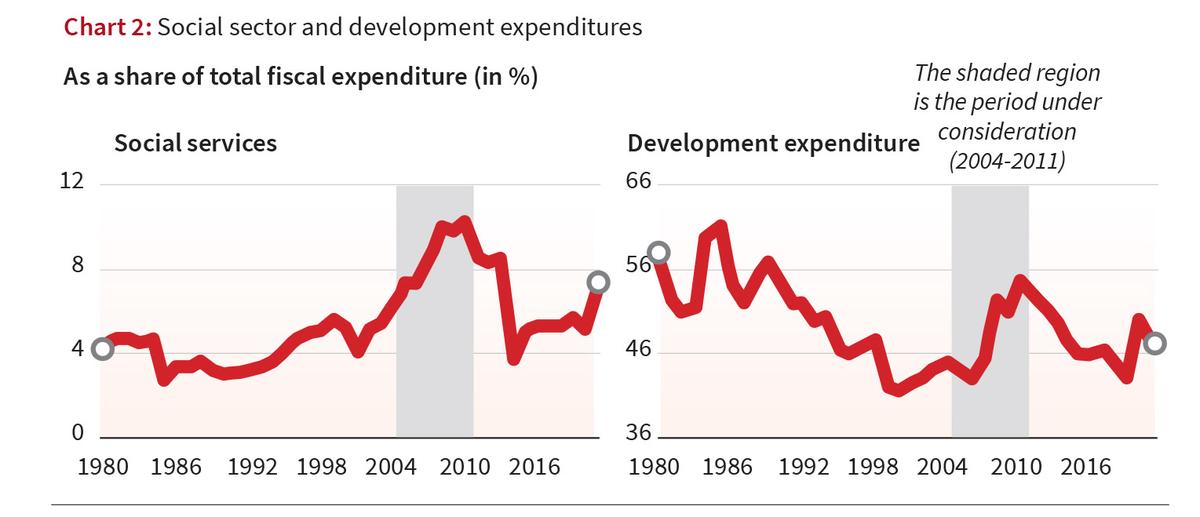
Chart 2 shows a sharp rise in the share of social services expenditure as well as development expenditures out of the total expenditure of the Union government, which exactly overlaps with the boom of 2004-2011. Developmental expenditure includes expenditure on economic as well as social services and therefore also includes the spending on agriculture and rural development, whereas social sector expenditure only includes the direct social sector spending such as education, health and welfare programmes.
Not surprisingly, this change in the nature of fiscal spending had a significant impact on consumption, across different categories of commodities, for the bottom 80% of the population (see Chart 3).
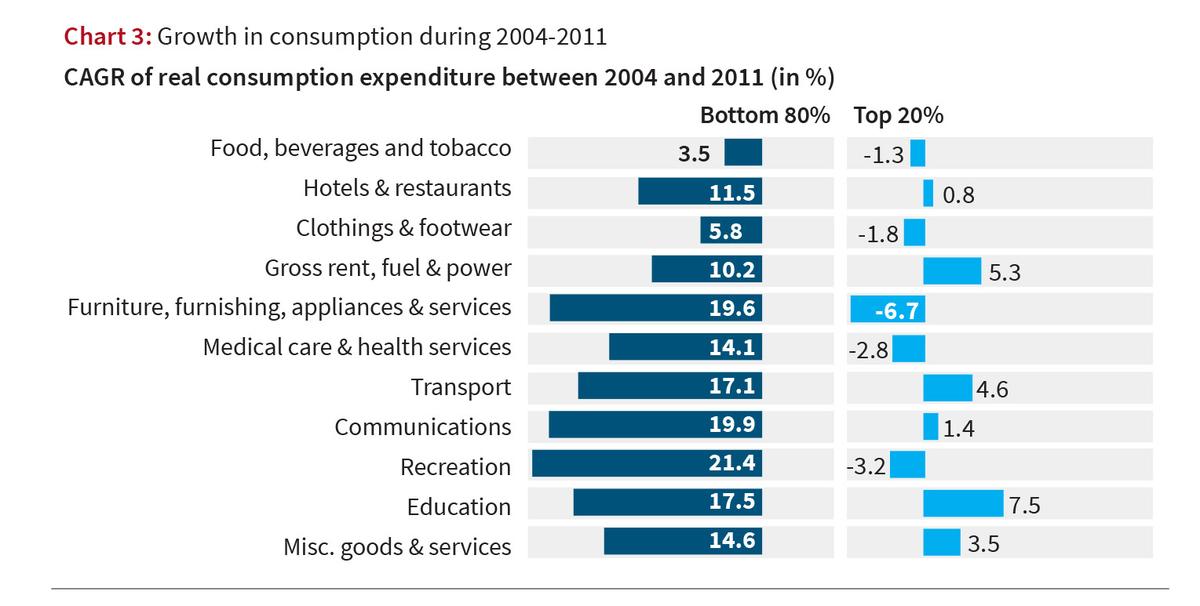
It is this rise in consumption of the bottom 80% (and this trend continues all the way down to the lowest income group as well) in comparison to the top 20% that explains the fall in the latter’s share in total consumption.
What has the government done so far to arrest the current slowdown?
While the government has acknowledged the slowdown and the lack of private investment (for example, in the last Economic Survey), its response has been to focus on capital expenditure of the kind mentioned in choice A as discussed above (see Chart 4).
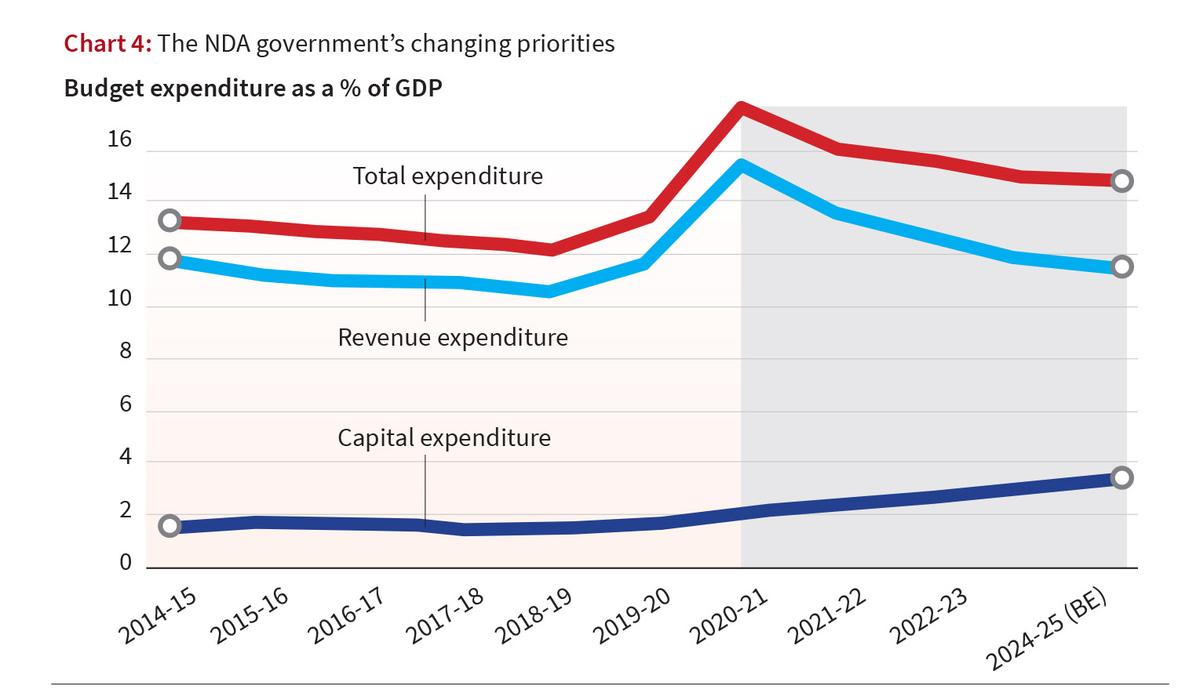
This was done even as the share of fiscal expenditure (as a percentage of GDP) was falling. This exclusive focus on capex was done with the expectation that this would crowd-in private investment but unfortunately the corporate sector has not responded either to this or to the tax cuts from 30% to 22% in 2019.

It is not surprising why private investment has not picked up. Under conditions of slowdown or lack of demand, investment responds more to the level of activity than to cost considerations. If the existing factories are not running to capacity, why would the firms invest more even if they are flush with funds (in the form of post-tax profits) or have access to cheap credit? It won’t be an exaggeration to argue, therefore, that an increase in capex, especially of a capital-using variety, is neither a necessary nor a sufficient condition for revival of the economy.
What should be done instead?
An increase in revenue expenditure, particularly in the social sector, would result in a virtuous cycle of higher income for the workers and therefore to a higher income and employment multiplier, which may kickstart private investment as well. Capital expenditure too must be focused on labour-intensive projects that have a higher multiplier. The experience of 2004-2011 is particularly telling in this regard. What is required, therefore, is a two pronged strategy — (a) fiscal expenditure as a share of GDP has to rise (b) and within that the share of revenue expenditure needs to rise. In other words, a complete reversal in the trend shown in Chart 4.
It remains to be seen on February 1 whether the priority of the government is to placate the markets by keeping such expenses low or to improve the living conditions of the working people of this country to reverse the slowdown.
Dipa Sinha is an independent researcher and Rohit Azad teaches economics at Jawaharlal Nehru University
Published – January 30, 2025 08:30 am IST