



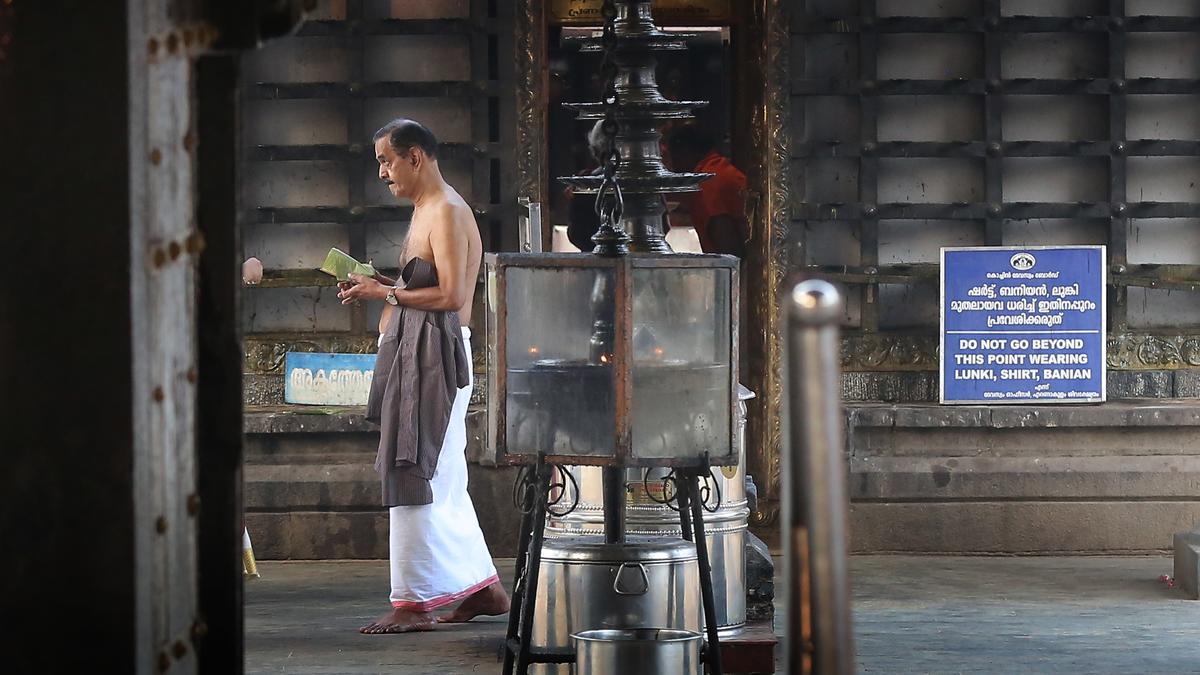
Sugin G. Nair, a 44-year-old interior designer, chants a hymn as he walks down the granite-laid path encircling the Chuttambalam, or outer enclosure, of the Siva temple in Ernakulam. The air is cold and fragrant with the smell of incense.
Nair is dressed in a blue dhoti. His shirt, hung on his right arm, gently flutters in the breeze that wafts in from the backwaters, a network of brackish lagoons and canals lying parallel to the Arabian Sea in Kerala.
A few worshippers, some of them holding flowers and other offerings, follow the chief priest as he carries the idol, adorned with garlands, around the temple in a procession. This daily temple ritual is called Seeveli. Nair stands in prayer as the procession ends before the sanctum sanctorum. He then steps outside the temple and puts on his shirt.
“I won’t break the centuries-old practice of entering temples without upper body clothing even if the temple authorities permit me to wear a shirt. It is my choice not to wear a shirt while I submit myself before a deity,” he says.
In 2017, the Kerala government decided to permit non-Brahmin priests to perform temple rites. Today, another campaign is ongoing in the State. This time, it is about men’s wear in temples.
It began a few weeks ago when Swami Sathchidananda, the religious head of Sree Narayana Dharma Sangham Trust, the organisation leading the spiritual activities of the Ezhavas, who are classified as an Other Backward Class, said that men should be allowed to enter Hindu temples wearing shirts.
His remarks sparked a controversy. Some priests and community leaders got upset, saying temple practices should be left untouched. The call also exposed the deep divide among the major Hindu communities, with the general secretary of the Nair Service Society criticising the suggestion. However, Chief Minister Pinarayi Vijayan supported the call and lauded the campaign. He said it imbibed the spirit of social reformation led by Sree Narayana Guru, the 20th century seer and social reformer.
Pushing for reform
Swami Sathchidananda argues that there are many “undesirable” temple practices that continue to exist even today. “This is one practice which should have long been abandoned,” he says. “Temple rituals and customs need to be reformed to be in tune with the changing times. The argument in favour of removing the shirt was that the divine radiance of temples would be diminished if men wore clothes on the upper part of their body. Hundreds of devotees who reach the hill shrine of Sabarimala and other temples have been wearing clothes on the upper part of their body,” he points out.
Swami Sathchidananda adds that the practice of not wearing a shirt is also “unhygienic”. “Skin diseases could be transmitted through contact,” he says. “The practice of allowing people to rent dhotis and wear them over trousers and salwar in some temples is also abominable.”
The seer contends that the practice of bare-chested men entering temples was introduced to prevent people from ‘lower castes’ from entering temples at a time when only ‘upper castes’ were permitted to enter temples.
“Asking devotees to remove their shirts was the easiest way of identifying who was wearing a poonal (the sacred thread worn by Brahmins across the body) and prevent the lower castes from entering temples,” he argues.
The Jagannatha temple in Thalassery, in the northern district of Kannur, has a special place in the history of the Sree Narayana movement in Kerala, as the idol was consecrated by Sree Narayana Guru himself. Designed to resemble the Puri Jagannatha temple in Puri, Odisha, it was the first place where devotees from all castes were allowed to worship.
K. Sathyan, the president of Jnanodaya Yogam, the managing committee of the Jagannath temple, had tried to implement the committee’s decision to permit men to wear shirts inside the temple two years ago. This attempt failed.
“The decision had to be shelved,” he recalls. “Some were apprehensive that some sections of society would resist this. We didn’t want the temple premises to become a battlefield. So, we decided to keep the decision in abeyance.”
Sathyan says only a “mature society” can accept such social changes. He says no one prevents fully clothed devotees, who are mostly from the southern districts, from entering the Jagannatha temple. “We hope that this practice will gather steam following Swami Satchidananda’s call,” says Sathyan, who had been heading the temple administration panel for three years.
A mark of respect, a matter of faith
However, some historians and temple priests refuse to buy the argument that the practice of men removing shirts was started with the aim of keeping non-Brahmins out of temples.
Historian Manu S. Pillai says it was a common practice in Kerala society to take off the thorthu (the thin long traditional bath towel that is widely used in Kerala) from one’s shoulder and tie it around the waist as a mark of respect to elders, landlords, and others who were ‘superior’ on the social ladder. “It was a way of showing respect. A younger person would never wear a melmundu (upper garment) or thorthu in front of a family elder. Similarly, a peasant would never keep the thorthu on his shoulders while standing before a landlord,” he says.
Temple priests, Brahmins, and even kings took off their upper clothing inside temples as a gesture of obeisance, Pillai says. This practice stems from the belief that god is superior to everybody. Removing upper body clothing is an act of obeisance to the idol, he explains. “The erstwhile Kings of Travancore and Kochi never wore anything above their waist, as can be seen from their photographs and portraits,” he observes.
He is firm that the practice has nothing to do with identifying Brahmins who wear the sacred thread. “Most people belonging to the so-called upper caste, including those employed in temples, did not wear the sacred thread. So, that cannot be the reason for asking men to remove upper body clothing to enter temples,” he reasons.
Also read | Swami Sachidananda’s call on ending shirt removal not a new stance: Vellappally
N. Radhakrishnan Potti, the general secretary of the Akhila Kerala Thanthri Mandalam, the community organisation of Kerala Brahmin priests, defends the practice. He says it has been in vogue for centuries in all the major temples of the State. “It is believed that male devotees absorb the radiance of the idol through their hearts and women through their foreheads. It is a matter of faith for temple worshippers and cannot be tampered with,” he says.
Potti explains how men in Kerala used to cover their torso using an uthareeyam, a piece of thin cloth draped over the body, which they would remove while paying obeisance to gurus and gods. “Such customs may have trickled into temples over the years. It is unique to Kerala,” he says.
Potti cites Kshethracharangal, a book on temple rituals and practices written by Kanippayyur Sankaran Namboodiripad, which lists out practices that men must avoid when they visit temples. “It mentions smearing your hair with ghee and oil and wearing clothes on the upper part of your body, as well as headgear,” he says.
Potti is also clear that the task of initiating reforms and altering practices should be left to senior priests. “It is not an issue to be deliberated by seers and politicians,” he asserts.
Changing with the times
The dress code followed in the temples of Kerala is not uniform. Women were banned from wearing salwars to the Guruvayur temple in the town of Guruvayur; they could only wear sarees. This was until 2013, when the authorities modified the dress code to allow salwars too. They said that this had been a long-pending demand, especially from women who came to the temple from north India, and so they finally agreed to it.
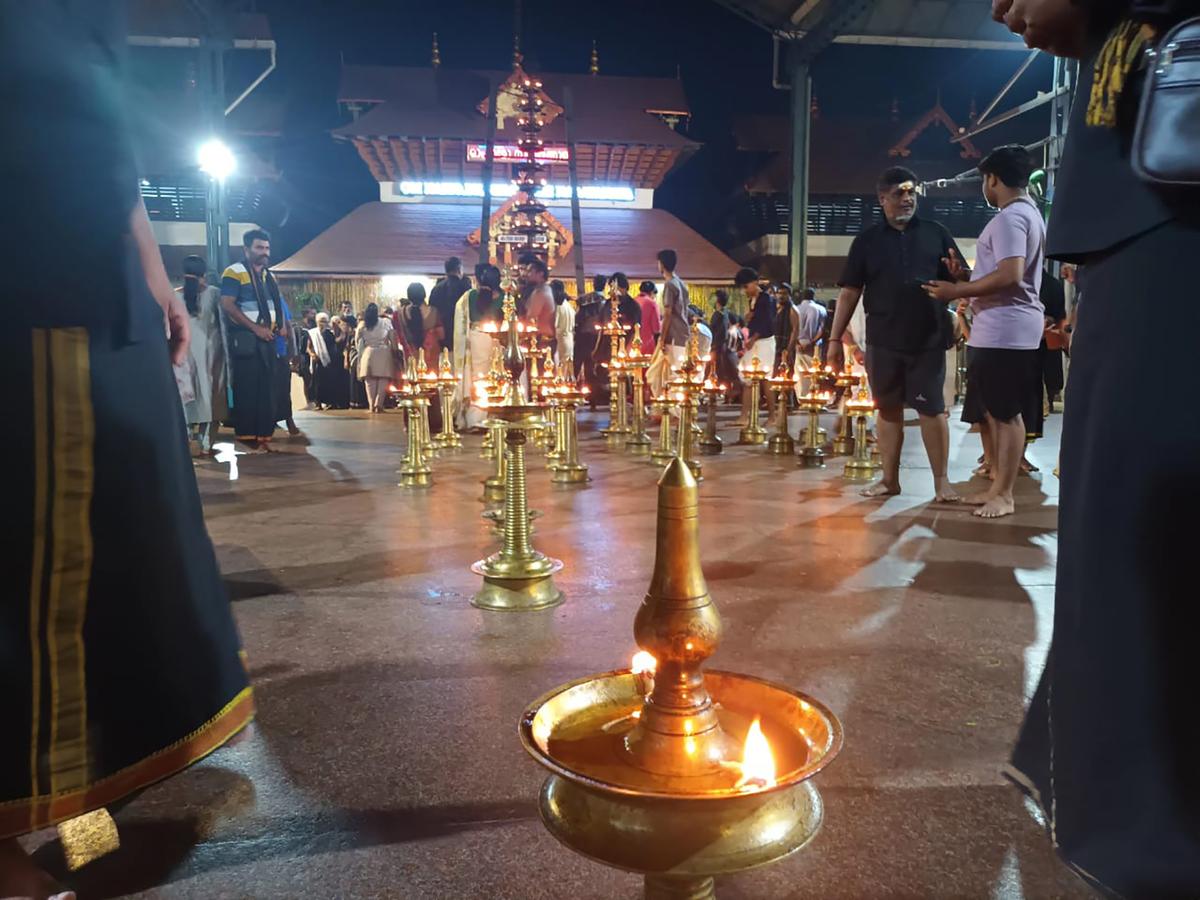
Visitors outside the premises of the Guruvayoor temple premises. Photo: Special Arrangement
Though no dress code has been prescribed for devotees in most of the temples governed by the Travancore Devaswom Board, men are mandated to remove their upper body garments to enter major temples, namely the Karikkakom temple in Thiruvananthapuram and the Ettumanoor temple in Kottayam.
At the Sree Padmanabha temple in Thiruvananthapuram, men are mandated to wear a dhoti and women are expected to wear a sari or the mundu-set. Men who come to the temple in trousers are allowed to rent a dhoti, while women in salwar are allowed to rent a saree, both to be worn over their clothes, from the temple premises before entering the temple.
Vedanta scholar Swami Chidananda Puri has long been campaigning for such restrictions to be lifted. Speaking of how women’s attire changed over centuries, he says, “Women in Kerala never wore clothes on the upper part of their body. Then, Neriyathu (an upper garment) and Mulakacha (cloth worn around the chest) became their attire. Later, blouses were accepted.”
Through this point, Puri underscores how only those religions and practices that have changed with time, to keep in step with societal changes, have thrived. “The dress code of devotees needs to be reformed. The insistence that one should enter temples bare-chested is deterring young men from going to temples. The Marga Darshak Mandal (a platform of Hindu seers) held last year at Thrissur had called for modifying the dress code of men. Now, many temple authorities are making changes in this direction,” he says.
Lekshmy Rajeev, author and a researcher on temple tantra, says women had to fight for their right to cover their breasts in Kerala, whereas men never protested about wearing clothing. “I believe this practice of not wearing sufficient clothing evolved into a ritual over time,” she says.
Rajeev also says not all men may feel comfortable displaying their torsos. “Men are forced to display their bodies publicly, which can make them feel uncomfortable and uneasy,” she says.
Arayakkandi Santhosh, the Devaswom Secretary of Sree Narayana Dharma Paripalana Yogam, a social service organisation representing the Ezhavas, says the Yogam has always stood for reformative practices. “The managing committees of a few temples have recently resolved to abolish the practice and update the dress code. Temple committees stick to customary practices to avoid conflicts. However, men are free to wear shirts at the newly consecrated Guru temples,” he says.
The controversies surrounding the dress code have only helped Mukkoli Raveendran, a social activist and a follower of Sree Narayana Guru, strengthen his resolve about temple wear. “I will offer my prayers at a temple only when I am allowed to enter wearing a shirt. It has been five years since I prayed at a temple as a mark of protest against the dress code,” says Raveendran, who is also a member of the administrative committee of the Jagannath temple. He also scoffs as the argument that shirts prevent the “transmission of the radiance of the idols to the devotees”.
Sajesh Kumar Manalel, the State vice president of the youth movement of the Yogam, echoes his sentiment. “Though I have been to the Sree Krishna Temple at Guruvayur a few times, I stayed outside and offered my prayers. I hope that one day all the temples of the State will welcome men with upper clothing,” he says.
sudhi.ks@thehindu.co.in
Published – January 11, 2025 03:43 am IST