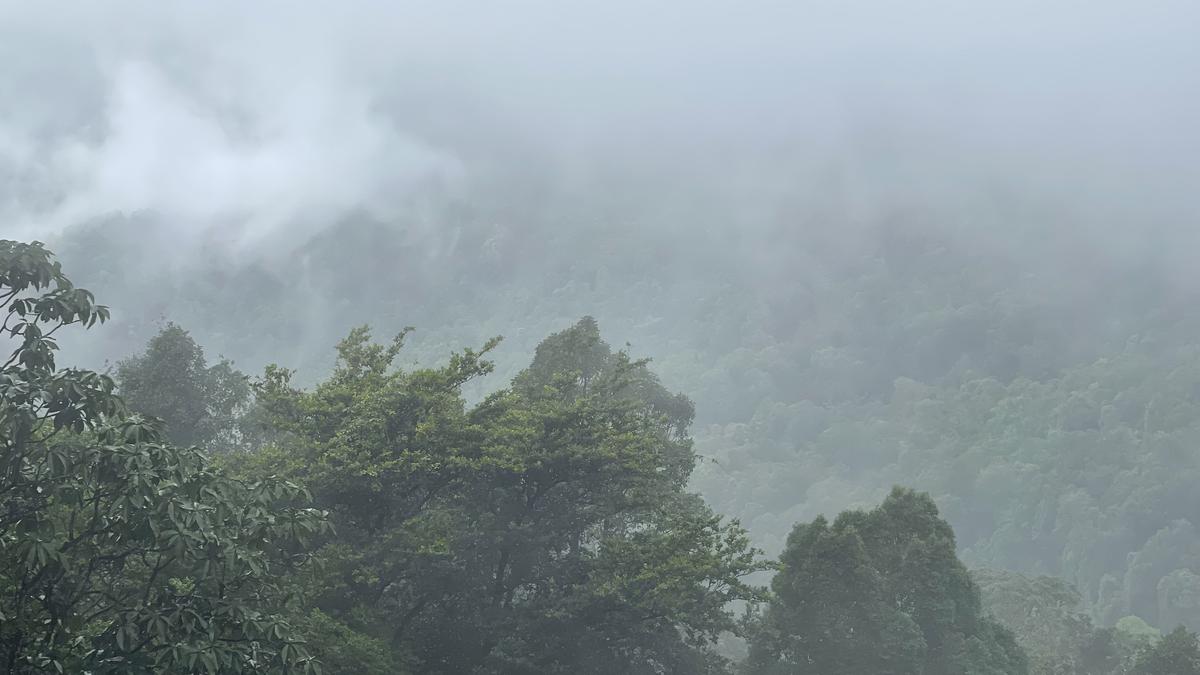





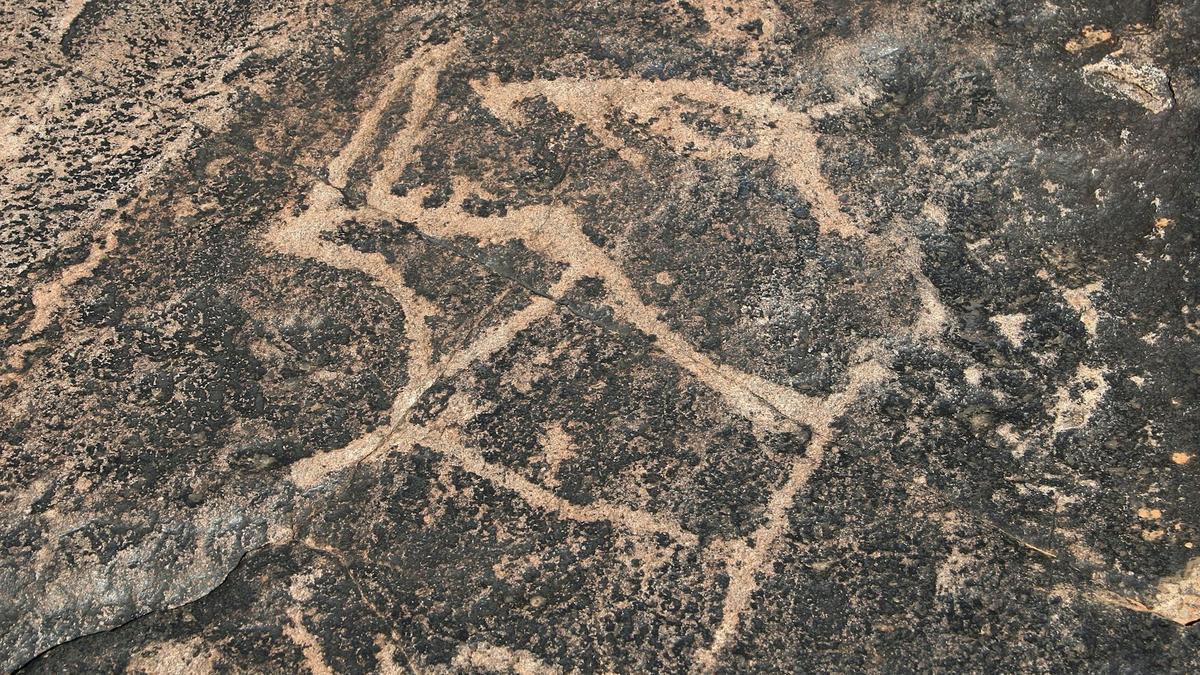
The study site, Kurukop, is in South Africa’s Northern Cape province, in the Nama Karoo region, where the geological formation began to accumulate from about 300 million years ago, before the breakup of the super continent Gondwanaland.
| Photo Credit: Neil Rusch/The Conversation
Physics does not adequately explain reflected sound and echo effects. Take as example the echo-producing Echoplex, a magnetic tape device that influenced the soundtrack of a generation. Think of Led Zeppelin’s Whole Lotta Love (1969) and the echo on its violin sections. The echo coming from Hank Marvin’s guitar shaped the sound of The Shadows in the late 1950s and 1960s.
But are echoes and reverberations a passing feature of musical appreciation, limited to a generation or two? Acoustic research at a rock art site suggests not.
The study site, Kurukop, is in South Africa’s Northern Cape province, in the Nama Karoo region, where the geological formation began to accumulate from about 300 million years ago, before the breakup of the super continent Gondwanaland. This eroded sandstone hill, transformed by volcanic activity, is marked with 112 petroglyphs, or rock engravings. The images depict various figures – eland, elephants, zebra, ostriches, wildebeest, rhinoceros and animal-human hybrids.
The collection is too diverse to be the work of one person or group of people. There’s great variation in technique and execution. There are images that are several thousand years old, an age estimate based on oxidation of the rock surface compared to the oxidation of the images. Others are more recent, created within the last 2,000 years. The depictions were made by hunter-gatherer San and Khoe herder people who visited Kurukop repeatedly.
What was it that kept bringing them back?
Part of the answer is a distinctive echo. This is significant, firstly because it confirms that the creation of rock art was combined with performance – clapping, singing, dancing – which in this case was enhanced by echoes. The Kurukop echo also provides a reference point for a mythological story from the region that speaks about the relationship between echo, wind, mountain and breath.
Petroglyphs, engraved on rocks, have an obvious visual attraction. What is important and exciting about this study is the discovery that these images have an acoustic aspect as well.
Measuring the echo
As a researcher interested in archaeoacoustics I first noticed the echo while camping at the site. This was confirmed by my colleague Professor Sarah Wurz and my daughter Amy. The echo enveloped us when we clapped or made high pitched sounds. Could the many Kurukop mark-makers have noticed this too, we wondered? Intrigued, we returned to measure the echo.
We applied a combination of techniques to see if there was a connection between echo and art. First we located each petroglyph on Kurukop, an area of 70,000 square metres, using on-the-ground survey, drone imaging and GIS (Geographic Information System) techniques.
Next, we measured the echo zone, using what’s called the impulse response method. Researchers at Stanford University used the same procedure to measure the acoustic features of Turkey’s most famous monument, the Hagia Sophia in Istanbul. The method allows researchers to capture information about a space’s acoustic architecture. What the ears hear as reverberations and echoes, the instruments measure objectively as intensity, time-delay and frequency loss.
Once we’d completed both processes, we compared petroglyph distribution data and the echo pattern. Our results show that 60% of the petroglyphs were created directly in the echo zone. This suggests that at Kurukop people were most likely to create images in the area that echoed strongly.
This makes sense when considering how important sound and performance were to the Khoe and San people. But sound sensibility is not particular to one group of people, or person. Reverberant sounds attract attention and have done so for thousands of years in distinctly different cultures and in whichever way the echo is created and enhanced – sacred space, magnetic play-back tape or the geomorphology of a rock outcrop. What is noteworthy, given the Kurukop example, is how reflected sound is included and interpreted within specific cultures.
The role of myth
The Kurukop echo’s significance is borne out by a |Xam San myth from the region. The story was recorded in the 19th century by Gideon Retief von Wielligh (1859-1932). He is best known in literary and folkloristic circles for his recording of |Xam narratives, which were first published in Afrikaans (1919-1921) after the |Xam language had become extinct.
The story explains that Echo is daughter of Mountain and Wind. Narrative details introduce associations connected to wind and breath, which are entangled in Khoe and San hunting and healing practices.
Two ideas represented in the story are relevant to our study. First, reflected sound is a fine example of how people, animals and other entities animate one another. The animation idea is reinforced and personified in the story. We learn that Wind does not speak but “speaks through his daughter”. This narrative detail might ultimately be saying that everyone is animated by wind, breath and echo.
Secondly, the story links music-making and echo. Speelman (player or musician in Afrikaans), “the man who first discovered music”, engages Echo in dialogue and the reader is left wondering: who is talking to whom? This element of the story gains substance and resounds in a performative setting when echoes combine with music-making.
Collective memory
The themes in the Echo myth are reinforced at a place like Kurukop where echoes bring story and soundscape together. This makes Kurukop a powerful place and further accounts for the petroglyphs.
The San and the Khoe left no written records: theirs were oral cultures in which memory and remembering are potent tools.
This means that Kurukop and other places like it act as external archives of collective memory. Multiple traces of activity over long periods of time usher the past into the present. This allows cultural knowledge to be transmitted from generation to generation. Communication through a living past includes connection to ancestors and it also endows Kurukop with a spiritual dimension.
This article is republished from The Conversation under a Creative Commons license. Read the original article here.
Published – January 09, 2025 05:28 pm IST