



Skip to content
  • Facebook
  • X
  • Linkedin
  • WhatsApp
  • Associate Journalism
  • About Us
  • Privacy Policy
  • 033-46046046
  • editor@artifex.news
Artifex.News

Artifex.News

Stay Connected. Stay Informed.

  • Breaking News
  • World
  • Nation
  • Sports
  • Business
  • Science
  • Entertainment
  • Lifestyle
  • Toggle search form
  • Election Commission Seeks Modification Of Electoral Bonds Order, Supreme Court Hearing Today Nation
  • 2 Bodies Found In Hotel Room In Delhi, Suicide Note Recovered: Cops Nation
  • Who Was The Masked Torchbearer At Paris Olympics Opening Ceremony? World
  • Deserves “Oscar”: Sunil Gavaskar’s Mega Comment On Viral Virat Kohli-Gautam Gambhir Hug In IPL Game Sports
  • Process To Unlock Biometrics Can Start With Citizenship Law CAA Implementation: Himanta Sarma Nation
  • Paris Olympics: Sreejesh walks off into the sunset in glorious style Sports
  • Why Mira Murati Quit As Chief Technology Officer Of OpenAI World
  • Fitness Influencer Larissa Borges, 33, Dies After Double Cardiac Arrest World

Researchers find bacteria that can clean up pesticides from soil to enhance crop yield

Posted on January 2, 2025 By admin


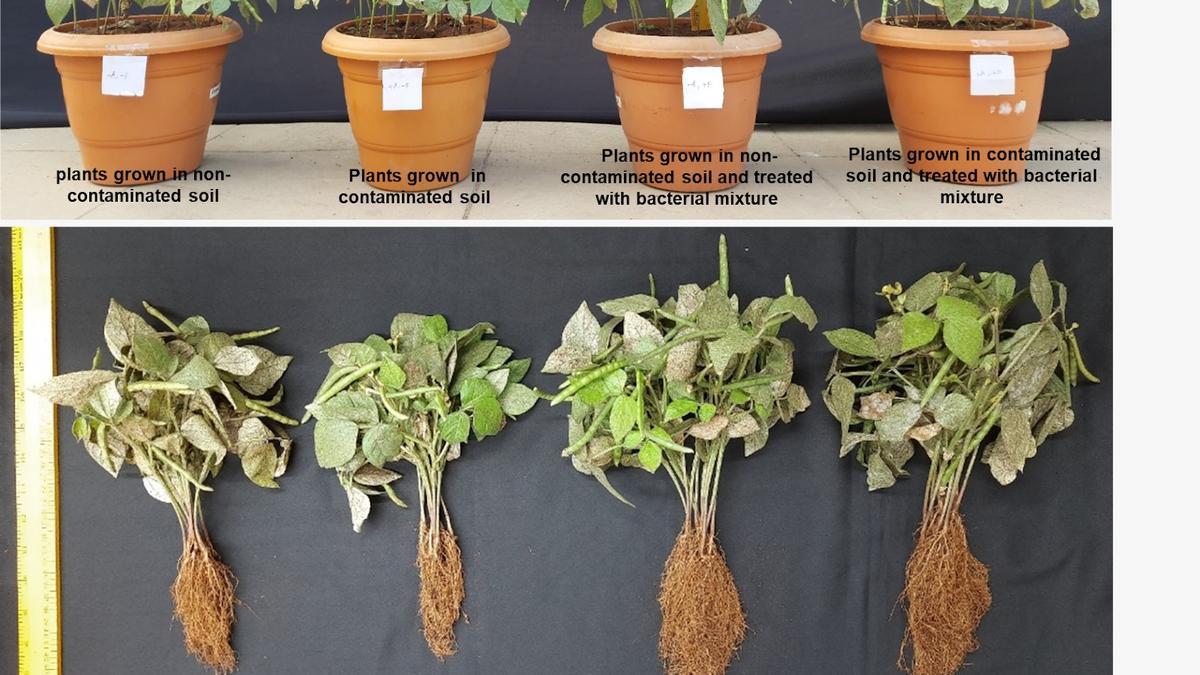
Image demonstrating the effects of bacterial mixture from the study. 
| Photo Credit: Special Arrangement

Soil contamination is one of the major issues in the agriculture industry. These compounds are toxic, can inhibit seed germination, reduce plant growth, yield and also accumulate in seeds and plant biomass.  

Traditional approaches to remove these pollutants, like chemical treatments or soil removal, often turn out to be band-aid solutions – expensive and unable to tackle the problem completely. 

To address this issue, a team of researchers from the Indian Institute of Technology Bombay (IIT Bombay) have identified bacteria from toxic environments. While doing so, they noticed that certain bacterial species, specifically from the genera Pseudomonas and Acinetobacter, were especially good at breaking down aromatic compounds. In a recent study published in the journal Environmental Technology and Innovation, researchers have used the power of specific bacterial species to remove organic pollutants from soil. 

Professor Prashant Phale, from the Department of Biosciences and Bioengineering at IIT Bombay, under whose guidance Sandesh Papade carried out the research for his PhD. explained that these bacteria were isolated from contaminated soil and agricultural fields.

“They feed on pollutants, breaking them down into simpler, harmless, non-toxic compounds. In this way, they act as natural cleaners of polluted environments. Like feeding two birds with one scone, while breaking down aromatic pollutants, these bacteria were also found to convert insoluble forms of essential nutrients, such as phosphorus and potassium, into soluble forms and make them readily available to the plants. They also produce substances called siderophores, which help plants absorb iron in nutrient-limited environments.”  

Moreover, these bacteria also contribute to plant growth and health by producing a high amount of growth hormone called indoleacetic acid (IAA). “So, while these bacteria are cleaning the soil, they are also helping plants grow healthier and more robust by fertilising the soil and improving soil health,” Mr. Phale added. 

Interestingly, when a mixture of bacteria from the Pseudomonas and Acinetobacter genera is used, they significantly boost the growth and yield of crops (wheat, mung bean, spinach, fenugreek, etc.) up to 45-50%, the research said.  

“As they say, ‘unity is the best policy.’ Some strains might be really good at breaking down pollutants, while others might be better at promoting plant growth or defending against diseases. By combining them, we assembled a team of bacteria that can work together cooperatively, doing a variety of jobs simultaneously and more efficiently,” Mr. Phale said.  

Fungal diseases are another problem affecting several crops worldwide. According to the Food and Agricultural Organisation of the United Nations, hundreds of fungal diseases impact 168 crops essential to human nutrition. Despite the use of fungicides and disease-resistant cultivars, fungal infections still cause global crop losses of 10–23% annually, with key calorie crops consumed in India, like rice and wheat, particularly affected. Mr. Phale said that the study has a potential solution to this grave problem, too.

“These helpful bacteria produce substances like lytic enzymes and HCN [hydrogen cyanide] that can kill or inhibit the growth of plant pathogenic fungi. These bacteria act like a natural defence system for plants. Unlike chemical pesticides, which can harm the environment and beneficial organisms, these bacteria are eco-friendly and target only the harmful fungi,” he explained.   

Although the findings from the research have a lot of potential in a real-world situation, the researchers believe that it will take some time for widespread adoption, as the technology will need to be scaled up, tested in different environments, and made available as commercial products. 

In the future, researchers also want to test how these helpful bacteria benefit plants during droughts and other environmental stress conditions. They also intend to create easy-to-use products, called bio-formulations, that combine the bacteria with natural materials, making them long-lasting and simple for farmers to apply in agriculture fields. 

Published – January 02, 2025 06:52 pm IST


Source link

Science Tags:bacteria to clean soil, IIT Bombay, indoleacetic acid, Soil contamination impact on agriculture

Post navigation

Previous Post: Hydrogel developed for targeted breast cancer therapy
Next Post: A Breakup, A Bar And 12 Grapes: The NYE Tradition That Changed Everything

Related Posts

  • India’s ambitious plans on space station on track, says Chandrayaan-3 project director Science
  • How scientists found that LK-99 is probably not a superconductor Science
  • Ayurveda, Siddha: Can Indian Knowledge Systems be evidence-based? Science
  • Big Butterfly Month | A month for the winged ones Science
  • Climate change has made the Hajj pilgrimage more risky Science
  • NIMHANS to arrange first-in-the-world mind and thoughts museum Science

More Related Articles

The Science Quiz: AI in science, from neurons to nodes Science
On the physics of pressure: how the microscopic world interacts with us Science
How does using the AC affect a car’s mileage while driving? Science
Chilling out instead of blowing off steam better to manage anger, review of 154 studies says Science
Two new malaria vaccines are being rolled out across Africa — how they work and what they promise Science
Is there any evidence that eyes have evolved several times independently of one another? Science
SiteLock

Archives

  • January 2025
  • December 2024
  • November 2024
  • October 2024
  • September 2024
  • August 2024
  • July 2024
  • June 2024
  • May 2024
  • April 2024
  • March 2024
  • February 2024
  • January 2024
  • December 2023
  • November 2023
  • October 2023
  • September 2023
  • August 2023
  • July 2023
  • June 2023
  • May 2023
  • April 2023
  • March 2023
  • February 2023
  • January 2023
  • December 2022
  • November 2022
  • October 2022
  • September 2022
  • August 2022
  • July 2022
  • June 2022
  • May 2022

Categories

  • Business
  • Nation
  • Science
  • Sports
  • World

Recent Posts

  • Hamas’ Armed Wing Releases New Video Of Gaza Hostage
  • Yuzvendra Chahal’s Cryptic Post Amid Divorce Rumours With Wife Dhanashree Verma
  • Man Slides Across Himachal Valley On Rope As Ritual Returns After 40 Years
  • IND vs AUS fifth Test | Bumrah unavailable to bowl in Australia’s second innings
  • Rahul Gandhi Was Asked How Congress, BJP Are Different. His Response

Recent Comments

  1. dfb{{98991*97996}}xca on UP Teacher Who Asked Students To Slap Muslim Classmate
  2. "dfbzzzzzzzzbbbccccdddeeexca".replace("z","o") on UP Teacher Who Asked Students To Slap Muslim Classmate
  3. 1}}"}}'}}1%>"%>'%> on UP Teacher Who Asked Students To Slap Muslim Classmate
  4. bfg6520<s1﹥s2ʺs3ʹhjl6520 on UP Teacher Who Asked Students To Slap Muslim Classmate
  5. pHqghUme9356321 on UP Teacher Who Asked Students To Slap Muslim Classmate
  • Why Congress Is Protesting In Puri And History Of Jagannath Temple Nation
  • NATO confirms that North Korea has sent troops to join Russia’s war in Ukraine World
  • India’s external debt rises to $629.1 billion at end-June 2023: RBI Business
  • Taiwan Braces For Super Typhoon Kong-Rey, Thousands Evacuated, Schools Shut World
  • Indian Navy Rescues 23 Pakistani Nationals From Iranian Fishing Vessel Al-Kambar 786 Attacked By Pirates Nation
  • Who Among Anil Kumble, Rahul Dravid, R Ashwin, K Srikkanth Is Not An Engineer? Kaun Banega Crorepati Rs 12.5 Lakh Question Viral Sports
  • 3 Injured In Knife Attack At National Conference’s Poll Rally Of Farooq Abdullah In Jammu and Kashmir’s Poonch Nation
  • The Hindu Morning Digest, December 13, 2024 World

Editor-in-Chief:
Mohammad Ariff,
MSW, MAJMC, BSW, DTL, CTS, CNM, CCR, CAL, RSL, ASOC.
editor@artifex.news

Associate Editors:
1. Zenellis R. Tuba,
zenelis@artifex.news
2. Haris Daniyel
daniyel@artifex.news

Photograher:
Rohan Das
rohan@artifex.news

Artifex.News offers Online Paid Internships to college students from India and Abroad. Interns will get a PRESS CARD and other online offers.
Send your CV (Subjectline: Paid Internship) to internship@artifex.news

Links:
Associate Journalism
About Us
Privacy Policy

News Links:
Breaking News
World
Nation
Sports
Business
Entertainment
Lifestyle

Registered Office:
72/A, Elliot Road, Kolkata - 700016
Tel: 033-22277777, 033-22172217
Email: office@artifex.news

Editorial Office / News Desk:
No. 13, Mezzanine Floor, Esplanade Metro Rail Station,
12 J. L. Nehru Road, Kolkata - 700069.
(Entry from Gate No. 5)
Tel: 033-46011099, 033-46046046
Email: editor@artifex.news

Copyright © 2023 Artifex.News Newsportal designed by Artifex Infotech.