




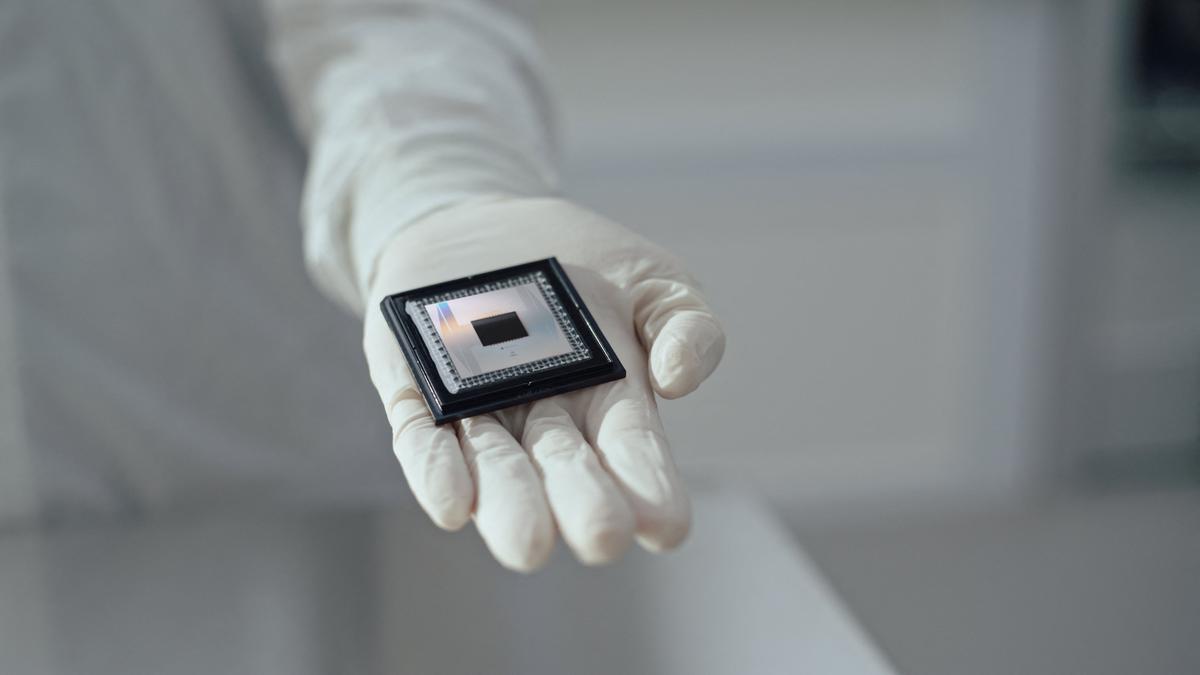
Google recently unveiled its latest quantum processor, named ‘Willow’. The research team that built it also tested it and the results were published in Nature.
They created a great level of buzz about the realisability of quantum computers that could tackle many practical problems.
The results also kicked up intriguing debates about explaining the power of quantum information processing and how they could solve problems that even the most powerful classical computers struggle with.
Bit versus qubit
Computers process information stored in an array of 0s and 1s. In classical computers, some physical system with two possible states is used to represent these 0s and 1s. These physical systems are called bits. A common example is an electric circuit that allows two levels of voltage, one called 0 and the other called 1. A classical computer is a collection of bits together, and the information flowing in and out of bits is controlled and manipulated by physical operations called gate operations. For example, an AND gate accepts two inputs, each either 0 or 1, and outputs 1 if both inputs are 1 and 0 for any other combination of inputs.
A quantum bit, or qubit, has two distinct states representing 0 and 1. More importantly, a qubit can be in states that are also combinations of 0 and 1. This feature is called quantum superposition. Classical bits can’t do this. Because of this ability, each qubit needs two distinct numbers to represent the contributions of 0 and 1 respectively in the qubit’s state. If we have two bits, we need two numbers, one for each bit, to represent the state of the collection. With two quantum bits, we need four numbers to represent the state. For 10 bits, we need 10 numbers to represent the state of the collection. For ten qubits, we need 210 (1,024) numbers.
This exponential growth in the information required to represent qubits’ states and the superposition of states are the major reasons why quantum computers could be more efficient and powerful than classical computers. Like a classical computer, a quantum computer is also a collection of qubits and a host of physical operations called quantum gates that change the states of qubits to perform calculations.
Difficult to isolate
A major impediment to realising quantum computers is the fragile nature of quantum states. Specifically, while classical bits are robust and long-lasting, qubits are fragile and collapse quickly at the slightest disturbance. This in turn limits the amount of time for which qubits can hold information, how errors-free the quantum computer can keep its calculations, and how well a quantum computer can be scaled.
It is difficult to isolate a physical gadget to avoid perturbations due to external noise. Therefore, computations are prone to errors. For example, when a bit is expected to represent 0, there is a small chance it may be in the state representing 1. This is called the bit flip error. Methods to identify and fix these errors are called error-correction protocols.
A single 0 is represented by three bits in the state 000 (corresponding to each bit in the state 0). If there is a bit-flip error, the resulting state could be 100, 010 or 001 (depending on whether the first, second or third bit is flipped). Similarly, 1 is represented as 111. If we need to encode 01 as the basic information, its true representation is 000111. Looking at the concatenated sequence in groups of three bits, the occurrence of 100, 010, 001, 011,101 or 110 will mean an error has crept in. When three physical bits represent one logical digit, it is easy to figure out which bit has flipped and correct it suitably before the next step in the computation.
Similarly, one way to mitigate the effect of errors in a quantum computer is to correct them using additional qubits that keep track of errors creeping in during computations. This is a logical answer to the error problem, it is however unsuitable for qubits in superposed states. Creating exact copies of unknown superposed states is prohibited by the no-cloning theorem of quantum physics. On the other hand, error correction often requires redundancy, i.e. providing more qubits than what is needed to encode information. This makes it clear more than one physical qubit is needed to represent a single logical qubit. (Qubits also have another type of error called phase flip error, which presents similar challenges to error correction.)

One effective method to detect and correct errors in a quantum computer without also violating the no-cloning theorem is called surface code. Here, engineers arrange an array of qubits on a grid. The qubits are grouped into two categories, namely data qubits and measurement qubits. While the error in data qubits is what we wish to identify and correct, any attempt to measure them will force them out of superposition and whatever information they encode will be lost.
To avoid this, the surface code method provides the set of measurement qubits. These qubits are entangled with data qubits through suitable gate operations. (If two qubits are entangled, any measurement of one particle will instantaneously cause the other particle to lose its superposition state.) In this setup, the presence of errors in the data qubits is inferred by making suitable measurements of the measurement qubits, while using the gates to prevent the data qubits from being affected, and thus correcting inconsistencies in the data qubits.
The error rate
According to Google, its new quantum processor Willow has significantly better error correction and is thus significantly faster than other quantum computers, not to mention classical computers as well. The researchers who developed it tested it by using it to solve a computationally hard problem.
Willow houses 105 physical qubits and operates at temperatures close to the theoretically possible lowest temperature (0 K, -273.15° C). Nearly half of these are data qubits and the remaining are measurement qubits. The superconducting qubits are not strictly two-state systems. When performing gate operations, the physical system can get excited or ‘leak’ to states other than 0 and 1. These excited states can subsequently interfere with the computations and introduce errors. So a few qubits — i.e. the measurement qubits — are reserved to correct such leakage errors.
Coherence time is the duration over which an intended state (typically, superpositions) of a qubit can survive without being changed due to interactions with the environment or with other parts of the computer. The coherence time of data qubits on Willow is about 100 microseconds, which is more than the coherence time of the physical qubits. This is a consequence of the error correction protocols used. This in itself is an interesting result because it means the information-holding time can be improved by external manoeuvring.
The next milestone for researchers to achieve is to lower the error rate — calculated as the ratio of the number of qubit errors to the number of gate operations — as they build ever-larger quantum computers with more physical qubits and more error correction operations. Google alone has progressed from 3-by-3 to 5-by-5 to 7-by-7 arrays of data qubits, and the error rate has decreased by more than half in each step.
What one expects for a collection of qubits on a circuit is that the error rate either remains the same or increases as the number of qubits is increased. That the error rate becomes smaller as more qubits are added is the below-the-threshold capability of Willow’s architecture and operation. This is vital to achieve quantum processors with enough qubits that perform almost error-free computations of problems of practical relevance — the ultimate goal.

No dead-ends
The particular computationally difficult task with which Google tested Willow is called random circuit sampling (RCS). In the RCS task, Willow has to calculate the probability of occurrence of possible strings of 0s and 1s in the output when the quantum gates that act on the qubits are chosen randomly. If there is no noise, RCS is a computationally hard task, meaning that the number of calculations required to make the prediction increases exponentially with the input size.
Willow completed the RCS task for random gate operations realisable on Willow in a few minutes. The researchers estimated that the same task on the most powerful classical computer available today would take 10 septillion years (i.e. 1 followed by 24 zeroes). To compare, the universe’s age in years is approximately 1 followed by 10 zeroes. It is plausible that classical computers running better algorithms may eventually match Willow’s feat, although researchers are not aware of such improvements today.
Researchers are still a long way away from realising quantum processors of reasonable size to be useful in practical contexts. This said, it’s only natural that Willow created the sort of buzz that it did: it has shown that the major issues in realising a reliable quantum computer can be addressed and surmounted, that they are not dead-ends. The work of the Google team provides hope that quantum computers may soon help us unravel nature’s mysteries and also solve computationally difficult problems in drug design, materials science, climate modelling, and optimisation, among others — all with deep societal impact.
S. Srinivasan is a professor of physics at Krea University.
Published – December 31, 2024 08:00 am IST