



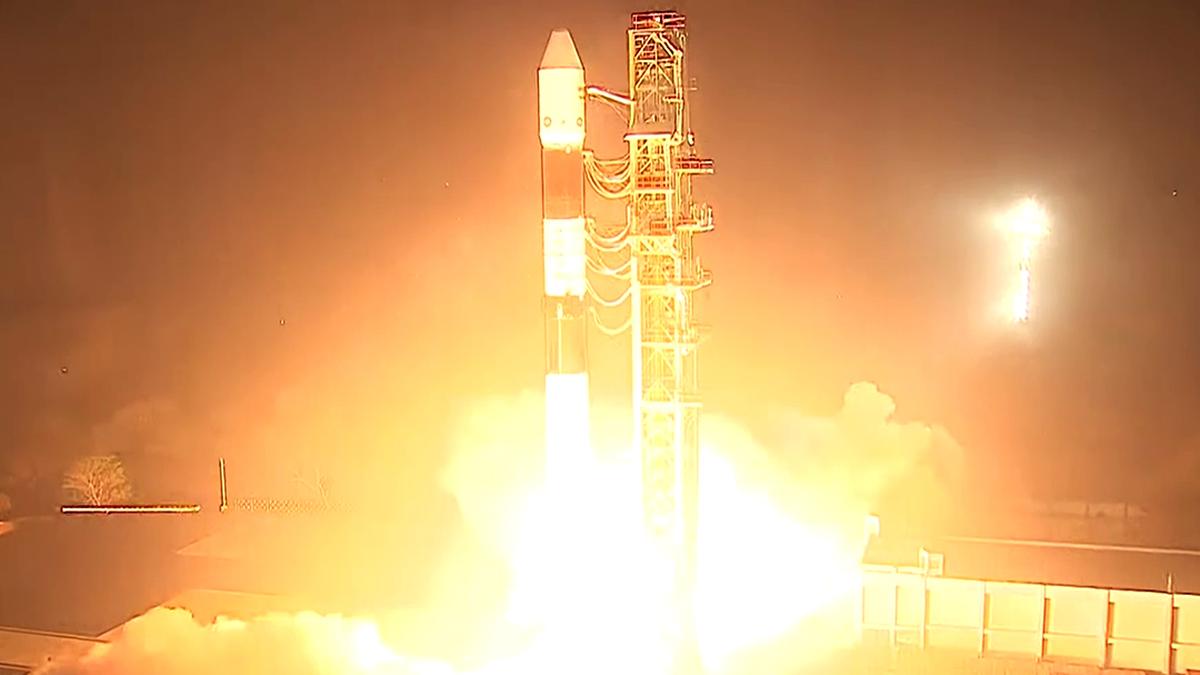
ISRO successfully launches Polar Satellite Launch vehicle (PSLV-C60) with two Space Docking Experiment (SpaDEX) satellites SDX01 (Chaser) and SDX02 (Target) and 24 other innovative payloads from the Satish Dhawan Space Centre (SDSC), in Sriharikota on December 30, 2024.
| Photo Credit: ANI/ISRO
ISRO’s PSLV-C60 rocket carrying two spacecraft that would aid in demonstration of space docking, a critical technology for future space missions, lifted off from the spaceport in Sriharikota late on Monday (December 30, 2024).
Billed as a prelude to ISRO’s setting up its own Space Station by 2035, the 44.5 metre tall Polar Satellite Launch Vehicle (PSLV) carried Spacecraft A and B, each weighing 220kg that would help in space docking, satellite servicing and interplanetary missions.
Upon the conclusion of the 25-hour countdown, PSLV-C60 in its 62nd flight lifted-off majestically, emanating thick orange colour fumes, from the first launch pad at this spaceport.
The lift-off was originally planned at 9.58 pm on Monday but ISRO authorities later rescheduled to 10 pm. However, there was no official information behind the reason for the rescheduling.
By mastering the space docking technologies, ISRO is set to enhance its operational flexibility besides expanding its mission horizons.
Apart from the SpaDeX mission, ISRO scientists have configured the fourth stage of the rocket (PS-4) as the PSLV Orbital Experimental Module-4 (POEM-4) in which 24 small payloads which comprise of 14 from ISRO and 10 from academia, would be placed in over 90 minutes after the lift-off in different orbits.
Related spacecraft separated successfully, says ISRO
Two spacecraft that would aid ISRO in demonstrating space docking, a critical technology for future space missions got separated successfully and were placed into the desired low earth orbit late on Monday night, ISRO said.
“PSLV C60 mission accomplished as of SpaDeX spacecraft is considered,” said Mission director M Jayakumar.
Dubbed as a prelude to ISRO setting up its own Space Station by 2035, the PSLV-C60 mission would also make India join an elite club in achieving this feat which is expected to take place in the coming days.
The 44.5 metre tall rocket carried two spacecraft — Spacecraft A and B, each weighing 220kg which would help in space docking, satellite servicing and interplanetary missions.
After the culmination of the 25 hour countdown which commenced on Sunday, the rocket lifted-off at 10 pm from the First Launch Pad at this spaceport, emanating thick orange coloured fumes and thunderous sound in the island, located about 135 km east of Chennai.
According to ISRO scientists, the two spacecraft-Spacecraft A (SDX01) or the ‘Chaser’ and Spacecraft B (SDX02) or the ‘Target’ would be merged together later at an altitude of about 470 km after travelling at the same speed and distance.
By mastering the docking technologies, ISRO is set to enhance its operational flexibility and also expand its mission horizons.
This technology is essential for some of India’s space ambitions like Indian on Moon, getting samples from the Moon (Chandrayaan-4 mission), building and operation of the Bharatiya Antariksh Station.
“In-space docking technology is essential when multiple rocket launches are required to achieve common mission objectives. Through this mission, India is marching towards becoming the fourth country in the world to have space docking technology,” ISRO said.
Published – December 30, 2024 10:14 pm IST