



Skip to content
  • Facebook
  • X
  • Linkedin
  • WhatsApp
  • YouTube
  • Associate Journalism
  • About Us
  • Privacy Policy
  • 033-46046046
  • editor@artifex.news
Artifex.News

Artifex.News

Stay Connected. Stay Informed.

  • Breaking News
  • World
  • Nation
  • Sports
  • Business
  • Science
  • Entertainment
  • Lifestyle
  • Toggle search form
  • Gupuks: The Khelo India Winter Games Venue Where Amateurs Become Professionals
    Gupuks: The Khelo India Winter Games Venue Where Amateurs Become Professionals Sports
  • Access Denied Business
  • Access Denied World
  • No Worth Of Olympic Sports”: Manu Bhaker’s Father On Shooter’s Khel Ratna Snub, Sports Ministry Says, “Not Final
    No Worth Of Olympic Sports”: Manu Bhaker’s Father On Shooter’s Khel Ratna Snub, Sports Ministry Says, “Not Final Sports
  • Trains suspended; people warned away from coastline as Typhoon Saola churns toward south China
    Trains suspended; people warned away from coastline as Typhoon Saola churns toward south China World
  • South Asian diaspora group starts mobilizing for Biden-Harris 2024
    South Asian diaspora group starts mobilizing for Biden-Harris 2024 World
  • Magnitude 7.6 quake strikes off Japan, triggering tsunami warning
    Magnitude 7.6 quake strikes off Japan, triggering tsunami warning World
  • Video Just Before Stampede Shows Extent Of Congestion At UP Gathering
    Video Just Before Stampede Shows Extent Of Congestion At UP Gathering Nation
India’s reliance on China for critical minerals | Explained

India’s reliance on China for critical minerals | Explained

Posted on December 24, 2024 By admin


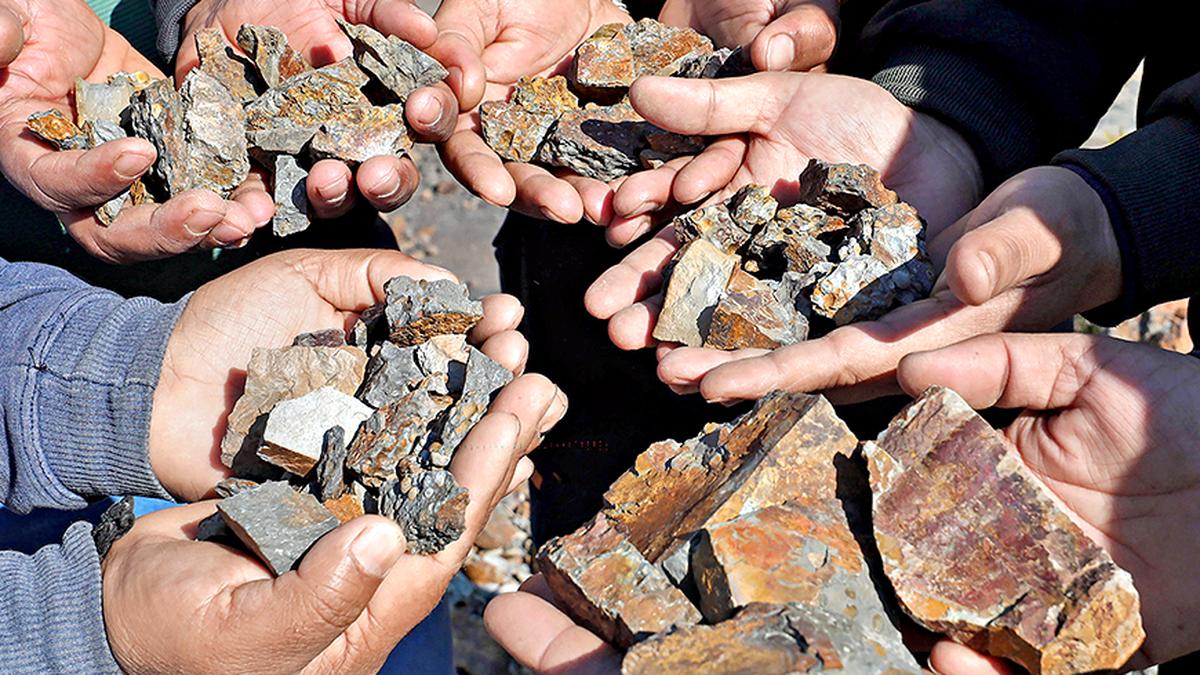
Villagers show lithium stones discovered in Reasi district, Jammu and Kashmir.
| Photo Credit: PTI

The story so far: The Ministry of Mines in 2023 identified 30 critical minerals deemed essential for the nation’s economic development and national security. While the report highlighted India’s complete import dependency for 10 critical minerals, it did not fully address a more pressing concern — the extent and nature of dependency on China.

Is China a dominant player?

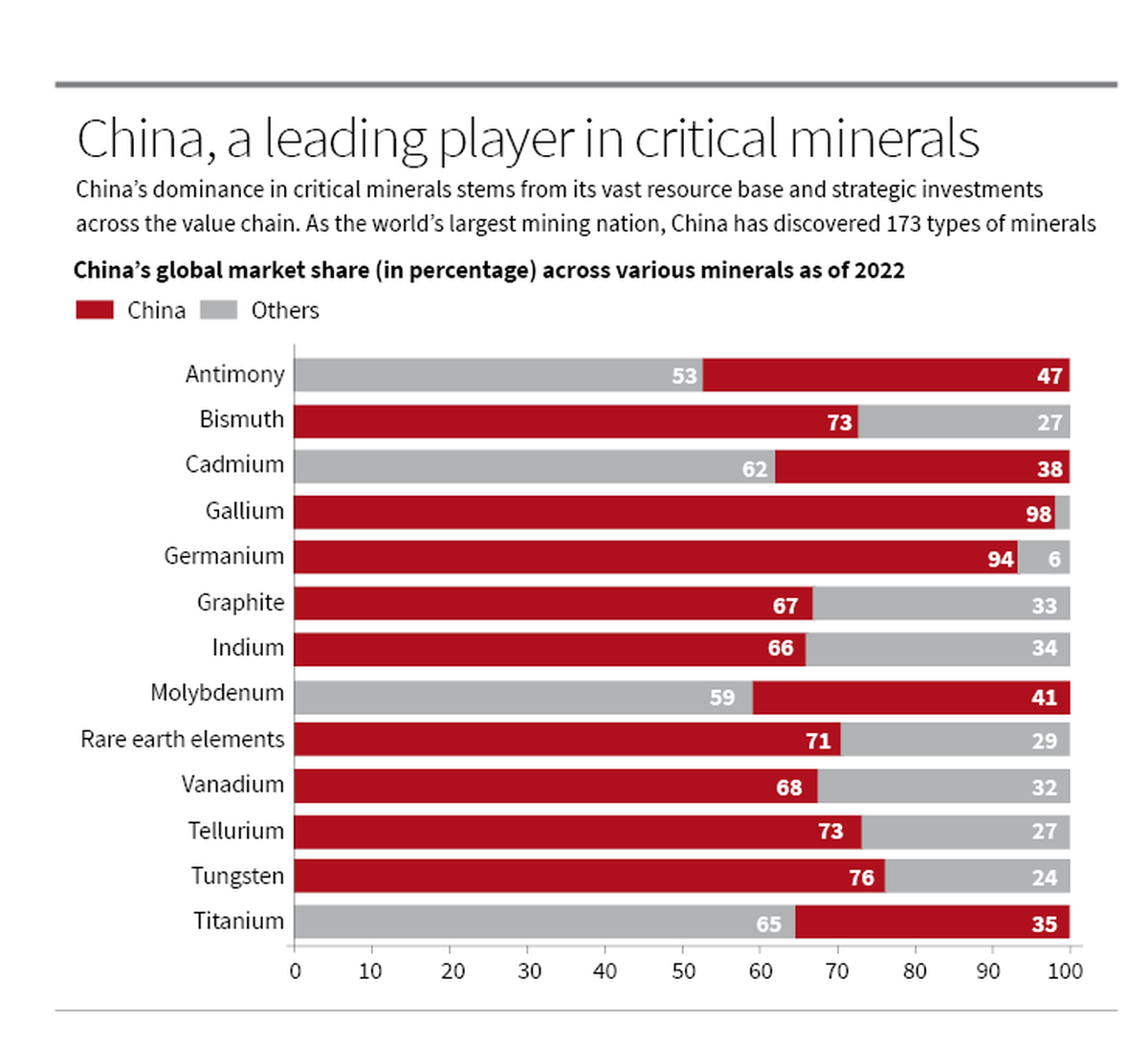
China’s unparalleled dominance in critical minerals stems from its vast resource base and strategic investments across the value chain. As the world’s largest mining nation, China has discovered 173 types of minerals, including 13 energy minerals, 59 metallic minerals, and 95 non-metallic minerals. Reserves of nearly 40% of these minerals, particularly copper, lead, zinc, nickel, cobalt, lithium, gallium, germanium, and crystalline graphite, increased significantly last year, supported by an exploration investment of $19.4 billion. This led to the discovery of 132 new mineral deposits, including 34 large ones. China’s dominance extends beyond reserves to include processing and refining, with control over 87% of rare earth processing, 58% of lithium refining, and 68% of silicon processing. Furthermore, China has strategically invested in overseas mining projects and built unparalleled midstream refining capabilities, raising supply chain vulnerabilities for countries including India, the U.S., and EU nations.
What about China’s export controls?

When it comes to China’s approach to weaponising critical mineral exports, it is strategic and calculated. Beijing primarily targets minerals deemed critical by Western nations and their allies, especially those essential for semiconductors, batteries, and high-tech manufacturing. However, China carefully balances these decisions against two constraining factors: it avoids controlling minerals which heavily depend on Western raw material imports, and it refrains from actions that could disrupt its domestic industrial enterprises or export-dependent sectors. This strategic calculus was evident in China’s 2010 rare earth embargo against Japan, its recent restrictions on antimony, gallium, and germanium exports, and its December 2023 ban on rare earth extraction and processing technologies.

Is India dependent on China?

An in-depth examination of import data of 30 critical minerals spanning 2019 to 2024 reveals India’s acute vulnerability to Chinese supplies, particularly for six critical minerals where dependency exceeds 40%: bismuth (85.6%), lithium (82%), silicon (76%), titanium (50.6%), tellurium (48.8%), and graphite (42.4%). Bismuth, primarily used in pharmaceuticals and chemicals, has few alternative sources, with China maintaining an estimated 80% of global refinery production. Lithium, crucial for EV batteries and energy storage, faces processing bottlenecks, despite alternative raw material sources, as China controls 58% of global refining. Silicon, vital for semiconductors and solar panels, requires sophisticated processing technology that few countries possess. Titanium, essential for aerospace and defence applications, has diversified sources but involves high switching costs. Tellurium, important for solar power and thermoelectric devices, is dominated by China’s 60% global production share and finally graphite, indispensable for EV batteries and steel production, faces supply constraints as China controls 67.2% of global output, including battery-grade material.

Why does India rely on imports?

Despite being endowed with significant mineral resources, India’s heavy reliance on imports stem from several structural challenges in its mining and processing ecosystem. Many critical minerals are deep-seated, requiring high-risk investments in exploration and mining technologies — a factor that has deterred private sector participation in the absence of adequate incentives and policy support. The country’s processing capabilities are also limited. This is particularly evident in the case of the recently discovered lithium deposits in Jammu and Kashmir, where despite the presence of 5.9 million tonnes of resources in clay deposits, India lacks the technological capability to extract lithium from such geological formations.

What is the way forward?

India has initiated a multi-pronged approach to reduce its dependency on China. The government has established KABIL, a joint venture of three State-owned companies, to secure overseas mineral assets. India has also joined strategic initiatives like the Minerals Security Partnership and the Critical Raw Materials Club to diversify its supply sources and strengthen partnerships. The country is also investing in research through institutions like the Geological Survey of India and the Council for Scientific and Industrial Research while promoting recycling and circular economy practices to reduce virgin mineral dependency. Production-linked incentives for extracting critical minerals through recycling also seem promising. However, transitioning away from China will require sustained investment and long-term commitment to these various initiatives.

The writer is a research analyst at The Takshashila Institution.

Published – December 24, 2024 08:30 am IST


Source link

Business Tags:china critical minerals, india china mineral diplomacy, india dependance china for minerals

Post navigation

Previous Post: Woman set on fire in New York City subway train: Sebastian Zapeta charged for murder
Next Post: How One Complaint Sparked Affordable Footwear For Millions

Related Posts

  • Stock markets bounce back after three-day decline; Sensex jumps 639 points
    Stock markets bounce back after three-day decline; Sensex jumps 639 points Business
  • Markets pare early losses to trade higher amid rally in Asian markets
    Markets pare early losses to trade higher amid rally in Asian markets Business
  • Mexico’s 50% tariffs have been in place since 2024, but can still hurt India’s auto exports
    Mexico’s 50% tariffs have been in place since 2024, but can still hurt India’s auto exports Business
  • Access Denied Business
  • Net tax receipts up 19.5%, corporate tax share at 36.6%
    Net tax receipts up 19.5%, corporate tax share at 36.6% Business
  • L&T Shares In Focus Ahead Of Budget 2026 Business

More Related Articles

Mining output growth hit 19-month low of 1.2% in signal for March IIP Mining output growth hit 19-month low of 1.2% in signal for March IIP Business
Access Denied Business
Rupee falls 6 paise against U.S. dollar amid rising crude prices Rupee falls 6 paise against U.S. dollar amid rising crude prices Business
Access Denied Business
Budget for Census slashed, population count may not take place in first quarter Budget for Census slashed, population count may not take place in first quarter Business
Access Denied Business
SiteLock

Archives

  • May 2026
  • April 2026
  • March 2026
  • February 2026
  • January 2026
  • December 2025
  • November 2025
  • October 2025
  • September 2025
  • August 2025
  • July 2025
  • June 2025
  • May 2025
  • April 2025
  • March 2025
  • February 2025
  • January 2025
  • December 2024
  • November 2024
  • October 2024
  • September 2024
  • August 2024
  • July 2024
  • June 2024
  • May 2024
  • April 2024
  • March 2024
  • February 2024
  • January 2024
  • December 2023
  • November 2023
  • October 2023
  • September 2023
  • August 2023
  • July 2023
  • June 2023
  • May 2023
  • April 2023
  • March 2023
  • February 2023
  • January 2023
  • December 2022
  • November 2022
  • October 2022
  • September 2022
  • August 2022
  • July 2022
  • June 2022
  • May 2022

Categories

  • Business
  • Nation
  • Science
  • Sports
  • World

Recent Posts

  • Learn from Sri Lanka’s experience on impact of fertilizer supply chains: experts
  • Sewage pollution of Cooum, groundwater depletion raise alarm
  • Device with low-grade explosives found inside private hospital in Pune; ATS joins probe
  • Punjab Kings seeks turnaround against Mumbai Indians
  • Around 83% of candidates lost their deposit in Tamil Nadu polls, says ECI

Recent Comments

  1. RichardClage on UP Teacher Who Asked Students To Slap Muslim Classmate
  2. JeffryFok on UP Teacher Who Asked Students To Slap Muslim Classmate
  3. DerrickSef on UP Teacher Who Asked Students To Slap Muslim Classmate
  4. Leonardren on UP Teacher Who Asked Students To Slap Muslim Classmate
  5. NathanQuins on UP Teacher Who Asked Students To Slap Muslim Classmate
  • Access Denied
    Access Denied Nation
  • Israel using water access as ‘weapon’ in Gaza: MSF
    Israel using water access as ‘weapon’ in Gaza: MSF World
  • A ‘New Front’ In Hamas War Depends On Israel’s Actions, Says Iran
    A ‘New Front’ In Hamas War Depends On Israel’s Actions, Says Iran World
  • Nepali Woman’s Affair With Married Army Officer Ends In A Dehradun Murder
    Nepali Woman’s Affair With Married Army Officer Ends In A Dehradun Murder Nation
  • White House says Nobel Committee places ‘politics over peace’ after Venezuela’s Maria Corina Machado wins Peace Prize
    White House says Nobel Committee places ‘politics over peace’ after Venezuela’s Maria Corina Machado wins Peace Prize World
  • Access Denied Business
  • Amit Shah’s Dig At Congress Over Article 370 Remark
    Amit Shah’s Dig At Congress Over Article 370 Remark Nation
  • Access Denied Sports

Editor-in-Chief:
Mohammad Ariff,
MSW, MAJMC, BSW, DTL, CTS, CNM, CCR, CAL, RSL, ASOC.
editor@artifex.news

Associate Editors:
1. Zenellis R. Tuba,
zenelis@artifex.news
2. Haris Daniyel
daniyel@artifex.news

Photograher:
Rohan Das
rohan@artifex.news

Artifex.News offers Online Paid Internships to college students from India and Abroad. Interns will get a PRESS CARD and other online offers.
Send your CV (Subjectline: Paid Internship) to internship@artifex.news

Links:
Associate Journalism
About Us
Privacy Policy

News Links:
Breaking News
World
Nation
Sports
Business
Entertainment
Lifestyle

Registered Office:
72/A, Elliot Road, Kolkata - 700016
Tel: 033-22277777, 033-22172217
Email: office@artifex.news

Editorial Office / News Desk:
No. 13, Mezzanine Floor, Esplanade Metro Rail Station,
12 J. L. Nehru Road, Kolkata - 700069.
(Entry from Gate No. 5)
Tel: 033-46011099, 033-46046046
Email: editor@artifex.news

Copyright © 2023 Artifex.News Newsportal designed by Artifex Infotech.