




The story so far: On December 13, Ajai Chowdhry, chairman of the Mission Governing Board of the nascent National Quantum Mission, said India plans to launch a quantum satellite in “2-3 years for quantum communications”.
What is the National Quantum Mission?
The National Quantum Mission (NQM) is a Department of Science & Technology programme to accelerate the use of quantum physics in the development of next-generation communications and sensing systems.
The development of computers changed the course of human history from the mid-20th century onwards. Thanks to advances in this sector, which continue to this day, humankind has access to telecommunications, weather forecasts, drug-discovery programmes, search-and-rescue plans, artificial intelligence, etc.
But many of these advances are nearing a saturation point because the physics phenomena on which they are based, called classical physics, are hitting a performance upper-limit. Today scientists around the world are building new devices to perform the same functions but using quantum physics. Because the rules of quantum physics allow for the outcomes of classical physics as well as ‘bonus’ ones not found in the classical paradigm, the new devices are expected to have new abilities.
The Union Cabinet approved the NQM in April 2023 at a total cost of Rs 6,000 crore, to be implemented from 2023 to 2031. The planned quantum satellite is an experiment in this package.
What is a quantum satellite?
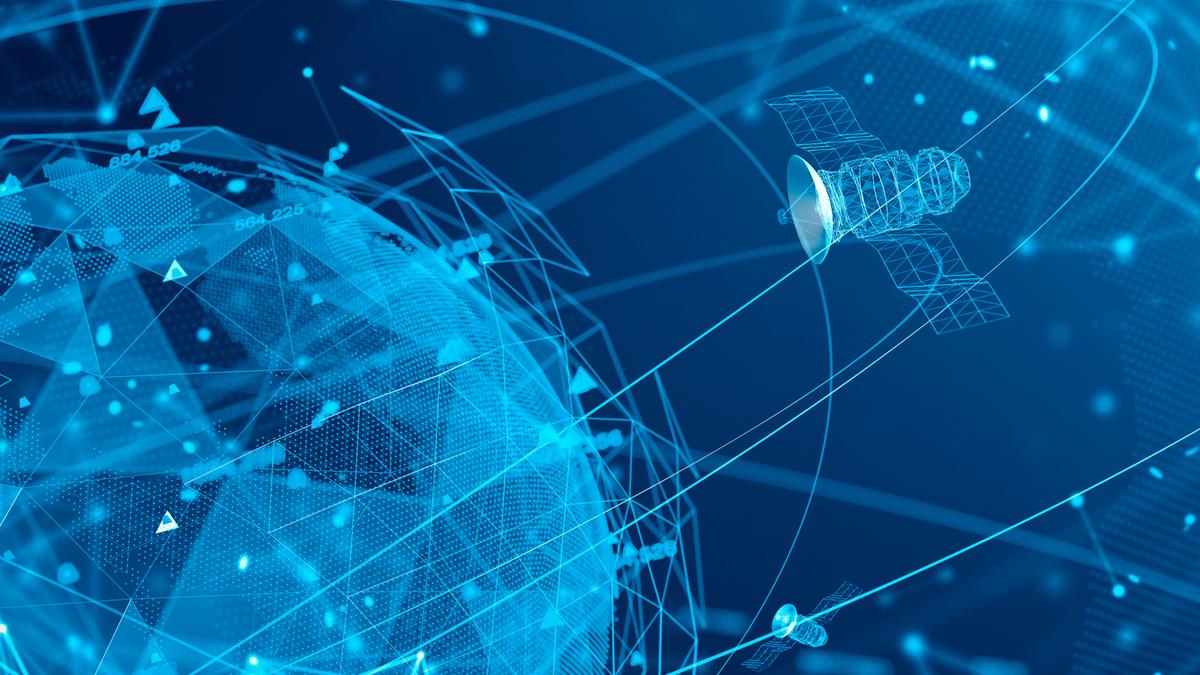
A quantum satellite is a term for a communications satellite that uses quantum physics to secure its signals.
Communications is a broad term that refers to technologies that send and receive signals. An important part of these technologies is security: preventing bad actors from intercepting a message being transmitted across large distances, through multiple networks.
The advent of quantum computers threatens the technologies currently being used to secure messages. Fortunately, quantum physics has also paved the way for new forms of protection, and quantum satellites are expected to facilitate them.
How are messages secured?
Say two people, Anil and Selvi, are standing at two ends of a playground and wish to speak to each other. The simplest way is to shout or wave their hands. There is also a third person, Kaushik, standing in the middle of the ground trying to eavesdrop on the conversation. If Anil and Selvi are shouting or using hand signals, Kaushik will have little difficulty intercepting their messages — but not if they are communicating via WhatsApp.
Messages in WhatsApp are encrypted. Encryption means a message is written in a secret code before it is transmitted. When the recipient receives it, they will use their knowledge of the code to decrypt the message and read it. If a bad actor like Kaushik somehow intercepts the message, he can’t read it without knowing the code.

For example, in a Caesar cipher, the letters of the alphabet are offset by a fixed number. If the number is 5, the words BIRDS FLY AWAY become GNWIX KQD FBFD.
This paradigm is called cryptographic security. It gets its strength by hiding the key to cracking the code behind an extremely difficult mathematical problem. Anil’s and Selvi’s devices already have the solution to this problem. If Kaushik wants it, however, he has to first solve the problem with a computer — and the harder the problem, the more time (or more computing resources) he will need.
A modern computer can crack a Caesar cipher quickly by repeatedly trying all possible keys (1-26) until the text becomes legible. But even the most powerful supercomputers can’t crack the best Advanced Encryption Standard ciphers today in a single lifetime. Quantum computers may be able to do better, however.
How can quantum physics protect messages?
Quantum cryptography uses the tenets of quantum physics to secure messages. Its most famous type is quantum key distribution (QKD).
In the example before, Anil used a secret code to encrypt or ‘lock’ his message and Selvi had the key to decrypt and read the message. QKD is concerned with sharing the key with Anil and Selvi such that if Kaushik is eavesdropping on the transmission, everyone will find out and the sharing is aborted.
Quantum physics can reveal eavesdropping in different ways. One is quantum measurement — the act of measuring the properties of a quantum system, like a photon (the subatomic particle of light). According to the rules of quantum physics, a quantum measurement changes the state of the system. If information about the key is encoded in a stream of photons (in two states, one representing 0 and the other 1) and Kaushik traps and measures them to look for it, the state of the photons will change and Anil and Selvi will know the key has been compromised.
Another way is to use quantum entanglement: when two photons are entangled, any change to one particle will instantaneously change the other. (This is a necessarily simplistic description.)
Since the key will be lost irrespective of what technological capabilities Kaushik possesses, QKD is said to provide unconditional security.
Has QKD been implemented?
Ravindra Pratap Singh, of the Physical Research Laboratory, Ahmedabad, wrote in 2023 that the standards for different QKD protocols and the technologies they will require to implement as designed are still a decade away. This said, China currently operates the world’s largest QKD network with three quantum satellites and four ground stations.
Experts are also trying to implement QKD across longer distances. In the two decades since its experimental proof in 1992, the distance of reliable transmissions has increased to several hundred kilometres either through fibre-optic cables or free space.
In 2013, researchers from China reported that they had implemented QKD between a ground station and a moving hot-air balloon (carrying a payload of instruments) 20 km up. This demonstration bolstered the case for quantum satellites.
In an October 2024 study, researchers at the Raman Research Institute, Bengaluru, reported that the Indian Astronomical Observatory in Hanle, Ladakh, offered the best atmospheric conditions through which to transmit data for a satellite-based QKD system. It had an estimated signal loss of 44 dB, compared to 50 dB in the Chinese experiment.
“Our main signal would be at 810 nm while the uplink and downlink would use 532 nm and 1550 nm of wavelength, respectively,” the paper’s lead author Satya Ranjan Behera told the Department of Science & Technology. The planned beam distance is 500 km.

Does QKD have drawbacks?
Because QKD on paper can be very different from that in the real-world, the U.S. National Security Agency has recommended the use of post-quantum cryptography rather than quantum cryptography. Its criticism is focused on five limitations:
(i) “QKD does not provide a means to authenticate the QKD transmission source”;
(ii) “since QKD is hardware-based”, QKD networks can’t be upgraded or patched easily;
(iii) “QKD increases infrastructure costs and insider threat risks” that “eliminate many use cases from consideration”;
(iv) “the actual security provided by a QKD system is not the theoretical unconditional security from the laws of physics … but rather the more limited security that can be achieved by hardware and engineering designs”; and
(v) since eavesdroppers can cause a transmission to stop, they can deny the use of a transmission by its intended users (a.k.a. a denial-of-service attack).
Post-quantum cryptography refers to cryptographic techniques that resist attacks from both quantum and classical devices using more advanced classical encryption.
Quantum physics also imposes some restrictions. For example, non-quantum information can be amplified before being transmitted across large distances whereas the no-cloning theorem prohibits the amplification of quantum information.
Published – December 20, 2024 06:00 am IST