



Skip to content
  • Facebook
  • X
  • Linkedin
  • WhatsApp
  • Associate Journalism
  • About Us
  • Privacy Policy
  • 033-46046046
  • editor@artifex.news
Artifex.News

Artifex.News

Stay Connected. Stay Informed.

  • Breaking News
  • World
  • Nation
  • Sports
  • Business
  • Science
  • Entertainment
  • Lifestyle
  • Toggle search form
  • Rupee turns flat at 83.87 against U.S. dollar in early trade Business
  • Parents Of Sanjiv Khanna, Next CJI, Wanted Him To Be Chartered Accountant Nation
  • Hezbollah fires over 200 rockets into Israel after killing of senior commander World
  • 2 Terrorists Killed In Encounter With Security Forces In J&K’s Anantnag Nation
  • How will AlphaFold 3 change life sciences research? Science
  • Samoan batter Darius Visser sets new T20 international record with 39-run over Sports
  • ICC Delegation To Discuss Tentative Schedule Of Champions Trophy With PCB Sports
  • Russia, China conduct joint navy patrol in the Pacific World

Firefly Sparkle galaxy offers a taste of the infant Milky Way

Posted on December 12, 2024 By admin


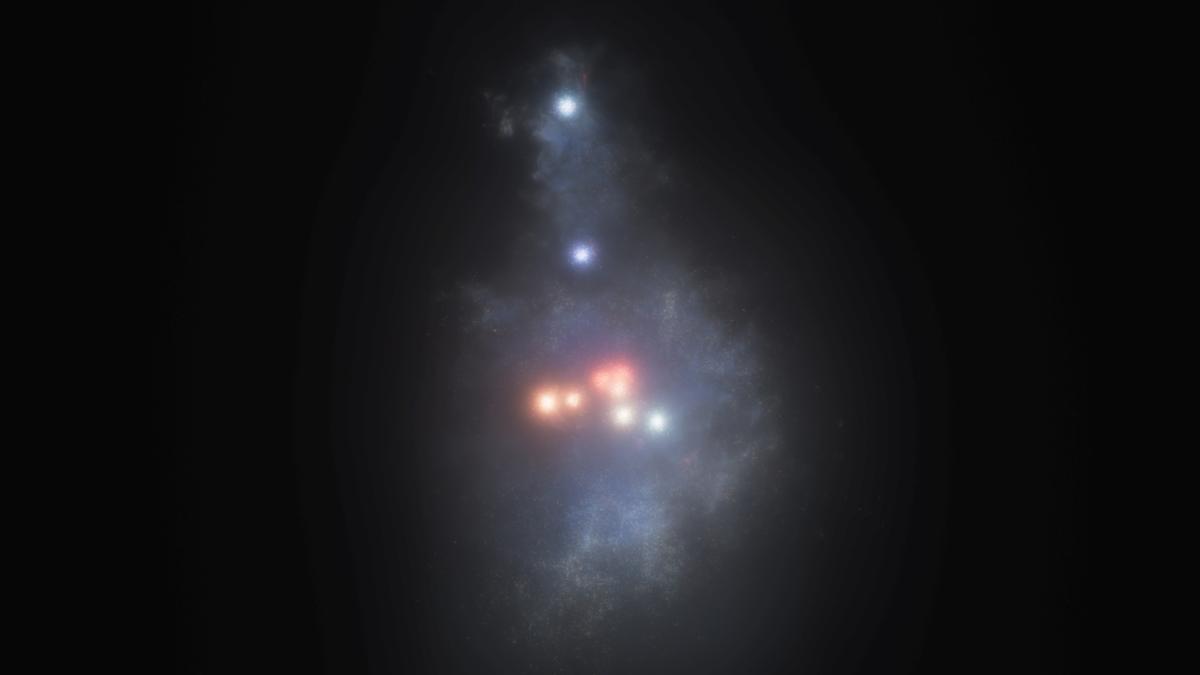
An illustration depicting a reconstruction of what the Firefly Sparkle galaxy looked like about 600 million years after the Big Bang if it was not stretched and distorted by a natural effect known as gravitational lensing. This concept is based on images and data from NASA’s James Webb Space Telescope.
| Photo Credit: Reuters

NASA’s James Webb Space Telescope has spotted a young galaxy dating to the early universe – called Firefly Sparkle because its gleaming star clusters resemble the bioluminescent bugs – in a discovery that is giving astronomers a peek at what our Milky Way may have looked like in its infancy.

Researchers said the galaxy, still in the process of assembling, dates to when the universe was roughly 5% of its current age, about 600 million years after the Big Bang event that initiated the cosmos. It has a mass equal to about 10 million stars the size of our sun, and has two other relatively small galaxies as neighbors, dubbed Firefly-Best Friend and Firefly-New Best Friend.

It is comprised of 10 densely packed star clusters embedded in a diffuse arc of stars, eight in its central region and two along its extended arm. Its main visible portion spans about 1,000 light-years across. A light year is the distance light travels in a year, 5.9 trillion miles (9.5 trillion km).

The galaxy is estimated to have formed 100-400 million years before its evolutionary stage that was observed by Webb, the most capable space telescope ever deployed.

“The Milky Way began forming very early in the universe’s history, likely around the same time as Firefly Sparkle,” said astronomer Lamiya Mowla of Wellesley College in Massachusetts and the Center for Astronomy, Space Science and Astrophysics in Bangladesh, co-lead author of the study published on Wednesday in the journal Nature.

“This observation gives us a direct look at what galaxies like our Milky Way might have looked like in their infancy. Using simulations and statistical methods, we find that the Firefly Sparkle’s mass is consistent with what we’d expect for a Milky Way ancestor at that early time. At this stage, the galaxy was about 10,000 times less massive than our current Milky Way, which is typical of galaxies at that epoch,” Mowla added.

So how did the firefly name come about?

“A group of fireflies – which is what this galaxy looks like – is called a sparkle,” Mowla said.

Firefly Sparkle is located about 6,500 light-years from Firefly-Best Friend and about 42,000 light-years from Firefly-New Best Friend. All three would fit neatly inside the present-day Milky Way, which measures about 100,000 light-years across.

“The Milky Way continued to grow and evolve over billions of years through mergers with other galaxies and continued star formation, while we’re seeing Firefly Sparkle in its initial formation stages,” said astronomer and study co-lead author Kartheik Iyer, a NASA Hubble Fellow at Columbia University in New York.

“Early galaxies like Firefly Sparkle appear to form through the collapse of dense gas clouds in the early universe. Current theory and simulations suggest several possible mechanisms for how stars form from gas in the extreme conditions of the early universe. Our analysis suggests that these galaxies can build up through the formation of massive star clusters in regions of extreme pressure and density, which then merge or grow together over time,” Iyer added.

Its star clusters display slightly different colors, indicating they did not all form simultaneously. For instance, hotter, younger stars look more blue, while older stars are more red.

Webb has been able to look across vast distances – thus back in history because of the time it takes light to travel – to see galaxies dating to the first few hundred million years after the Big Bang roughly 13.8 billion years ago, an age called cosmic dawn.

Firefly Sparkle is one of the earliest low-mass galaxies currently known, observed with the help of a phenomenon called gravitational lensing. This occurs when a massive object with tremendous gravitational strength – in this case, a galaxy cluster – bends light from more distant objects behind it from the vantage point of Earth, acting like a natural magnifying glass.

“In this study, the foreground galaxy cluster magnified the light from Firefly Sparkle by about 16-26 times, making it possible to see details that would otherwise be too faint to observe,” Iyer said.

Published – December 12, 2024 01:53 pm IST


Source link

Science Tags:Firefly sparkle galaxy, Milky Way, science, science news

Post navigation

Previous Post: Who Are Alexander Brothers, Real Estate Tycoons Accused Of Sexual Assault
Next Post: Son Of Scientist At Bhabha Atomic Research Centre Confesses To Killing Mother

Related Posts

  • CSIR-IICT scientists identify microalgae as a potential protein supplement Science
  • How can a quantum computer prove that it is superior? Science
  • Whales near Antarctica face dire competitor for krill: industrial fishing Science
  • Chandrayaan-3 | Centre asks universities to organise special assemblies to watch Moon landing Science
  • ISRO to hold more tests for Gaganyaan in coming months Science
  • Glycemic index of diets: importance beyond diabetes control Science

More Related Articles

Why can’t light microscopes see inside cells? Science
Chandrayaan 4 and 5 design complete; 70 satellites likely to be launched in 5 years: ISRO chief Science
Ultradian rhythms: The cycles of life Science
Russia reports coolant leak in backup line at space station and says crew not in danger Science
Chandrayaan vs. Chang’e: How different are India’s and China’s lunar missions? Science
Chandrayaan-3 | Another instrument onboard Pragyan confirms presence of sulphur Science
SiteLock

Archives

  • December 2024
  • November 2024
  • October 2024
  • September 2024
  • August 2024
  • July 2024
  • June 2024
  • May 2024
  • April 2024
  • March 2024
  • February 2024
  • January 2024
  • December 2023
  • November 2023
  • October 2023
  • September 2023
  • August 2023
  • July 2023
  • June 2023
  • May 2023
  • April 2023
  • March 2023
  • February 2023
  • January 2023
  • December 2022
  • November 2022
  • October 2022
  • September 2022
  • August 2022
  • July 2022
  • June 2022
  • May 2022

Categories

  • Business
  • Nation
  • Science
  • Sports
  • World

Recent Posts

  • India As 3 Indian Students Killed In Canada
  • Who is Francois Bayrou, France’s Fourth Prime Minister In 12 Months
  • Trump wants to turn the clock on daylight saving time
  • Reeza Hendricks’ Maiden T20I Ton Seals Series Win For South Africa vs Pakistan
  • India vs Australia: Steve Smith’s Dressing Room Activity During 3rd Test Viral, Leaves Internet Intrigued

Recent Comments

  1. dfb{{98991*97996}}xca on UP Teacher Who Asked Students To Slap Muslim Classmate
  2. "dfbzzzzzzzzbbbccccdddeeexca".replace("z","o") on UP Teacher Who Asked Students To Slap Muslim Classmate
  3. 1}}"}}'}}1%>"%>'%> on UP Teacher Who Asked Students To Slap Muslim Classmate
  4. bfg6520<s1﹥s2ʺs3ʹhjl6520 on UP Teacher Who Asked Students To Slap Muslim Classmate
  5. pHqghUme9356321 on UP Teacher Who Asked Students To Slap Muslim Classmate
  • ISRO all set for third reusable launch vehicle landing experiment Science
  • Opposition Questions Special Parliament Session Timing, Cites Ganesh Chaturthi Nation
  • Centuries-old ‘kalithattu’ structures left to decay in Kerala’s Alappuzha Nation
  • Pragyan rover comes throughout 4-meter diameter crater on lunar floor: ISRO Science
  • Markets decline in early trade on weak Asian peers, foreign fund outflows Business
  • North Korea’s Kim Jong Guides Artillery Firing Drill In Range Of Seoul: Report World
  • How A 660-Tonne Pendulum Protected Taiwan’s Tallest Skyscraper During A 7.4-Magnitude Earthquake World
  • IPL-17: RCB vs KKR | Blazing Narine leads the chase as KKR makes short work of RCB Sports

Editor-in-Chief:
Mohammad Ariff,
MSW, MAJMC, BSW, DTL, CTS, CNM, CCR, CAL, RSL, ASOC.
editor@artifex.news

Associate Editors:
1. Zenellis R. Tuba,
zenelis@artifex.news
2. Haris Daniyel
daniyel@artifex.news

Photograher:
Rohan Das
rohan@artifex.news

Artifex.News offers Online Paid Internships to college students from India and Abroad. Interns will get a PRESS CARD and other online offers.
Send your CV (Subjectline: Paid Internship) to internship@artifex.news

Links:
Associate Journalism
About Us
Privacy Policy

News Links:
Breaking News
World
Nation
Sports
Business
Entertainment
Lifestyle

Registered Office:
72/A, Elliot Road, Kolkata - 700016
Tel: 033-22277777, 033-22172217
Email: office@artifex.news

Editorial Office / News Desk:
No. 13, Mezzanine Floor, Esplanade Metro Rail Station,
12 J. L. Nehru Road, Kolkata - 700069.
(Entry from Gate No. 5)
Tel: 033-46011099, 033-46046046
Email: editor@artifex.news

Copyright © 2023 Artifex.News Newsportal designed by Artifex Infotech.