







One of the most astonishing facts about the natural world is the existence of antiparticles. Theorised by the English physicist Paul A.M. Dirac in 1928 and observed in cosmic rays by American physicist Carl Anderson in 1932, an antiparticle is a ‘partner’ of a particle type that has the same mass but opposite charge. For example, the antielectron is the antiparticle of the electron; it has the same mass and is positively charged.
Antiparticles are an inevitable consequence of describing the world in terms of quantum mechanics and special relativity.
An antiparticle is a particle travelling backward in time. This is not an oversimplification. If it sounds eerie, that’s because it is.
O antimatter, where art thou?
But where is all the antimatter made of antiparticles? It is certainly scarce, or we would have discovered it a long time ago. Still, antiparticles are detectably numerous. Our own bodies make one antielectron every 20 seconds from the decay of potassium-40. Cosmic rays raining down on us supply antiprotons, antielectrons, and even antinuclei. Every proton and neutron — constituents of the nuclei that make up all the matter we can touch — is teeming with antiquarks.
But it is when we look out at the universe as a whole that antimatter’s scarcity becomes clear. All galaxies are made of matter, not antimatter. Even in the infant universe, there had to have been a small dissimilarity between the populations of protons and antiprotons for our predictions about the outcomes of the synthesis of nuclei in the early universe and the features of the cosmic microwave background (radiation leftover from the Big Bang) to hold.
That is, for every 1.7 billion proton-antiproton pairs, there should have been an extra unpaired proton.
Something happened
Presumably the universe started out with equal amounts of matter and antimatter before something happened to distort this symmetry. That’s a good thing: otherwise matter and antimatter would have mutually annihilated to fill the universe with nothing but a fog of radiation — no raw material to make stars, planets or us.
But what spoiled the symmetry? Put differently, why is there something around us rather than nothing (but that fog)? Nobody knows for certain. What we do know is that any theory attempting to explain it must satisfy three conditions, called the Sakharov conditions. The best current theory to explain the world, the Standard Model of particle physics, falls woefully short of meeting all of them.
At least this was the lore until the authors of an August 2024 preprint paper pointed out an interesting caveat.
They showed that one of the conditions can be satisfied by the Standard Model alone, provided some new particle species helps with the process of making matter.

An unsettling discovery
Look at the world in a mirror. Does it look the same? Apples would still fall and moons would circle planets because gravity would be unchanged. Protons and neutrons would cling to form nuclei because the strong nuclear force would be preserved. But atomic nuclei won’t undergo radioactive fission because that happens via the weak force. And the weak force, like a vampire, vanishes in the mirror-world.
The discovery of this fact in 1957 was profoundly unsettling because it struck at cherished notions of symmetry in nature. A parity transformation (denoted P) — the act of swapping left and right — appeared to eliminate the weak force. But soon physicists found that if they replaced a particle with its antiparticle in the mirror-world, the weak force reappeared. This action is called charge conjugation (C). It seems the universe didn’t conserve P and C separately but did so when they happened together. This is called CP symmetry.
But in 1964, American physicists James Cronin and Val Fitch found that even CP symmetry is violated. And it wasn’t violated all the time — which made it more nagging. They found that it was violated around once for every thousand times a process involving the weak force happened in nature. Nine years later, Makoto Kobayashi and Toshihide Maskawa in Japan found that if there were at least three variants of every quark species — with all properties the same except for the mass — CP symmetry violation is unavoidable. And all fermion particles do come in three variants, a.k.a. generations. For instance, the up quark has two other variants: the charm and top quarks.
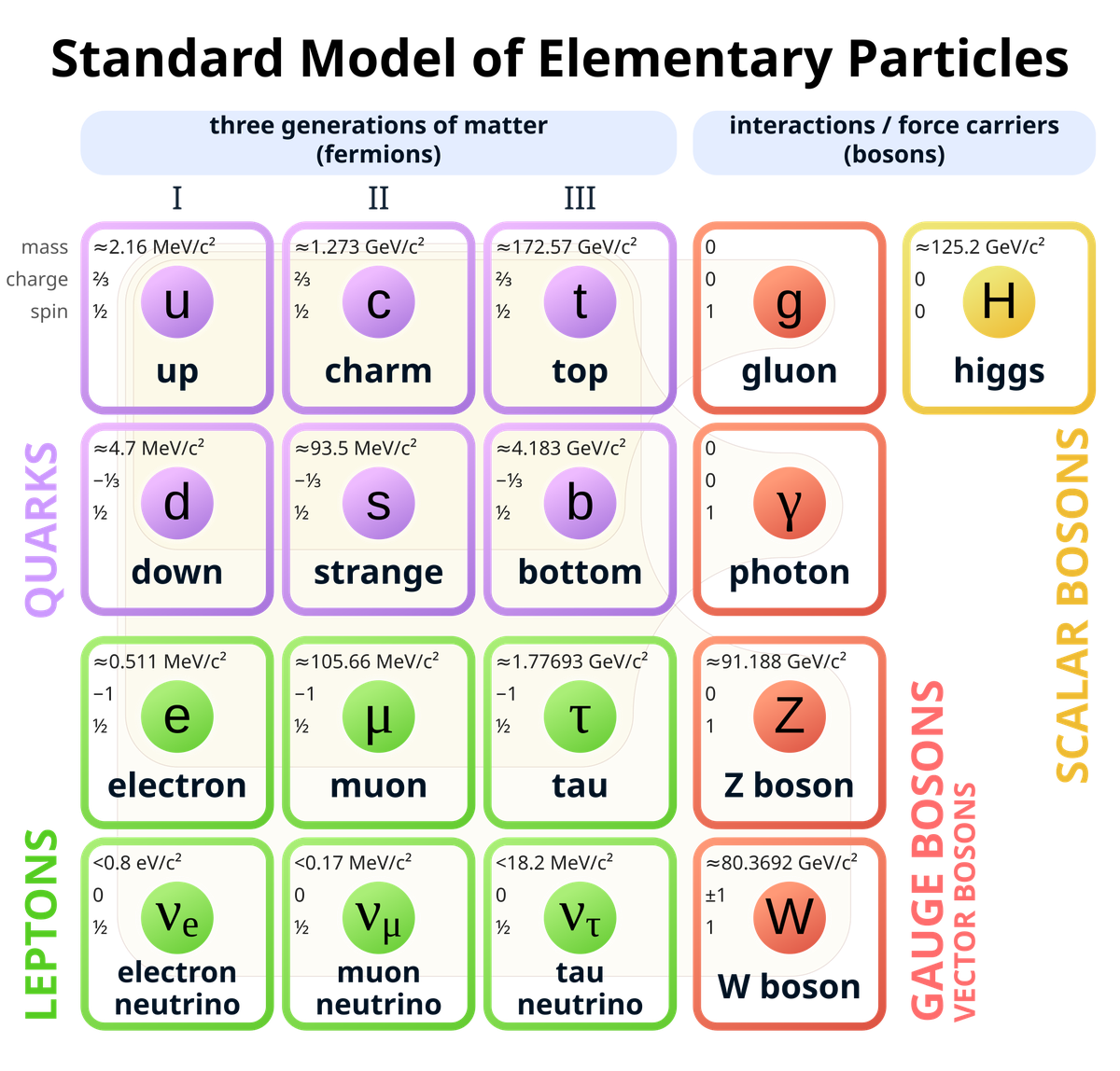
The (current) crop of fundamental particles making up matter as we know it and the different ways they can interact. The W and Z bosons mediate the weak force.
| Photo Credit:
Public domain
(Around the same time, physicists also found that the strong nuclear force — involved in fission and fusion — ought to violate CP symmetry strongly but doesn’t. This is called the strong CP puzzle.)
The Sakharov conditions
Now, as soon as CP symmetry violation was confirmed, the Soviet physicist Andrei Sakharov realised it’s actually an essential condition to create a matter-antimatter asymmetry in the early universe. Unfortunately, the amount of CP symmetry violation the Standard Model allowed for (the ~1 in 1,000 rate) proved insufficient to explain the magnitude of the asymmetry.
This is where the authors of the August paper have pointed out a loophole. We have known for some time that processes involving mesons — particles made of quark-antiquark pairs — violate CP symmetry, which is just how Cronin and Fitch made their discovery. Now, if a meson could decay to particles not contained in the Standard Model, the matter-antimatter asymmetry could be controlled by the product of two quantities: the amount of standard CP violation and the fraction of decays into the non-standard particles. This fraction can’t be too large: otherwise we would have detected the non-standard particles in particle colliders.

The study’s conceit, then, is to introduce a mechanism that ensured this fraction was large just in the early universe but evolved to a smaller number today. This can be done if the masses of the new particles vary over time, which is possible to arrange in quantum field theory.
Hard-won progress
This mechanism has thus brought one of the three Sakharov conditions within the reach of the Standard Model five decades since these conditions came to light.
The other two conditions are: (i) A large violation in a type of charge carried by particles, called the baryon number. For example, protons and neutrons have a baryon number of 1 and their antiparticles carry a value of -1. (ii) Interactions must occur out of thermal equilibrium, meaning that particle processes in the forward and backward directions do not occur at the same rate.
While the Standard Model does not meet these conditions adequately, the work discussed here serves as an important step towards understanding why matter overwhelmingly dominates over antimatter in our universe today.
Nirmal Raj is an assistant professor of theoretical physics at the Centre for High Energy Physics in the Indian Institute of Science, Bengaluru.
Published – December 10, 2024 05:30 am IST