




The story so far: The air quality in the national capital has been struggling to recover from the lows to which it dropped right after Deepavali despite the implementation of GRAP stage IV measures, the active intervention of the Supreme Court, and stop-gap measures by the Delhi government. Many fingers are currently pointed at the farm fires in the surrounding states, where farmers are burning paddy stubble in time for the wheat-sowing season. While these fires aren’t solely responsible for Delhi’s plight, a controversy over measuring their prevalence illustrates the amount of attention they’re receiving.
How are the fires counted?
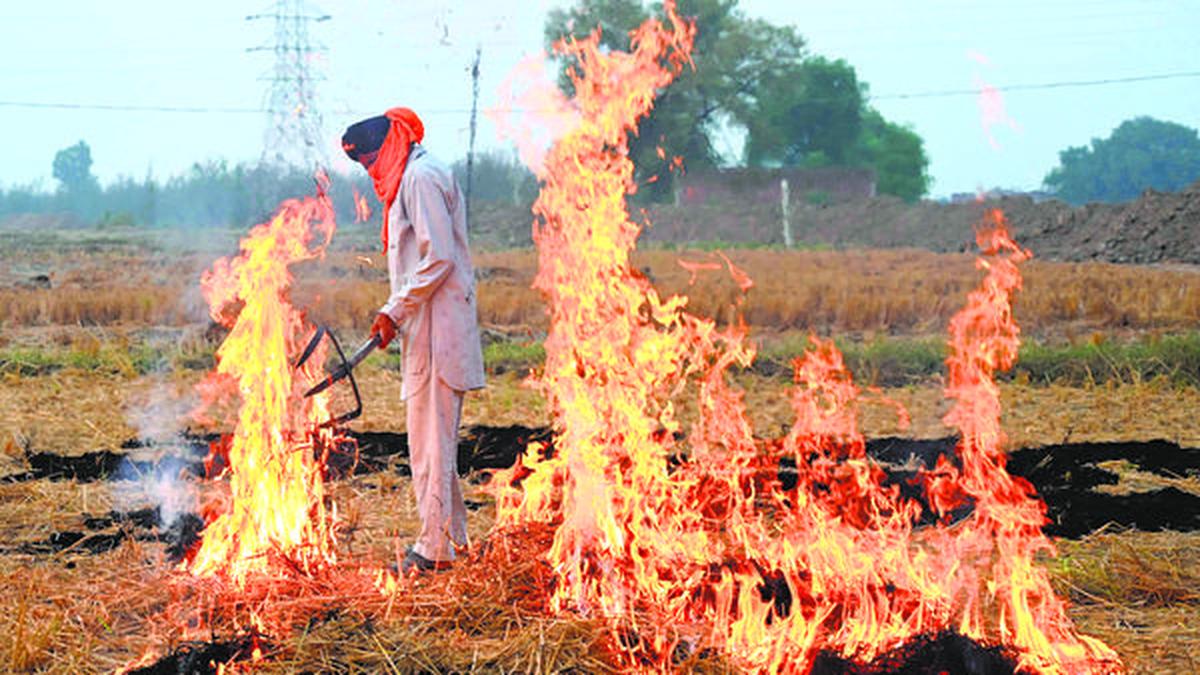
Farmers in Punjab and Haryana sow rice in the kharif season and harvest it in November, using the summer monsoons to quench the crop’s high water demand. After the rice is harvested, they need to clear the leftover organic material — called paddy stubble — in order to make way for the next sowing season. For reasons of time and cost, they have traditionally preferred to burn the stubble.
But thanks to the winds at this time of the year over the National Capital Region, the toxic particulate matter from the fires is floated to and hangs over New Delhi, dragging its air quality down.
Because of the large area over which farmers light the fires, officials have said satellites are the best way to track the fires. The Indian government currently procures this data from two NASA satellites called Aqua and Suomi-NPP.
NASA launched Aqua in 2002 and it is currently in the twilight stage of its designed lifespan. Its Moderate Resolution Imaging Spectroradiometer (MODIS) instrument was built to track changes in the lower atmosphere, especially over land, through time. MODIS’s technical successor is the Visible Infrared Imaging Radiometer Suite (VIIRS) instrument onboard Suomi-NPP, which NASA launched in 2011. Both satellites are part of NASA’s ‘Earth Observing System’.
Aqua’s and Suomi-NPP’s overpass at each location happens at 1.30 pm local time in the day and at 1.30 am local time at night. Their MODIS and VIIRS instruments collect high-resolution visible and infrared images of the earth at around these intervals and are capable of spotting fires and smoke in a small window centred on the overpass time.
What is the new controversy?
On October 2, a senior scientist at NASA’s Goddard Space Flight Centre named Hiren Jethva wrote on X (Twitter) that there were 40% fewer farm fires than predicted in 2023 and expressed hope for the trend to continue this year. On October 24, Jethva wrote in the same thread that the number of fires in 2024 seemed to be the “lowest in [the] last decade”, and added that either “ground efforts to curb residue-burning appear to be working or burning activities [are] taking place after satellite overpass time, but it needs ground-truthing”.
His post implied farmers were burning paddy stubble after the Aqua and Suomi-NPP satellites had completed their overpass at around 1.30 pm.
The next day Jethva followed up by comparing data from Aqua and Suomi-NPP with data from the GEO-KOMPSAT 2A satellite. South Korea launched this satellite, also called Cheollian 2A, in 2018 as a “dedicated geostationary weather satellite”; it’s currently stationed at 128.2º E and has a planned mission life of at least a decade.
In the visuals Jethva collected and presented from the three satellites, the smoke cover over cropland in Punjab and Haryana seemed to thicken after Aqua and Suomi-NPP had completed their overpass, as if farmers were lighting more fires later in the day from before.
The senior scientist also wrote that the quantity of aerosols in the air was roughly the same as in previous years whereas it should’ve been lower given Aqua and Suomi-NPP indicated there were fewer fires.
Is the discrepancy real?
In 2020, the Indian government created the Commission for Air Quality Management in the NCR and Adjoining Areas (CAQM for short) by ordinance and a subsequent Act of Parliament in 2021. Its mandate was to study, identify, and resolve issues relevant to improving air quality in its jurisdiction.

On November 23, The Hindu reported based on multiple sources and documents that the CAQM was aware farmers were burning paddy stubble after the NASA satellites had completed their overpass to avoid being detected. However the CAQM has continued to insist in the public that the number of farm fires has dropped, defending its conclusion in the face of contrary evidence by claiming it used different formulae.
That farmers were aware of the overpass timings is recorded in the minutes of a March 7, 2024, meeting, where director of Haryana Space Applications Centre Sultan Singh and National Remote Sensing Centre (NRSC) scientist Bhavana Sahay alleged as much. Farmers on the ground also told The Hindu a government official had asked them to light fires after 4 pm.
(The alleged advice echoes Goodhart’s law: “when a measure becomes a target, it ceases to be a good measure”.)
The CAQM has also come under the pump from a second angle: in affidavits to the Supreme Court, it has said the burnt area in Punjab shrunk 26.5% between 2022 and 2023 whereas data from the Government of Punjab and the Indian Agricultural Research Institute, which is funded by the Centre, says it increased 24% and 15% respectively.
How is the government responding?
The Centre had originally created the CAQM to replace the Environmental Pollution (Prevention and Control) Authority (EPCA), which the Supreme Court had created in 1998. EPCA was a non-statutory body and lacked the instruments to sanction non-compliant actors. CAQM was designed to have teeth in the 2021 Act — and which it has since been accused of not wielding.
The Supreme Court in particular has upbraided the CAQM for failing to mitigate air pollution resulting from the fires over the years. The body is expected to respond on November 25 to the Supreme Court to allegations that it was aware farmers were delaying burns to after the satellites’ overpass.The Indian government is also on the back foot after Union agriculture minister Shivraj Singh Chouhan said on October 26 that the number of stubble-burning incidents have dropped this year.
But the CAQM has also maintained that its efforts have lowered the prevalence of fires by 71% in Punjab and 44% in Haryana between 2020 and 2024, and has objected to the idea of a group of retired judges overseeing the fight against stubble-burning.
The CAQM also said it wrote to the NRSC — a body under the Indian Space Research Organisation (ISRO) — asking it to develop a standard protocol to measure burnt area in January 2024. At present, burnt area data is available once every five days from the Sentinel II satellites of the European Space Agency.

Can Indian satellites help?
In an affidavit to the Supreme Court on November 21, the CAQM said ISRO plans to evaluate the usability of data from various satellites to identify farm fires. According to the affidavit, ISRO experts are of the view that data from INSAT-3DR (by India), GEO-KOMPSAT 2-AMI (South Korea), Meteosat-9, Feng Yun-4A/4B (China), and HIMAWARI-8 (Japan) can’t provide account fire counts — although their assessments won’t be complete for at least another month.
The problem with INSAT-3DR is that its data is too coarse: of 1 km in visible and short-wave infrared radiation, of 4 km in middle and thermal infrared, and of 8 km for water vapour.
ISRO also operates the three RESOURCESAT satellites, launched in 2003, 2011, and 2016, with similar payloads. Those in RESOURCESAT 2A have better features, however. The Linear Imaging Self Scanner (LISS) cameras 3 and 4, both of which ‘see’ in visible and near-infrared radiation; LISS-4 has a spatial resolution of 5.8 m and LISS-3, of 23.5 m. The Advanced Wide Field Sensor (AWiFS) camera detects similar radiation at an even lower resolution of 56 m.
Published – November 24, 2024 10:36 am IST