




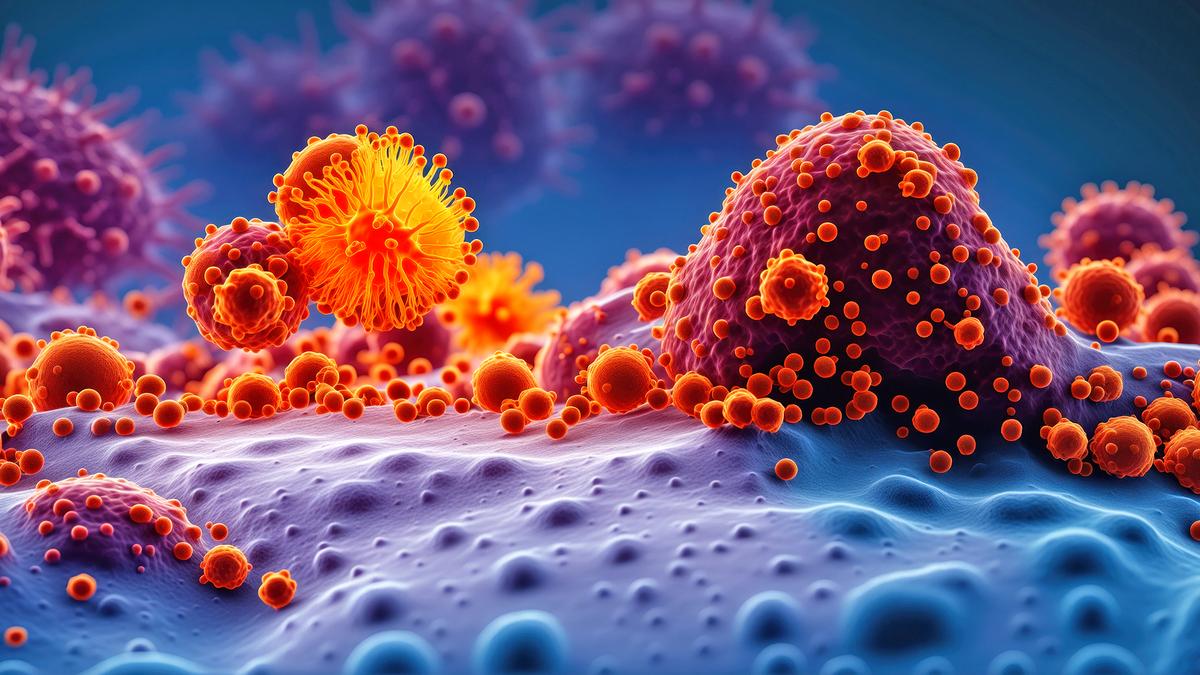
Broadly speaking, cancer is a rogue colony of body cells that grow uncontrollably, feed on the body’s resources, and spread to other parts of the body through the bloodstream
| Photo Credit: Getty Images
Cancer, often called the “emperor of all maladies,” remains a formidable adversary despite decades of scientific progress. However, research in recent years has brought us closer to unlocking new ways to combat it. A study from Northwestern University in Chicago, published in the November issue of The Journal of Clinical Investigation, has gained attention for discovering that white blood cells activated by severe COVID-19 demonstrate cancer-fighting abilities.
Working with laboratory mice, researchers showed that the spread of cancer, also known as metastasis, could be slowed by a specialised type of white blood cell called induced non-classical monocytes (I-NCMs). These cells can be generated through severe infections like COVID-19 or by using certain chemicals. Once activated, I-NCMs are able to leave blood vessels and migrate to tumours, where they launch an attack on cancer cells. COVID-19 is known to cause worse outcomes for older individuals and those weakened by ailments including cancer. However, there are rare reports of cancer going into remission (absence of disease) following COVID-19.
A 2023 study by De Nigris and colleagues in the Journal of Translational Medicine described 16 such cases involving different types of cancer, including leukemia, lymphoma, myeloma, and kidney cancer. However, it is unclear if these outcomes were directly caused by COVID-19 or were part of the natural progression of the disease. This raises the question: Can cancers go away on their own? While extremely rare, the answer is yes. The most well-studied example is neuroblastoma, a rare childhood tumour that occasionally disappears without treatment. Such spontaneous improvement may be due to a newly-activated immune system gaining the ability to target cancer cells.

The potential of immunotherapy
Over the past decade, immunotherapy has emerged as a promising approach to cancer treatment.
Broadly speaking, cancer is a rogue colony of body cells that grow uncontrollably, feed on the body’s resources, and spread to other parts of the body through the bloodstream. Cancer cells often reprogramme the body’s immune system to protect themselves from detection and destruction, much like a thief bribing a security guard to look the other way. Immunotherapy aims to overcome these defences by empowering the body’s immune cells to fight back. The Northwestern University research showed that injecting a specific type of white blood cell, I-NCMs, into mice was effective in combating cancer metastasis.
I-NCMs are derived from monocytes which circulate in the bloodstream. Monocytes are involved with fighting off infections, immune regulation and repairing damaged tissue. When exposed to certain bacterial or viral infections or chemicals, a small number of these monocytes transform into I-NCMs. If white blood cells represent all adults in a town and monocytes are those who made it to military selection, think of I-NCM’s as the select few from the military who qualified for a specialised commando unit.
Unlike regular monocytes, I-NCMs possess a unique receptor, CCR2, which acts like a specialised antenna to detect signals emitted by certain types of cancer cells or inflamed tissues. These signals guide I-NCMs to the source, where they perform specific tasks. For example, at an infection site, they help eliminate pathogens. At a tumour site, they recruit other immune cells called natural killer (NK) cells, which are effective at destroying cancer cells. Natural killer cells are a vital component of the immune system, directly targeting and eliminating abnormal-appearing cells, such as cancer cells or virus-infected cells. Unlike T cells and B cells, natural killer cells do not require prior approval from the body’s adaptive immune system. This ability to act swiftly and assertively makes them a critical part of the body’s innate immunity. They work as frontline defenders against infections and cancer.
The Northwestern University study found that I-NCMs play a crucial role in summoning these NK cells to tumour sites. So, how can these specialised I-NCMs be generated? The researchers discovered that infections like COVID-19, caused by the SARS-CoV-2 virus, can trigger their formation. However, this does not mean that all COVID-19 patients will experience improvements in cancer outcomes. Bacterial products like peptidoglycans and NOD2 agonists such as MDP (muramyl dipeptide) analogues can also be used to convert regular monocytes to I-NCM’s.

Breakthroughs over the years
The idea of using the immune system to fight cancer is not new. In the late 19th century, William Coley, a surgeon at Memorial Hospital in the United States, observed that some cancer patients who developed bacterial infections showed better outcomes. He injected bacterial toxins into cancer patients and found that it helped to prevent cancer recurrence after surgery. These “Coley’s toxins” were used until the mid-20th century, eventually giving way to treatments such as chemotherapy and radiation. Although Dr. Coley’s work fell out of favour, it laid the foundation for modern immunotherapy, which has seen remarkable success in select patients.
A groundbreaking study published in The New England Journal of Medicine in 2022 by Cersek et al. demonstrated this potential. In the study, carefully-selected patients with rectal cancer achieved complete remission—without surgery—using an immune checkpoint inhibitor. These are agents that remove the checkpoints or brakes on T cells that were preventing them from recognising cancer cells. Once the T cells are able to recognise cancer cells, they go on to destroy them.
The key to the success of immune checkpoint inhibitors in rectal cancer lay in the specific characteristics of the patients’ tumours. These patients had locally advanced mismatch repair-deficient (dMMR) rectal cancer, a condition where the tumour’s DNA repair mechanism is impaired. This impairment leads to the accumulation of numerous DNA errors or mutations, resulting in the production of abnormal proteins that are readily recognisable to the immune system. This baseline handicap made these tumours vulnerable to immunotherapy.

The use of CAR-T
Another form of immunotherapy is the use of CAR-T where the patient’s own T cells are reprogrammed in the lab and reintroduced into the body to attack the cancer. This is used in certain blood cancers like leukaemia and lymphoma.
Not all cancers respond to immunotherapy, and even when treatments show initial success, cancer cells can adapt and develop resistance. Factors such as the tumor microenvironment, the number of mutations, and PD-L1 expression, play a role in determining the effectiveness of immune checkpoint inhibitors. Similarly, attempts to generate non-classical monocytes (I-NCMs) using chemicals like MDP analogues, such as mifamurtide, have shown limited success when tried in actual cancer patients. Complete remission remains elusive. At present, mifamurtide is approved only as an additional therapy for a rare type of bone cancer in children and young adults, showcasing its limited scope.
The Northwestern University study highlights the potential of using I-NCMs in treating cancer metastasis, independent of adaptive components of the immune system like T cells and B cells. If these findings can be replicated in humans, they could add a new dimension to cancer treatment. While we are still far from a universal cure for cancer, this research offers a glimpse into a future where the body’s own defences could be effectively harnessed to fight one of humanity’s greatest challenges
(Dr. Rajeev Jayadevan is Chairman, Research Cell, Kerala State Indian Medical Association)
Published – November 22, 2024 08:00 pm IST