







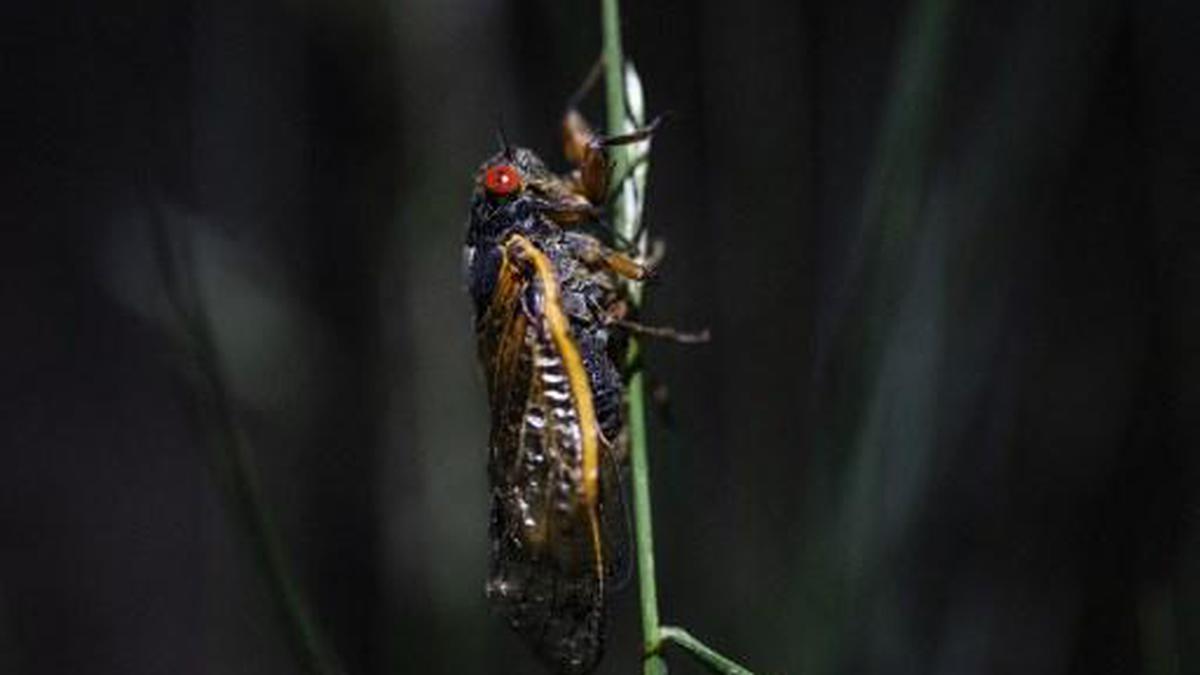
It’s a big year in America – for wildlife as well as for politics. I’m talking about periodical cicadas.
These curious creatures spend most of their lives in the ground, emerging after 13 or 17 years to eat, breed, die and repeat the cycle. For the first time in more than 200 years, two specific broods of the 13- and 17-year cicadas have emerged together: Brood XIX, in the southeastern United States, and Brood XIII, found in the country’s Midwest.
What’s more, this time the emergence of these broods also happens to coincide with an unrelated event on the other side of the world: the emergence of a big batch of Australian greengrocer cicadas, which have a seven-year life cycle.
This remarkable event has been 1,547 years in the making. Thinking about it sheds light on some of the deepest questions about mathematics.
Did we invent mathematics, or was it there all along?
Are mathematical facts created or discovered? Ask a mathematician, and they are likely to tell you that mathematical facts are discovered.
But this is perplexing: if such facts are discovered, what are we discovering? Are mathematical facts somehow “out there” before we discover them? Does that mean there’s some realm of pure mathematics that we uncover with our minds?
These sorts of questions quickly begin to feel pretty uncomfortable. We find ourselves in deep metaphysical territory, beset by questions about the nature of reality.
For it seems that in addition to the physical components of the world, there must also exist things like numbers, and even more exotic mathematical entities such as sets and functions. These seem to be real objects, that we gradually uncover through the activity of mathematics.
On the other hand, if we think of mathematics as an act of creation, these metaphysical questions disappear. Mathematics can be like a language we’ve invented to describe the world.
In this picture, mathematics is just a very precise way of speaking that happens to be useful.
Which brings us back to the cicadas: these little critters put pressure on the idea that mathematics is something we created ourselves.
Cicada life cycles
North American cicadas have life cycles that last for prime numbers of years. Why 13 or 17 years? Why not 12, 14, 15 or 16?
One explanation asks us to imagine the cicadas are hunted by periodical predators that spend most of their lives in the ground and then, after a period of time, emerge to hunt. In particular, suppose there are five species of predator, with life cycles of two, three, four, five, six and seven years.
A cicada will have the best chance of survival if it can emerge from the ground when its predators are lying dormant. The cicadas with the best chance of survival will therefore be those that manage to avoid emerging at the same time as their predators.
It turns out the best way to avoid periodical predators is to move to a life cycle that lasts a prime number of years.
To see this, suppose a cicada has 12-year life cycle. Whenever it comes out of the ground, there will be predators with two-, three-, four- and six-year life cycles on the hunt.
A cicada with a 14-year life cycle will overlap with predators possessing two- and seven-year life cycles, and a cicada with a 15-year life cycle will overlap with predators on three- and five-year cycles. Cicadas with 13- or 17-year life cycles, by contrast, will generally avoid all of these predators.
There is a general mathematical result that explains all of this, involving the lowest common multiple of two numbers: the smallest number that both can divide into evenly.
How often a cicada overlaps with a predator turns out to depend on the lowest common multiple of the cicada and predator life-cycles. For instance, a cicada with a 12-year life cycle and a predator with a two-year life cycle will overlap every 12 years, which is the lowest common multiple of two and 12. By contrast, a cicada with a 13-year life cycle and a predator with a 2-year life cycle will only overlap every 26 years.
As a general rule, having a prime-numbered life cycle is a very good way for a cicada to ensure it overlaps as little as possible with its predator.
Another theory suggests the prime-numbered life cycles actually help cicadas avoid interbreeding with other broods. Either way, similar mathematical logic applies.
This is also why Australian cicadas (with their seven-year cycle) overlap so infrequently with their US cousins (with 13- and 17-year cycles). The lowest common multiple of seven, 13 and 17 is 1,547!
What happens when mathematics explains biology?
As the US philosopher Alan Baker has argued, this biological explanation for why cicadas have prime-numbered life cycles relies heavily on mathematics. In this case, it seems like facts about mathematics explain facts about biology and evolution.
This is very hard to understand if mathematics is something we have simply created. If mathematics is a language we invented, why should it apparently guide the evolutionary history of cicadas? This would be a bit like saying the planets move the way they do because of how we talk about them in English.
Once we start looking for these explanations involving mathematics, they seem to be everywhere. To take an example from my own research: why do gears in machinery generally have prime numbers of teeth?
The answer is very similar to the cicada story. If gears have a prime-numbered amount of teeth, then the same two teeth will contact each other much less frequently than if the gear-teeth are not prime-numbered.
This ensures that if there is an imperfection on a specific pair of teeth, one from each gear, then the imperfections won’t keep striking each other. This way, the chance of the gear failing is minimised.
The end of an empire
One thousand, five hundred and forty-seven years is a long time – long enough to see empires rise and fall.
Indeed, the last time American and Australian cicadas emerged together, in the year 477, the Western Roman Empire was in the throes of collapse.
It is, of course, a coincidence that they have emerged again at what may be another turning point in Western civilisation. One can’t help but wonder, though: are the bugs to blame?
Sam Baron is associate professor, Philosophy of Science, The University of Melbourne. This article is republished from The Conversation.
Published – November 20, 2024 07:00 am IST