





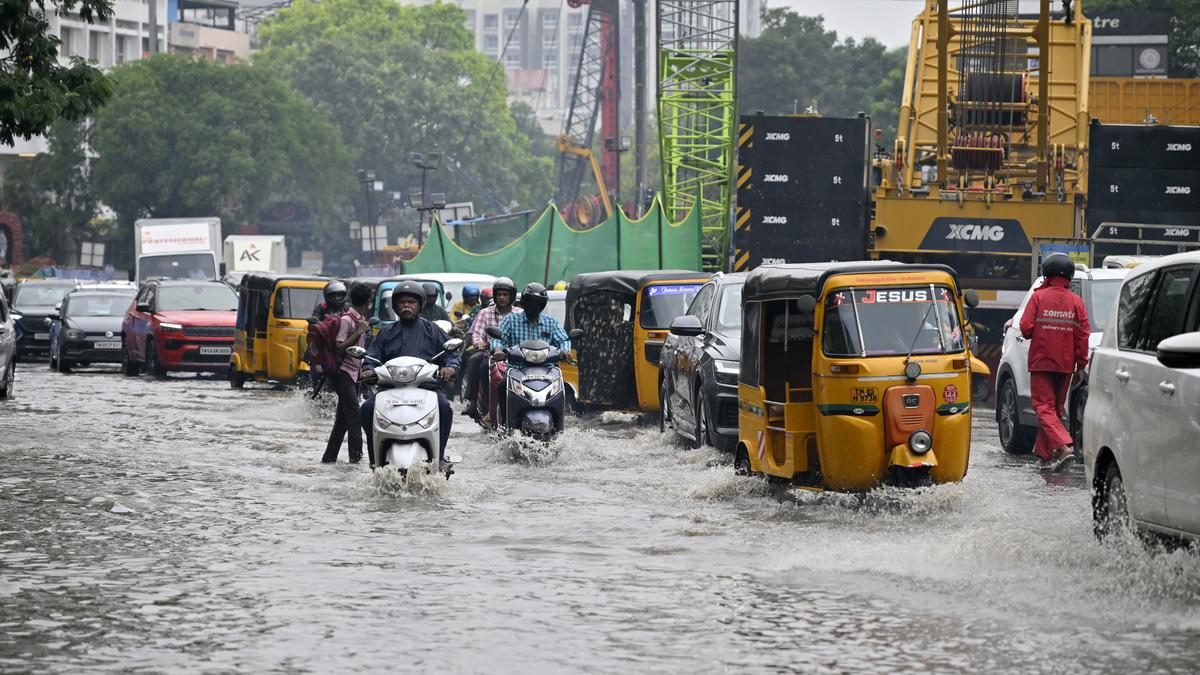
Flooding from hurricanes Helene and Milton inflicted billions of dollars in damage across the Southeast U.S. in September and October 2024, pushing buildings off their foundations and undercutting roads and bridges. It also caused dozens of electric vehicles and other battery-powered objects, such as scooters and golf carts, to catch fire.
According to one tally, 11 electric cars and 48 lithium-ion batteries caught fire after exposure to salty floodwater from Helene. In some cases, these fires spread to homes.
When a lithium-ion battery pack bursts into flames, it releases toxic fumes, burns violently and is extremely hard to put out. Frequently, firefighters’ only option is to let it burn out by itself.
Particularly when these batteries are soaked in saltwater, they can become “ticking time bombs,” in the words of Florida State Fire Marshall Jimmy Patronis. That’s because the fire doesn’t always occur immediately when the battery is flooded. According to the National Highway Traffic Safety Administration, about 36 EVs flooded by Hurricane Ian in Florida in 2022 caught fire, including several that were being towed after the storm on flatbed trailers.
Many consumers are unaware of this risk, and lithium-ion batteries are widely used in EVs and hybrid cars, e-bikes and scooters, electric lawnmowers and cordless power tools.
I’m a mechanical engineer and am working to help solve battery safety issues for our increasingly electrified society. Here’s what all owners should know about water and the risk of battery fires.
The threat of saltwater
The trigger for lithium-ion battery fires is a process called thermal runaway – a cascading sequence of heat-releasing reactions inside the battery cell.
Under normal operating conditions, the probability of a lithium-ion cell going into thermal runaway is less than 1 in 10 million. But it increases sharply if the cell is subjected to electrical, thermal or mechanical stress, such as short-circuiting, overheating or puncture.
Saltwater is a particular problem for batteries because salt dissolved in water is conductive, which means that electric current readily flows through it. Pure water is not very conductive, but the electrical conductivity of seawater can be more than a thousand-times higher than that of fresh water.
All EV battery pack enclosures use gaskets to seal off their internal space from the elements outside. Typically, they have waterproof ratings of IP66 or IP67. While these ratings are high, they do not guarantee that a battery will be watertight when it is immersed for a long period of time – say, over 30 minutes.
Battery packs also have various ports to equalise pressure inside the battery and move electrical power in and out. These can be potential pathways for water to leak into the pack enclosure. Inadequate seal ratings and manufacturing defects can also enable water to find its way into the battery pack if it is immersed.
How water leads to fire
All batteries have two terminals. One is marked positive (+), and the other is marked negative (-). When the terminals are connected to a device that uses electricity to do work, such as a light bulb, chemical reactions occur inside the battery that cause electrons to flow from the negative to the positive terminal. This creates an electric current and releases the energy stored in the battery.

Electrons flow between a battery’s terminals because the chemical reactions inside the battery create different electrical potentials between the two terminals. This difference is also known as voltage. When saltwater comes into contact with metal battery terminals with different electrical potentials, the battery can short-circuit, inducing rapid corrosion and electric arcing, and generating excessive current and heat. The more conductive the liquid is that penetrates the battery pack, the higher the shorting current and rate of corrosion.
Rapid corrosion reactions within the battery pack produce hydrogen and oxygen, corroding away materials from metallic terminals on the positive side of the battery and depositing them onto the negative side. Even after the water drains away, these deposited materials can form solid shorting bridges that remain inside the battery pack, causing a delayed thermal runaway. A fire can start days after the battery is flooded.
Even a battery pack that is fully discharged isn’t necessarily safe during flooding. A lithium-ion cell, even at 0% state of charge, still has about a three-volt potential difference between its positive and negative terminals, so some current can flow between them. For a battery string with many cells in a series – a typical configuration in electric cars – residual voltage can still be high enough to drive these reactions.
Many scientists, including me and my colleagues, are working to understand the exact sequence of events that can occur in a battery pack after it is exposed to saltwater and lead to thermal runaway. We also are looking for ways to help reduce fire risks from flooded battery packs.
These could include finding better ways to seal the battery packs; using alternative, more corrosion-resistant materials for the battery terminals; and applying waterproof coatings to exposed terminals inside the battery pack.
What EV owners should know
Electric cars are still very safe to drive and own in most circumstances. However, during extreme situations like hurricanes and flooding, it is very important to keep EV battery packs from becoming submerged in water, particularly saltwater. The same is true for other products that contain lithium-ion batteries.

For EVs, this means evacuating cars out of the affected zone or parking them on high ground before flooding occurs. Smaller objects, like e-bikes and power tools, can be moved to upper floors of buildings or stored on high shelves.
If you own an EV that has been submerged in water for hours to days, particularly in saltwater, public safety experts recommend treating it as a fire hazard and placing it on open ground away from other valuable property. Do not attempt to charge or operate it. Contact the manufacturer for an inspection to assess battery damage.
Often, a flooded electric vehicle will need to be towed away for further inspection. However, since thermal runaway can occur well after submersion, the car should not be moved until it has been professionally assessed.
Xinyu Huang is associate professor of mechanical engineering, University of South Carolina. This article is republished from The Conversation.

Published – November 17, 2024 09:19 am IST