




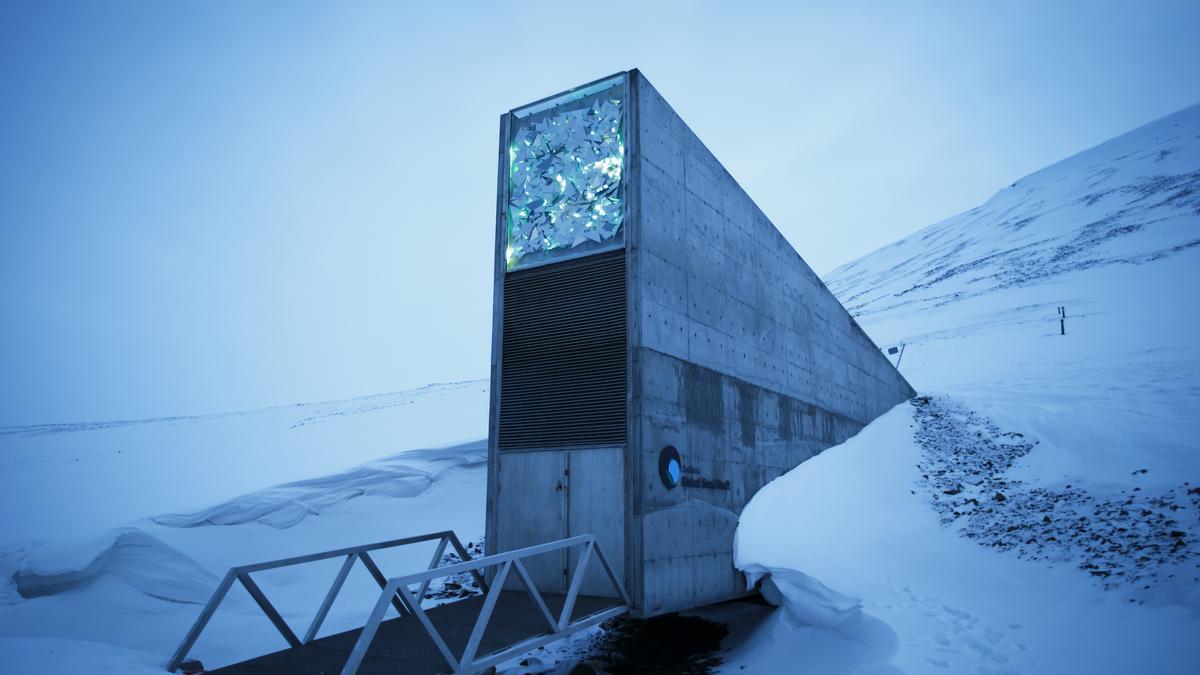
Exterior view of the Svalbard Global Seed Vault, the secure seed bank on Svalbard, Norway, March 2, 2016. Two men who were instrumental in the “craziest idea anyone ever had” of creating a global seed vault designed to safeguard the world’s agricultural diversity will be honored as the 2024 World Food Prize laureates, officials announced Thursday, May 9, 2024, in Washington.
| Photo Credit: AP
Two-thirds of the world’s food comes today from just nine plants: sugar cane, maize (corn), rice, wheat, potatoes, soybeans, oil-palm fruit, sugar beet and cassava. In the past, farmers grew tens of thousands of crop varieties around the world. This biodiversity protected agriculture from crop losses caused by plant diseases and climate change.
Today, seed banks around the world are doing much of the work of saving crop varieties that could be essential resources under future growing conditions. The Svalbard Global Seed Vault in Norway supports them all. It is the world’s most famous backup site for seeds that are more precious than data.
Tens of thousands of new seeds from around the world arrived at the seed vault on Svalbard, a Norwegian archipelago in the Arctic Ocean, in mid-October 2024. This was one of the largest deposits in the vault’s 16-year history.
And on Oct. 31, crop scientists Cary Fowler and Geoffrey Hawtin, who played key roles in creating the Global Seed Vault, received the US$500,000 World Food Prize, which recognizes work that has helped increase the supply, quality or accessibility of food worldwide.
The Global Seed Vault has been politically controversial since it opened in 2008. It is the most visible site in a global agricultural research network associated with the United Nations and funders such as the World Bank.
These organizations supported the Green Revolution – a concerted effort to introduce high-yielding seeds to developing nations in the mid-20th century. This effort saved millions of people from starvation, but it shifted agriculture in a technology-intensive direction. The Global Seed Vault has become a lightning rod for critiques of that effort and its long-term impacts.
Also Read | What’s inside the Svalbard Global Seed Vault ?
I have visited the vault and am completing a book about connections between scientific research on seeds and ideas about immortality over centuries. My research shows that the Global Seed Vault’s controversies are in part inspired by religious associations that predate it. But these cultural beliefs also remain essential for the vault’s support and influence and thus for its goal of protecting biodiversity.
Backup for a global network
Several hundred million seeds from thousands of species of agricultural plants live inside the Global Seed Vault. They come from 80 nations and are tucked away in special metallic pouches that keep them dry.
The vault is designed to prolong their dormancy at zero degrees Fahrenheit (-18 degrees Celsius) in three ice-covered caverns inside a sandstone mountain. The air is so cold inside that when I entered the vault, my eyelashes and the inside of my nose froze.
The Global Seed Vault is owned by Norway and run by the Nordic Genetic Resources Centre. It was created under a U.N. treaty governing over 1,700 seed banks, where seeds are stored away from farms, to serve as what the U.N. calls “the ultimate insurance policy for the world’s food supply.”
This network enables nations, nongovernmental organizations, scientists and farmers to save and exchange seeds for research, breeding and replanting. The vault is the backup collection for all of these seed banks, storing their duplicate seeds at no charge to them.
The seed vault’s cultural meaning
The vault’s Arctic location and striking appearance contribute to both its public appeal and its controversies.
Svalbard is often described as a remote, frozen wasteland. For conspiracy theorists, early visits to the Global Seed Vault by billionaires such as Bill Gates and George Soros, and representatives from Google and Monsanto, signaled that the vault had a secret purpose or benefited global elites.
In fact, however, the archipelago of Svalbard has daily flights to other Norwegian cities. Its cosmopolitan capital, Longyearbyen, is home to 2,700 people from 50 countries, drawn by ecotourism and scientific research – hardly a well-hidden site for covert activities.
The vault’s entrance features a striking installation by Norwegian artist Dyveke Sanne. An illuminated kaleidoscope of mirrors, this iconic artwork glows in the long Arctic night and draws many tourists.
Because of its mission to preserve seeds through potential disasters, media regularly describe the Global Seed Vault as the “doomsday vault,” or a “modern Noah’s Ark.” Singled out based on its location, appearance and associations with Biblical myths such as the Flood, the Garden of Eden and the apocalypse, the vault has acquired a public meaning unlike that of any other seed bank.
The politics of seed conservation
One consequence is that the vault often serves as a lightning rod for critics who view seed conservation as the latest stage in a long history of Europeans removing natural resources from developing nations. But these critiques don’t really reflect how the Global Seed Vault works.
The vault and its sister seed banks don’t diminish cultivation of seeds grown by farmers in fields. The two methods complement one another, and seed depositors retain ownership of their seeds.

Another misleading criticism argues that storing seeds at Svalbard prevents these plants from adapting to climate change and could render them useless in a warmer future. But storing seeds in a dormant state actually mirrors plants’ own survival strategy.
Dormancy is the mysterious plant behavior that “protects against an unpredictable future,” according to biologist Anthony Trewavas. Plants are experts in coping with climate unpredictability by essentially hibernating.
Seed dormancy allows plants to hedge their bets on the future; the Global Seed Vault extends this state for decades or longer. While varieties in the field may become extinct, their banked seeds live to fight another day.
Storing more than seeds
In 2017, a delegation of Quechua farmers from the Peruvian Andes traveled to Svalbard to deposit seeds of their sacred potato varieties in the vault. In songs and prayers, they said goodbye to the seeds as their “loved ones” and “endangered children.” “We’re not just leaving genes, but also a family,” one farmer told Svalbard officials.
The farmers said the vault would protect what they called their “Indigenous biocultural heritage” – an interweaving of scientific and cultural value, and of plants and people, that for the farmers evoked the sacred.
People from around the world have sought to attach their art to the Global Seed Vault for a similar reason. In 2018, the Svalbard Seed Cultures Ark began depositing artworks that attach stories to seeds in a nearby mine.
Pope Francis sent an envoy with a handmade copy of a book reflecting on the pope’s message of hope to the world during the COVID-19 pandemic. Japanese sculptor Mitsuaki Tanabe created a 9-meter-long steel grain of rice for the vault’s opening and was permitted to place a miniature version inside.
Seeds sleeping in Svalbard are far from their home soil, but each one is enveloped in an invisible web of the microbes and fungi that traveled with it. These microbiomes are still interacting with each seed in ways scientists are just beginning to understand.
I see the Global Seed Vault as a lively and fragile place, powered not by money or technology but by the strange power of seeds. The World Food Prize once again highlights their vital promise.
This article is republished from The Conversation under a Creative Commons license. Read the original article here.
Published – November 07, 2024 01:05 pm IST