



The story so far:
Recently, Canada and India each expelled their top diplomats due to the fallout from Canadian Prime Minister Justin Trudeau’s allegation last year that there were possible links of Indian intelligence with the killing of a Canadian citizen, Hardeep Singh Nijjar, in Canada. India had categorised Nijjar as a Khalistani terrorist (he had faced no criminal charges in Canada, but was put on a no-fly list and his bank accounts were frozen). The row seems to be escalating Canadian Hindu-Sikh tensions.
Is there a historical context?
India’s long-held complaint has been that Canada acts as a safe haven for Khalistani separatists/extremists. Its biggest grouse has been Canada’s failure in preventing the 1985 Air India bombing (perpetrated by Canada-based Khalistani extremists) and the lack of support in subsequent investigations.
The bombing killed 329 people (including children), the biggest airline terrorist act before 9/11.
Is there a Sikh ‘vote bank’ in Canada?
Vote bank is an Indian terminology unfamiliar to Canadians. Sikhs constitute only 2% of Canada’s population but their political clout is far disproportionate because of geographic concentration. At one point, there were four Sikh ministers in the Trudeau cabinet. Most of the Sikh MPs are from Trudeau’s Liberal Party. However, there is no public evidence to state that the only motive for the Trudeau government to lay these accusations against India is to pander to Sikh voters (of whom Khalistanis are only a minority).
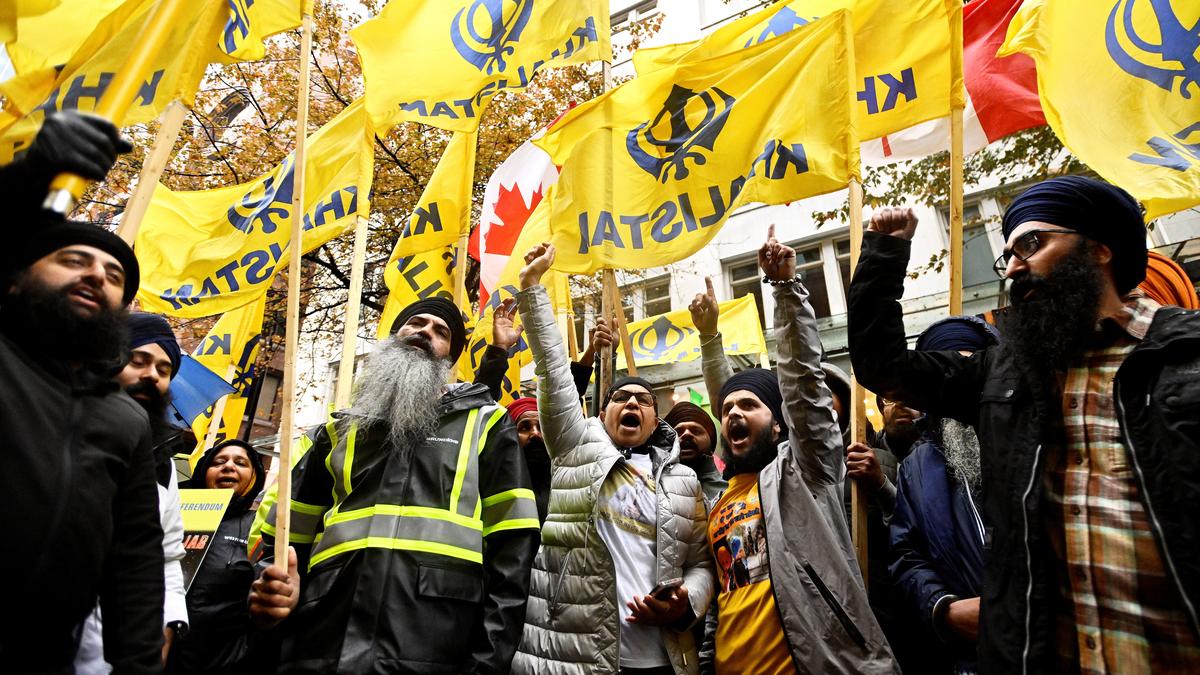
What we have as ‘evidence’ is the Trudeau government dropping the words Sikh and Khalistani from a government report which identified, for the first time, Khalistani extremism amongst the top five terrorism threats in Canada; the Canadian parliament marking Nijjar’s killing by holding a moment of silence; Mr. Trudeau and other party leaders attending Sikh community festivals which featured Khalistan flags and the glorification of Talwinder Parmar, the Air India bombing mastermind; and also drawing support from known Khalistani sympathisers. But all parties, not just the Liberal Party, have indulged in these kinds of acts. While Mr. Trudeau and his government have affirmed the territorial integrity of India, they have not explicitly condemned Khalistani extremism. But this ‘vote bank’ is not as India perceives it. In surveys, 54% of Sikhs in Canada intend to vote for the Conservative Party and 21% for Trudeau’s party in the next elections.
The Trudeau government has already been pilloried about its failures in countering Chinese interference in Canadian elections. A public inquiry into foreign interference has currently been instituted by the Canadian government. Therefore, an accusation such as this could bolster its weak image.
But the Canadian newspaper, The Globe and Mail, which exposed Chinese interference and was about to publish the allegations regarding India last year (before Mr. Trudeau went public with it), and other news outlets, have criticised Mr. Trudeau only for using a serious national security issue for political grandstanding, rather than manufacturing the case to pander to Sikh voters as India alleges.
Editorial |Canadian frostbite: On the India-Canada diplomatic war
Are there political and cultural misunderstandings?
There are misunderstandings on both sides. Canadian scholars have argued that despite the fact that a vast majority of the victims of the Air India bombing were Canadian citizens (of Indian descent), the Canadian government, for a long time, had seen it as a “foreign tragedy” and the victims as not “real Canadians”, clearly betraying systemic racism. Both Conservative and Liberal governments treated the victims shoddily until an official apology was issued by Conservative Prime Minister Stephen Harper in 2010. This racial prejudice is also emphasised by the fact that despite it being Canada’s worst terrorist act, 90% Canadians had little or no knowledge of it, and more than 50% under the age of 35 had never even heard of it. Further, as no Khalistani terrorist act has been perpetrated in Canada since then, the public is unaffected, and ignorant of Khalistani activism.
The Indian public, conversely, assumes that institutions work the same as in India. The rule of law is enforced in a more systematic manner in Canada than in India. Canadian police independence is guarded, and whenever there were attempts by politicians to interfere illegally, there has been a huge public outcry. Ujjal Dosanjh, a former Liberal cabinet minister, who himself was subject to life-threatening attacks by Khalistani extremists, has argued that while Canadian politicians have allowed Khalistani ideas to flourish, the law enforcement has not been soft on Khalistani terrorism. While the Air India investigations failed to a large extent, the evidence on hand does not suggest, as believed in India, that they were politically motivated to support the Khalistani extremists. The public inquiry that went into the Air India bombing, instead, was scathing about the security and investigation failures and termed them: “inconceivable, incomprehensible, indefensible, incompetence.”
Additionally, India is angry that Khalistan referendums are held in Canada and that Khalistani parades glorify the assassination of Indira Gandhi. However, freedom of speech and expression is a much guarded value in Canada and there is a high threshold on what constitutes as hate speech that can be prosecuted. Referendums and non-violent separatism advocacy are legal in Canada, and referendums have been held to seek the separation of Quebec from Canada. Burning the Canadian flag or the Bible in themselves are not criminal.
However, Canadian critics have argued for stronger legal vigilance around Khalistani hate speech especially when threats are issued.

What are the legal complexities?
India’s extradition requests, for those who it terms as Khalistani terrorists, are very often denied not due to political reasons but because they do not meet Canadian legal standards. Western democracies are wary of extraditions to countries with much poorer human rights records, where political dissenters and opponents are jailed for prolonged periods without criminal culpability, and without trial and bail, especially under anti-terror laws such as the Unlawful Activities (Prevention) Act (UAPA). Other reasons include the weakness of evidence solely relying on statements from the accused in custody, and (as journalist Praveen Swami has noted) the inadmissibility of Indian intelligence evidence in courts abroad as it is not gathered under the Indian Telegraph Act and the Information Technology Act. Only six wanted individuals have been extradited to India from Canada from 2002-2020 (this number is 10 for the U.S, and just one for the U.K.).
Notably, India has not managed to secure the extraditions of Mehul Choksi, Nirav Modi, Lalit Modi and Vijay Mallya (the last three from the U.K. with which India has friendly relations).
What role has the media played?
The Canadian media has asked some tough questions of the government and presented India’s version about the dangers of Khalistani diaspora politics. Conversely, the TV media in India, while rightly questioning Western hypocrisy on some matters, has substituted journalism with jingoism, and uncritically pushed the government’s narrative. It has spread disinformation that nobody was convicted for the Air India bombings (Inderjit Singh Reyat, the bomb-maker, spent nearly 30 years in jail); that Mr. Trudeau “admitted” that there was no evidence for his accusations, etc.
Parallely, the Globe and Mail (and other newspapers) which had asked Mr. Trudeau to provide more facts on his allegations last year, is presently attacking him for being soft on the “overtly hostile” actions of the Indian government, and for “curiously unwilling to acknowledge that India is, if not an enemy quite yet, certainly an adversary.” The reason is that this time around, the revelations are from the Canadian police and are not just “credible allegations” but “strong evidence.” It remains to be seen if it passes muster in the courts.
Nissim Mannathukkaren is Professor, International Development Studies, Dalhousie University, Canada
Published – November 06, 2024 08:30 am IST