


There are some scientific books that change the course of how we view and perceive the world around us. English naturalist Charles Darwin’s On the Origin of Species brought us natural selection and the theory of evolution. English polymath Isaac Newton gave us his laws of motion and the law of universal gravitation in his work, Principia.
Even though English polymath Robert Hooke’s Micrographia isn’t often seen on par with these, the book remains special in its own right. This is because it wasn’t only a scientific bestseller, but also got the wider public hooked onto a new branch of science – microscopy – for a change.
Nearly became an artist
Born on the Isle of Wight in 1635, Hooke could well have become a celebrated artist. At the young age of 13, Hooke was trained by court painter Peter Lely, a Dutch painter who spent his entire career in England and was one of the leading portrait painters of the day. Hooke, however, complained that the oils and varnishes irritated his chest and decided to attend Westminster School.
Here, Hooke is said to have mastered the first six books of Euclid’s Elements in a week! He had a penchant for ancient languages, learned to play the organ and even experimented with flying machines.
Three years of observations
In 1653, the 18-year-old acquired a place at Christ Church, Oxford. He became the assistant of Irish chemist Robert Boyle by 1658 and counted English architect and astronomer Christopher Wren among his friends.
Serving as the first Curator of Experiments of the newly formed Royal Society in 1662, he went on to become one of the early members of the society, three years after its formation in 1660. It was during the time period between 1661-64 that Hooke conducted the bulk of his experimentation and observations for what was to become Micrographia.
Coins the term “cell”
He used the microscope – still a new device then – to observe and discover the structure of rocks, plants, and what the book is now most famous for, insects. In addition to demonstrating the immense power of the microscope, Hooke also described planetary bodies that were distant, wrote on the wave theory of light and the organic origin of fossils. As history’s first treatise on microbiology, the book also saw Hooke coin the term “cell” in the biological context.
Model of Robert Hooke’s microscope.
| Photo Credit:
Wellcome Library, London. Wellcome Images / Wikimedia Commons
On November 3, 1664, an advance copy of the Micrographia: or, some Physiological Descriptions of Minute Bodies made by Magnifying Glasses, with Observations and Inquiries thereupon (full title) was presented to the Royal Society by Hooke. The order of the President of the Royal Society to print Micrographia came through on November 23 and this order is reproduced on the leaf facing the title in the book. By January 1665, Micrographia was out on the bookshelves.
Accessible writing
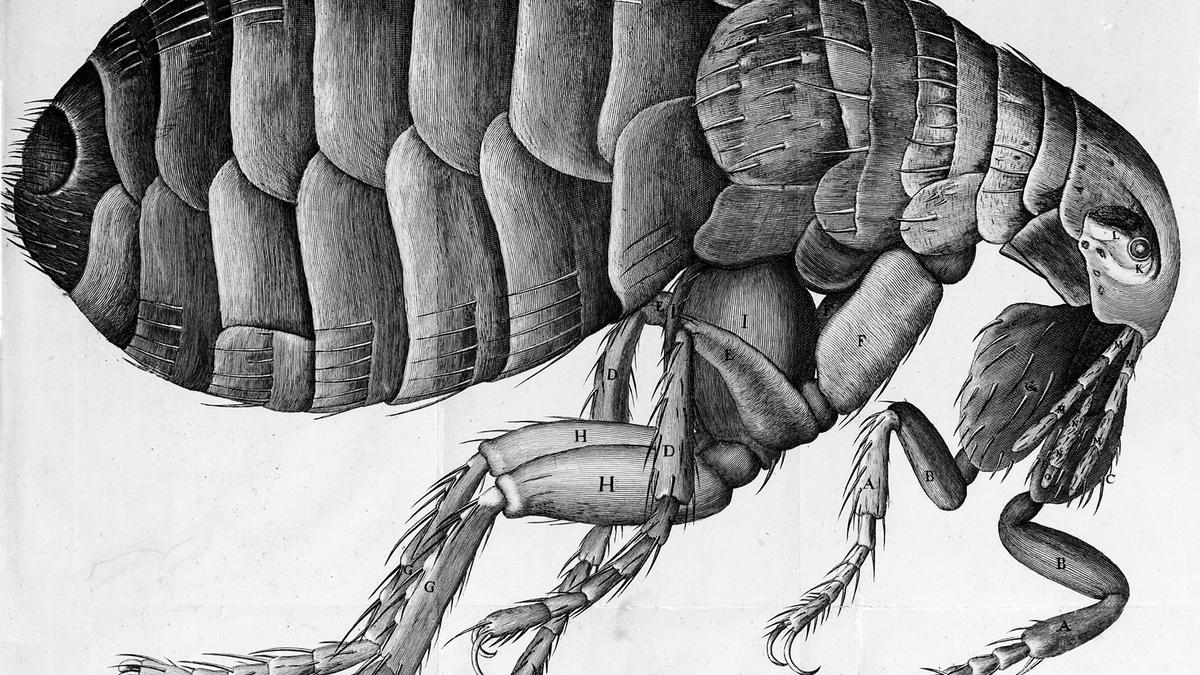
The impact was instant. It turned out to be a bestseller as scientists lapped it up for the wealth of data it provided. The astonishing details were a prerequisite from the Royal Society as the protocols had to be laid out bare to enable reproducible experimentation. Each image in the book was almost a work of art. Based on Hooke’s drawings (Lely’s teachings didn’t go wasted after all), the detail of the engravings still remain striking, with some of the images on par with modern-day reproductions of giant microscopes directly connected to computers.
Micrographia’s speciality lies in the fact that it also immediately appealed to the masses. As early as 1665, the politician and diarist Samuel Pepys obtained a copy. He called it “the most ingenious book that ever I read in my life,” and it left a profound impact on him. Pepys purchased his own scientific instruments, joined the Royal Society and went on to become its president in 1684.
Despite his various contributions, Hooke never achieved the kind of recognition that he wished for. That said, he did show that experimental philosophy works and he did his fair bit to extend the bounds of our knowledge. The Micrographia is a living testament to that fact.
See it for yourself!
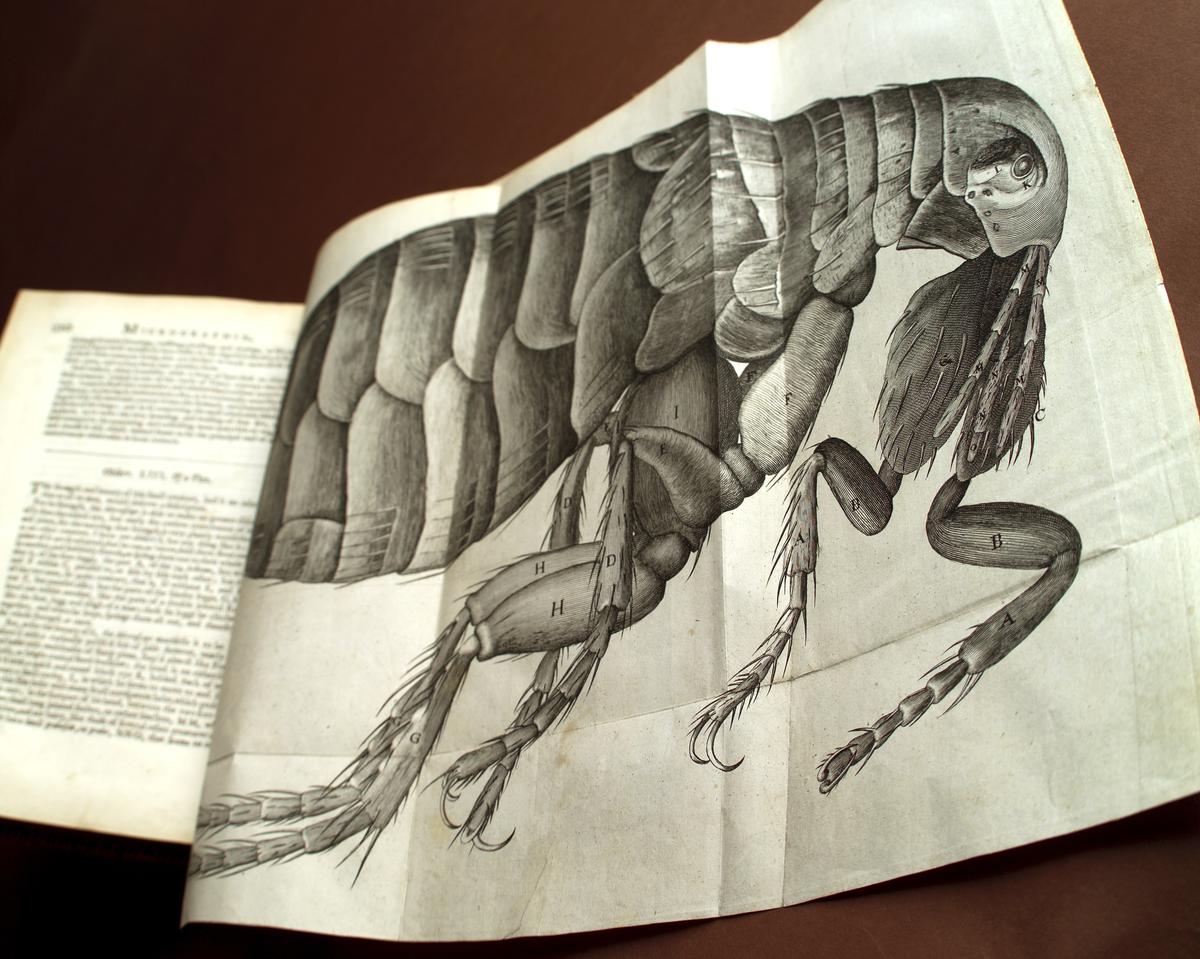
You can access a digital version of Micrographia made available by the Royal Society.
| Photo Credit:
Wellcome Library, London / Wikimedia Commons
Thanks to the technology available to us at the moment, various digital versions of Micrographia have been made available online.
The version available with the Royal Society offers a complete set of full-size plates along with an index for navigation. You also get the full machine-readable text, allowing you to search and download if required.
They’ve even got a special collection of all 38 plates in their Picture Library.
You can read the Royal Society’s version of Micrographia here: https://v.gd/Micrographia
(When you visit the above link, you will be shown the full link from the Royal Society that you will be visiting on clicking. Clicking it will take you to the book.)
Hooke’s looks
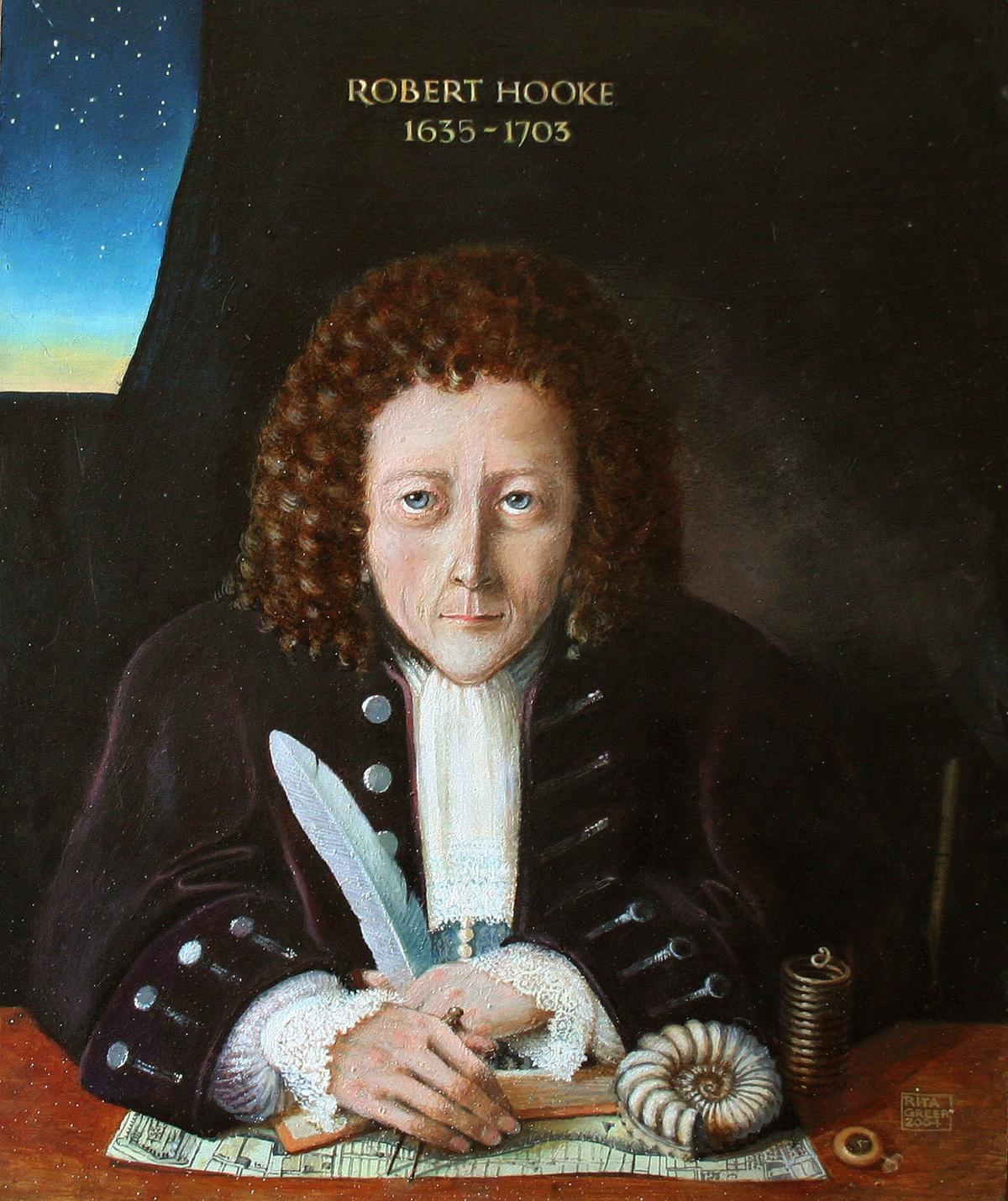
Imagined portrait of Robert Hooke.
| Photo Credit:
Rita Greer / Wikimedia Commons
Even though he was a renowned polymath, there are no authenticated portraits of Robert Hooke from his time that exist today.
This is despite the fact that an entry in Hooke’s diary mentions that he sat for a portrait by Mary Beale, an artist of repute.
Some fingers point towards fellow English polymath Isaac Newton and the animosity between the two. While there are rumours that Newton and his followers were responsible for deliberately destroying Hooke’s portrait, there is no proof to substantiate it.
What remains, therefore, are only written descriptions of his appearance from his time.
From time to time, few historians have conjectured that some recently discovered portrait could be that of Hooke, only to be proved wrong later on.
In an attempt to put all this to rest, amateur painter Rita Greer started a project in 2003 to produce credible images of Hooke that match the written descriptions of him that exist.
The portrait that you see here is such an imagined portrait of Hooke made available for free use under the Free Art License.
Published – November 03, 2024 12:22 am IST