





Aspirants wait to board a train to go home after completing the Uttar Pradesh constable civil police direct recruitment examination in Lucknow. File
| Photo Credit: The Hindu
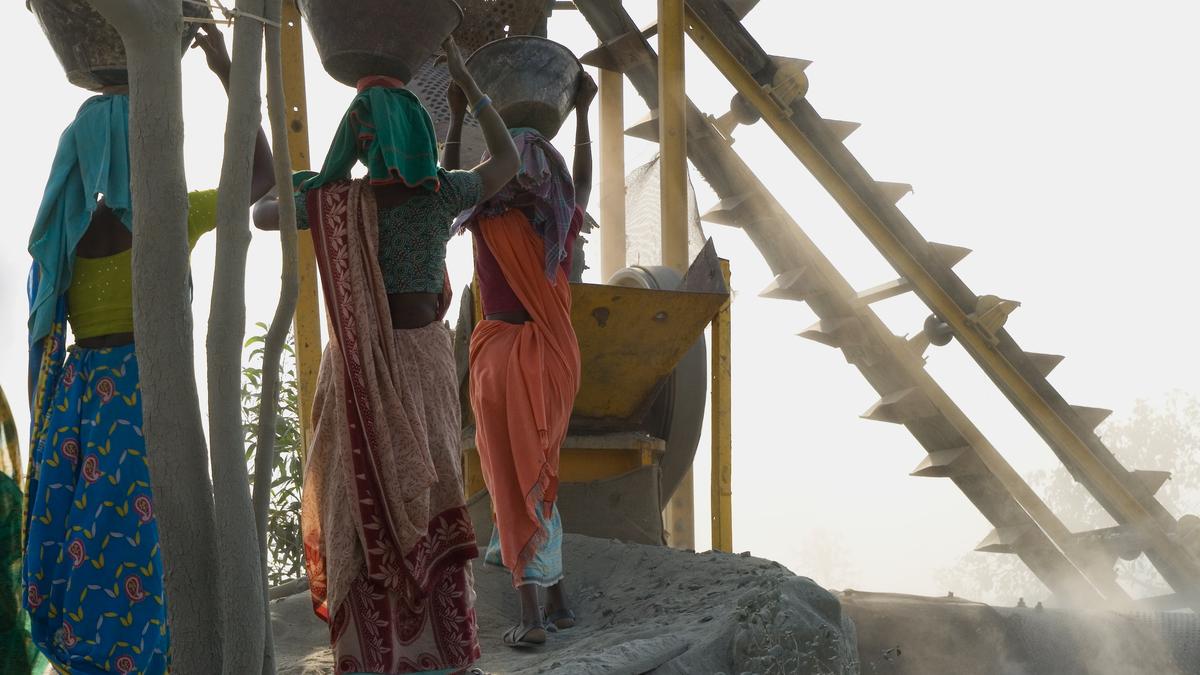
India is not producing enough good quality jobs for its people. A good quality job provides dignity, adequate compensation, an opportunity for learning, and advancement for those who strive. Instead, many jobs are unpaid, informal, and dead end. Worse, the seemingly low unemployment rate masks the fact that to count as employed, a person needs to have reported working for only one month in an entire year.
The dearth of quality employment, particularly among the youth, is a ticking time bomb that threatens not just our economy, but the very legitimacy of our state. If the government fails to create avenues for social and economic participation for young people, it will inevitably breed frustration.
A twofold problem
The political problem is twofold: how do we give people a sense of dignity and purpose, and the means for financial support? Traditionally, people have derived dignity and purpose through a combination of community, work, and political engagement. However, the package deal of liberalism and capitalism have deprioritised traditional sources of community and increased the importance of work in conferring social standing and belonging. As a result, work has become the dominant entry point into a broader sense of community and political engagement.
While the elite find purpose and status through their control over societal discourse and decision-making, which also bring them substantial financial rewards, large sections of our population feel they lack both dignity and financial security. This disparity is likely to worsen as technological advancements and capital concentration potentially displace large numbers of workers, perhaps permanently. In a large democracy such as India, such concentration of purpose and financial gain among the elites can erode faith in the system and lead to political instability.
This challenge — how we structure our society, what we value, and how we include everyone — is fundamentally political. Yet, the political response has been inadequate, oscillating between deferring to market forces and resorting to short-term partisanship. The market-oriented approach is reflected in the superficial mantra of ‘creative destruction,’ suggesting that old jobs and industries will be seamlessly replaced by new and better ones. Meanwhile, some politicians and capitalists have mooted universal basic income (UBI) as a solution. UBI is a minimum “income” received by all citizens of a given population as financial transfers from the government without having to work.

Setting aside the question of UBI’s financial feasibility, it is important to recognise that inequality and an assault on human dignity are inherent in the very concept. UBI implies that a significant portion of the population is no longer needed in the economy, with a smaller subset “paying” for the rest. Its very premise concedes that technology and capital will create outsized winners while the majority will merely survive on their largesse. This approach fails to address people’s need to feel relevant and capable, and ignores the loss of dignity that comes from not contributing meaningfully to society. It does not, thus, account for the possibility that UBI might encourage more anger and populism because people want to contribute and thrive, not just survive on the sidelines.
There is a risk to democracy as a whole as well. UBI would shift focus from structural reforms to mere economic transfers and thus entrench elite power by insulating them from pressures to address fundamental inequities in the economy and labour markets. It risks recasting the state as a mere distributor of funds rather than the architect and arbitrator of societal processes required to create a just and participatory social and economic system.
Addressing structural issues
The partisan response has been to lob the issue between parties for short-term electoral gains instead of responding to the ongoing structural transformation of our society. Some political leaders are mindful of the long term, but institutionally, parties have become too narrow in their scope to address larger questions such as unemployment and have reduced their ambitions to winning elections alone. However, divesting societal issues to civil society or government in order to function solely as election-winning machines jeopardises their long-term legitimacy. This is because democracy is about more than elections — it is about creating a social contract that works for everyone.
In fact, the failure to anticipate and address long-term structural issues is a key reason why people feel neglected by the political class and view politics as a cynical game. When people believe the political system is incapable of addressing pressing challenges, they lose faith in democratic institutions. Thus parties and institutions must find ways to address structural issues, including unemployment, inequality, and dignity; else, people will seek alternatives, rendering political parties irrelevant. We are witnessing this globally through the rise of populism, authoritarianism, and civic disengagement.
Political parties must provide meaningful leadership by addressing structural issues head-on without resorting to deflection or partisanship. The future of Indian democracy — and the continued relevance of our political institutions — hinges on our ability to restore a broader sense of public purpose and economic participation to the centre of our national dialogue.
Ruchi Gupta, Executive Director of the Future of India Foundation, which anchors an initiative to harness the political process to create aspirational employment opportunities for youth at the district level
Published – October 23, 2024 01:48 am IST