






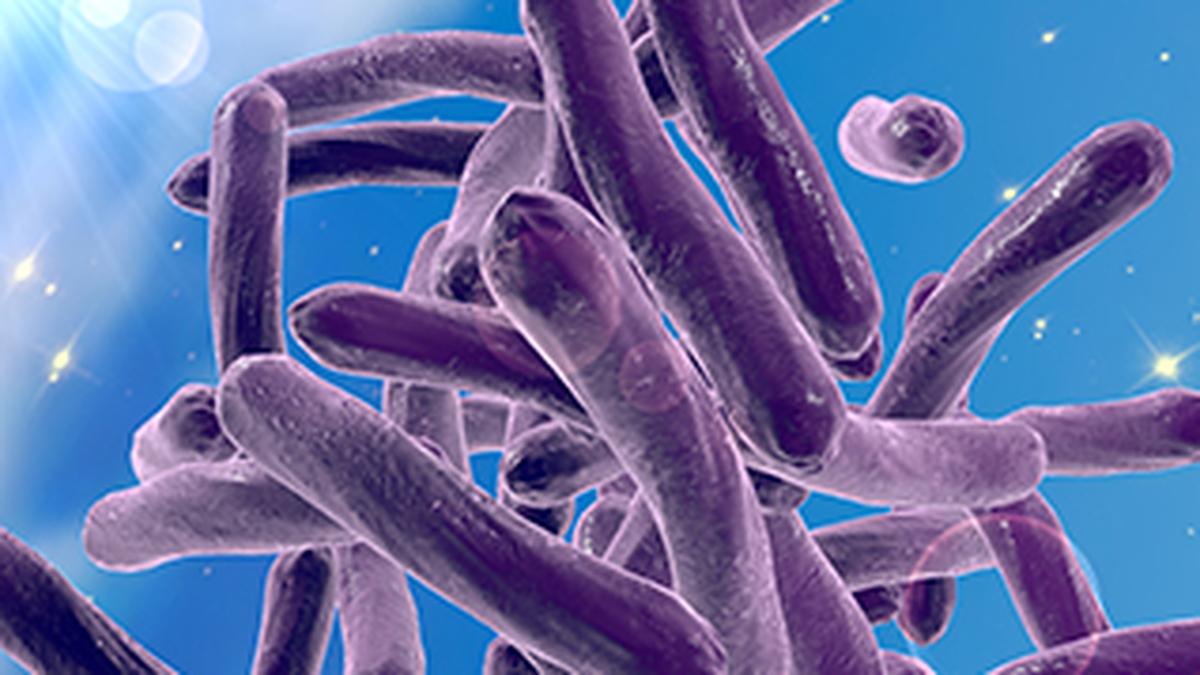
A 3D illustration of Mycobacterium tuberculosis bacteria. Researchers believe these bacteria’s many survival abilities are a result of its large genome, consisting of 4.4 million base pairs.
| Photo Credit: Getty Images/iStockphoto
Tuberculosis (TB) is a major focus in India’s healthcare goals. The country is steadily improving its ability to diagnose and track TB patients and help them adhere to the long course of antibiotics required to treat it. But with increasing antimicrobial resistance in Mycobacterium tuberculosis (Mtb), the pathogen that causes TB, many existing antibiotics aren’t working as effectively to kill it. So researchers are studying Mtb to identify its important proteins and then design new drugs that can act against them.
A companion over millennia
This is not an easy problem to solve. The pathogen has co-evolved with humans for millennia. Researchers have found the Mtb complex was present as long as 70,000 years ago. Such a long relationship between the two species has allowed the microbe ample time to evolve and trick the human immune system in many ways.
One of them is its ability to grow in macrophages. The first line of human immune cells that destroy many other invading microorganisms are actually Mtb’s home. Macrophages are designed to engulf foreign particles, including microbes. They can initiate a plethora of chemical reactions involving peroxides, free radicals, and other compounds that break down the engulfed particle or microbe. These reactions often collectively induce a state called oxidative stress and alter the chemical nature of molecules, including the DNA, the RNA, and/or the proteins of life-forms, rendering them dysfunctional or even literally broken up. Macrophages also use diverse strategies to starve the engulfed microbes of essential nutrients, eventually killing them.
But these techniques don’t work against Mtb. Mtb keeps itself protected in clusters called tubercles (hence the name of the disease) surrounded by lipids (fatty substances) in the lungs. Though it’s a respiratory pathogen, it has been known to spread to various other tissues. It can also stay dormant in the cells for a long time, up to a few decades, without causing disease or spreading to other people.
Enzymes of particular interest
Researchers believe Mtb’s many survival abilities are a result of its large genome, consisting of 4.4 million base pairs. To compare, the respiratory bacteria Staphylococcus aureus has 2.8 million base pairs and Streptococcus pneumoniae, 1.9 million to 2.7 million.
A larger genome means more proteins. Scientists are yet to understand the role of many Mtb proteins — but they believe Mtb’s genetic and protein machinery allows it to lead an independent life once it finds a home inside the macrophages.
Scientists are intrigued by whatever allows Mtb to survive and persist in the macrophage’s hostile environment and are on the lookout for proteins that shield it. One category of proteins called the cysteine synthase enzymes is of particular interest. They help cells synthesise cysteine, a sulphur-containing amino acid. Cells use cysteine to make antioxidants, whereby the sulphur disrupts the reactions that cause oxidative stress.
Where there’s a Cys, there’s a way
A study published on August 29 in the journal eLife by researchers at the CSIR-Centre for Cellular and Molecular Biology (CCMB), Hyderabad, explored the role of different cysteine synthases in Mtb. The researchers grew Mtb in a bacterial growth medium and restricted its access to nutrients. Then they created oxidative stress conditions in the dish (by adding certain compounds) and looked for genes whose expression patterns changed as a result. This is how they found Mtb’s cysteine synthase genes are expressed more during oxidative stress.
Mtb has at least three cysteine synthase enzymes. They make cysteine in cells through different chemical reactions. The scientists found that two of the enzymes, called CysK2 and CysM, significantly influenced the microbe’s survival during nutritional deficiency and oxidative stress. They also found Mtb’s ability to produce various antioxidants was impaired when the researchers knocked out the genes used to make either of the two synthases.
It is nearly impossible to get human lung tissue to infect for an experiment. Instead, the researchers infected mice with the wild-type Mtb and mutant Mtb. After allowing the bacteria time to infect the mice and for the mice immune systems to respond, they measured the amount of bacteria in the two groups. They found the wild-type Mtb survived better in the mice than the mutant Mtb. They also found similar effects when they infected just macrophages from the lungs and the spleen. (The spleen is the first organ after the lungs organ Mtb infects, by moving through the bloodstream.)
When the research team checked the pathogen’s survival in mice mutated to not develop oxidative stress, they found it didn’t matter if Mtb had the cysteine sythases. That is, Mtb with and without the cysteine synthases grew equally well in such mice.
Undermining Mtb’s survival
A study in 2017 by researchers at the Karolinska Institute, Stockholm, had reported a list of 71 compounds that could inhibit the cysteine synthases. Researchers at Vinay Nandicoori’s lab at CCMB tested these compounds against Mtb and found they all inhibited Mtb to some extent. Fortuitously, these inhibitors also made isoniazid, a known bacteria-killing drug, more potent against Mtb and together made for a strong antibiotic cocktail. Humans don’t have cysteine synthase enzymes, so these inhibitors could be promising targets for new antibiotics.
The study was conducted together with Luiz Pedro Sorio de Carvalho’s lab at the Francis Crick Institute, London.
In addition to cysteine synthases, scientists around the world are studying other ways Mtb survives the macrophage environment. For example, they are examining the roles of phosphates and carbon metabolism, which are central to Mtb’s life-cycle. Some are exploring how Mtb develops a cell wall strong enough to withstand oxidative stress. Some groups are unearthing details about how Mtb stops the production of molecules that lead to oxidative stress; trick a host macrophage into secreting damage-repair molecules (which macrophages produce to protect and revive immune cells from oxidative stress) sooner; or stay in the macrophages without activating its immune responses.
Through many doors at once
Some interesting new studies have also revealed how the bacteria erase the epigenetic memory of macrophages, i.e. healthy macrophages’ ability to make chemical changes to their genomes and pass it on to their daughter cells. This ability allows the new cells to identify an ongoing or a past infection and get rid of it faster. Without this memory, newly formed macrophages aren’t preconditioned to face an Mtb infection.
All these studies are together demystifying Mtb, like keeping many doors open through which to chase out the TB menace. For these possibilities to actually translate into treatments in the market, there are many unfulfilled steps — including finding ways to perform these studies with human cells — and India needs to focus on them.
Somdatta Karak, PhD is the head, Science Communication and Public Outreach, CSIR-Centre for Cellular and Molecular Biology, Hyderabad.
Published – October 15, 2024 05:30 am IST