






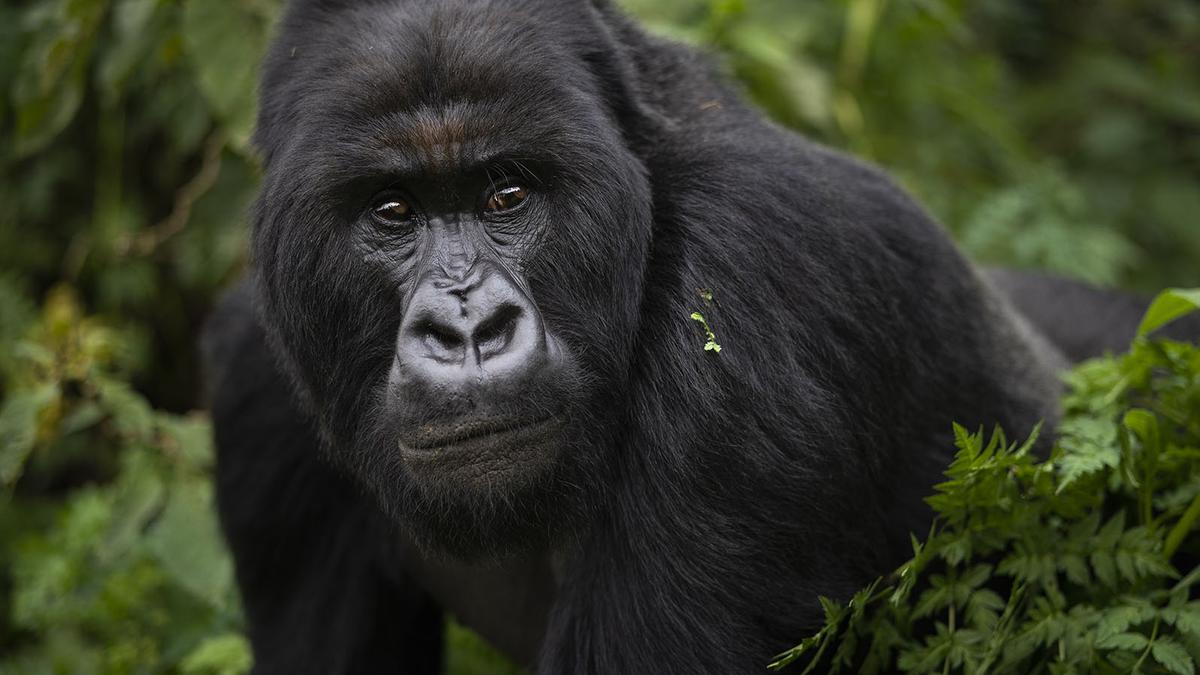
In this Sept. 2, 2019 photo, a silverback mountain gorilla named Segasira walks in the Volcanoes National Park, Rwanda. The Spanish government has announced plans to ban harmful experiments on great apes as part of a wider initiative to give them increased rights closer to the ones humans enjoy.
| Photo Credit: AP
The Spanish government has announced plans to ban harmful experiments on great apes as part of a wider initiative to give them increased rights closer to the ones humans enjoy.
These plans are forward thinking compared with most of the rest of the world but the move is a double edged one. Bestowing human rights on great apes because of their similarity to us creates a new criteria – other animals can only be free of pain and suffering if researchers can prove they are human-like.
Great apes are the subset of non-human primates which include orangutans, gorillas, bonobos and chimpanzees. Over 16 years ago Spain first tried to grant great apes personhood. The cross party resolution was discussed but was never brought into law.
Currently, “unnecessary” experimentation is banned on great apes in 29 countries including the UK, the EU and New Zealand. This includes vivisection (surgery on a live body) or torture, depending on your attitude to the moral rights of great apes).

This may sound progressive. The problem is that “necessary” is defined in different ways. It usually focuses on crisis situations such as pandemics and epidemics, and in brain related research (primarily Alzheimer’s and brain trauma research) where many scientists argue the similarity of the great ape brain to humans makes it the only equivalent model. In 1999, New Zealand proposed bestowing human rights on great apes, but stopped short of doing so, instead banning all invasive experimentation on great apes.
The Balearic islands followed in 2008, and Austria is the only country in the world to have banned all live surgery on non-human primates, great and lesser (also known as gibbons, which include marmosets and baboons).
The Great Ape Project founded by moral philosophers Peter Singer and Paola Cavalieri, campaigns for the end of great ape experimentation. On its homepage are reminders of chimpanzees still incarcerated in laboratories, many of whom have spent their entire lives undergoing experimental procedures, such as the Alamogordo 26 in New Mexico. These 26 chimpanzees are still held at a laboratory, despite not being used in medical research for over two decades.
The question of human rights for great apes raises a number of issues, especially the way humans understand the natural world in a hierarchical structure. Humans are at the apex of this structure, and control the other levels of the hierarchy. This is known as speciesism. Who decides what is ethical for other species? Humans are one species, yet it is our perception which legislates the fate of all nonhuman animals.
Many animal rights activists refer to 18th century English philosopher Jeremy Bentham’s quote: “The question is not, ‘can they reason? nor, can they talk? But, Can they suffer?‘”. But this isn’t the main paradox when it comes to modern animal experimentation. Instead, it is the belief that the more similar to humans a nonhuman animal is, the more useful they are to research that affects humans. This would also mean their pain and suffering is more similar.
Great apes are good enough to act as models for human physiology, but don’t seem to be good enough to count as sentient, suffering beings. This is just as applicable to less human-looking animals. For example, labs patent strains of mice with DNA that reflects human cancers. This also makes them more likely to suffer as if they were human. So do we accept that mice are so similar they can model us in experiments but not so similar that their pain matters?

The second issue is that great apes reflect in their faces and their actions an elicitation of empathy, but not always for lesser apes. In February 2024 charity Animal Aid published the results of a Freedom of Information request about the experiments carried out at the University of Cambridge on lesser apes. In 2022, 68 experiments at the university involved primates, for example drilling holes into marmosets’ skulls and injecting a substance into their brains.
The UK also hosts a large beagle breeding facility, in Cambridgeshire, where the dogs may be force fed toxic chemicals to study the effects. Beagles are often used for animal experimentation due to their placid nature.
The lesser ape is not the human-faced great ape, but many of their actions and responses are human-like. For instance, female gibbons dance to attract a mate.
The idea of a beagle, a potential family pet, being bred for experimentation highlights the speciesism inherent in how we decide what or whom to become incensed about.
Because make no mistake, every animal is a who, not a what.
It may sound outrageous to make such a statement. How can a mouse be a who, you might ask. Mice are the most common species used in experiments, and are bred with genetic illnesses and deformities especially for the purpose. Isn’t the squeak of the mouse or the shriek of the monkey their own form of expression? Some experiments on rodents have been designed to “recapitulate the human pain condition”. The problem comes from human perception of the natural world and different species as existing only in relation to ourselves.
Animal activists often say “if slaughterhouses had glass walls the world would be vegan”. How would we feel if vivisection labs had glass walls?
Some scientists argue animal testing harms humans because of unreliable results. With alternatives available, from stem cell modelling to using AI in experiments and trials, as well as charities and research centres focused on animal free studies, maybe the onus should be on humans.
We should be asking, if humans are so technologically adept and progressive, why are our scientific methods so archaic, unreliable and unethical?
This article is republished from The Conversation under a Creative Commons license. Read the original article.
Published – October 08, 2024 01:13 pm IST