




Scientists widely believed volcanic activity on the moon ceased about a billion years ago. A study published in Science on September 5 called this idea into question with evidence suggesting the moon had active volcanoes as recently as 120 million years ago.
The moon’s volcanic activity sheds light on how its surface was formed, its atmospheric conditions, and its tectonic activity. Volcanoes can also create conditions suitable for life by releasing water and providing energy and nutrients.
More recent research using remote-sensing data from satellites has found signs of volcanic activity from around 800 million years ago, but no exact date for the activity itself.
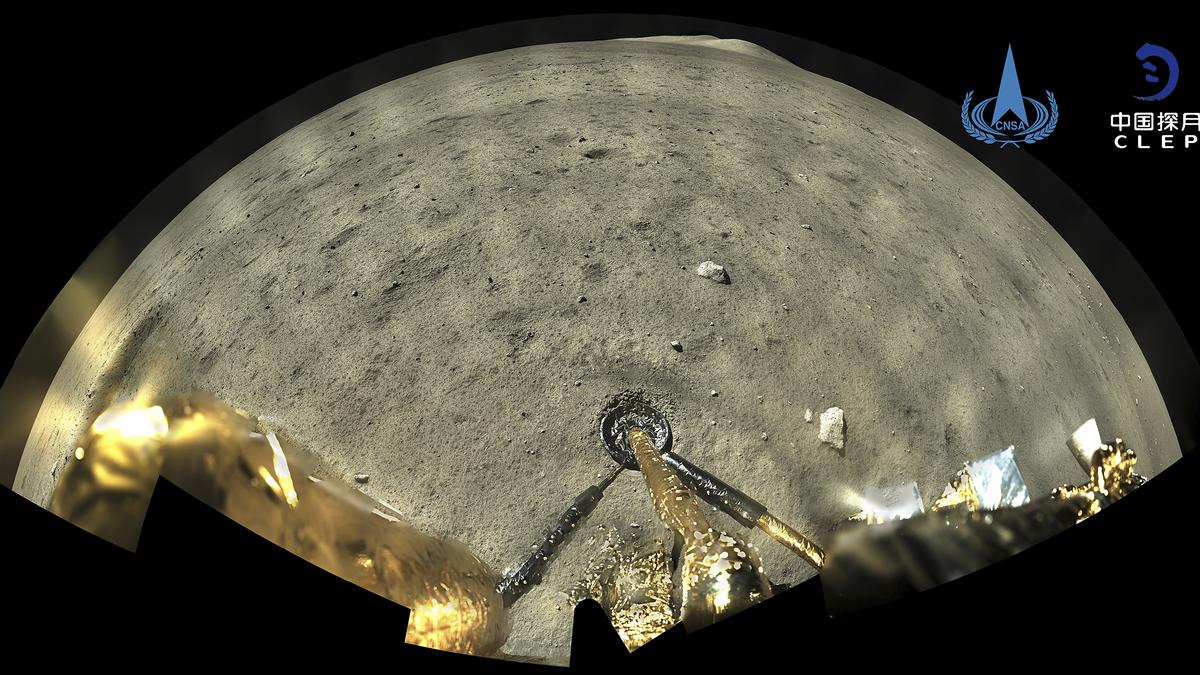
Researchers behind the new study, led by Bi-Wen Wang of the Chinese Academy of Sciences, investigated moon samples collected by China’s Chang’e-5 mission.
They focused their analysis on lunar glass beads — small spherical or egg-shaped glass pieces formed by volcanic activity or impact events like when rocks from space smash the moon’s surface.
The moon-made specks
The way high-energy events create glass beads on the moon is similar to how tektites formed from impacts and volcanic rock (like obsidian) from eruptions on the earth.
In volcanic eruptions, magma from the moon’s surface throws up lava fragments. When these fragments cool quickly they form the beads.
Likewise, the surface rock and soil melt under the intense pressure and heat produced by asteroid or meteorite impacts. The melted material is tossed into the air, where it rapidly cools and lands on the surface as glassy beads.
The materials thrown into the air are spherical because they take the least amount of energy to form. This is also why water droplets are spherical in space or egg-shaped on the earth, where gravity stretches them a little.
The glass beads’ atoms are arranged in a haphazard manner. They’re composed of silicon, magnesium, and iron with trace amounts of potassium, titanium, and uranium.
A volcano within a bead
Volcanic glass beads are typically more uniform while impact beads may display shock features like fractures or deformations. Nonetheless, identifying how some beads originated is challenging because they are derived from similar rocks.
The presence of elements from an impactor that is no longer found on the moon’s surface is another characteristic of impact glass beads. Volcanic glass beads on the other hand can have greater amounts of volatile elements, including sulphur emitted during eruptions.

None of these criteria are conclusive by themselves: scientists use many of them together to ascertain a bead’s origins.
The samples collected by Chang’e-5 were from Statio Tianchuan, near the volcanic complex Mons Rümker and part of a terrain known for its elevated heat-producing elements, thin crust, and prolonged volcanic activity.
The researchers analysed more than 3,000 bead samples, examining their physical features to look for patterns that would reveal clues to their origins.
They also studied the samples’ chemical composition to identify the most and least abundant elements present and compared them to known impact and volcanic glass compositions.
The team also looked out for evidence of incomplete melting, a characteristic of asteroid or meteorite impact.
Two and two together
From the 3,000 samples, the researchers shortlisted 13 for sulphur isotope analysis.
Isotopes are atoms of the same element that have an equal number of protons in their nuclei but different numbers of neutrons. Isotope analysis reveals the various quantities of isotopes in a sample. The researchers compared the sulphur isotope ratios in the beads with established values from older samples. This approach provides insights into a substance’s origin and the processes that helped form it.
The researchers’ analysis revealed that three of the 13 samples were from volcanic activity.
Then they used the uranium-lead radiometric dating method to accurately date the materials present in these samples. The method works by assessing the quantity of uranium isotopes that have decayed to lead isotopes, which happens at a predictable time-rate.
They determined the ages of the three volcanic samples to be 116-135 million years. The composition of the glass beads also indicated they came from a magmatic source.
While the age of the volcanic samples overlapped with those of impact glass beads collected by Chang’e-5, additional evidence based on mineral composition, sulphur isotope ratios, and lead isotopes pointed to a volcanic origin for the three beads.
Ergo, the moon may have had volcanic activity 116-135 million years ago.
A mystery erupts
The researchers’ use of sulphur isotope ratios was novel.
Sulphur isotopes aren’t commonly used to identify the origin of materials on celestial bodies. Scientists instead rely on techniques based on carbon, oxygen, and lead. But volcanic activity makes sulphur a better choice primarily because it releases sulphur dioxide gas.
The research team also showed the moon was volcanically active as recently as 120 million years ago, refuting previous claims. The three volcanic glass beads contained high concentrations of potassium, rare earth elements, phosphorus, sodium, and thorium, suggesting the source was rich in these elements.

According to the researchers, the presence of these minerals in the glass beads suggests they played a role in causing lunar volcanic activity by producing the heat required for an eruption.
Chances for Chandrayaans
We now have a new question: even as the moon’s interior cooled and its lithosphere thickened, how did volcanic activity continue for such a long time?
Future Chandrayaan missions could help answer this question. Chandrayaan-4 is poised to conduct on-site sampling and analysis of lunar materials, which may include rocks from volcanic periods in the moon’s history.
The Chandrayaan missions are also set to explore the lunar poles. This could help scientists study preserved lunar ice that may hold gases released during ancient volcanic eruptions.
Tejasri Gururaj is a freelance science writer and journalist with a master’s degree in physics.
Published – September 25, 2024 05:30 am IST