





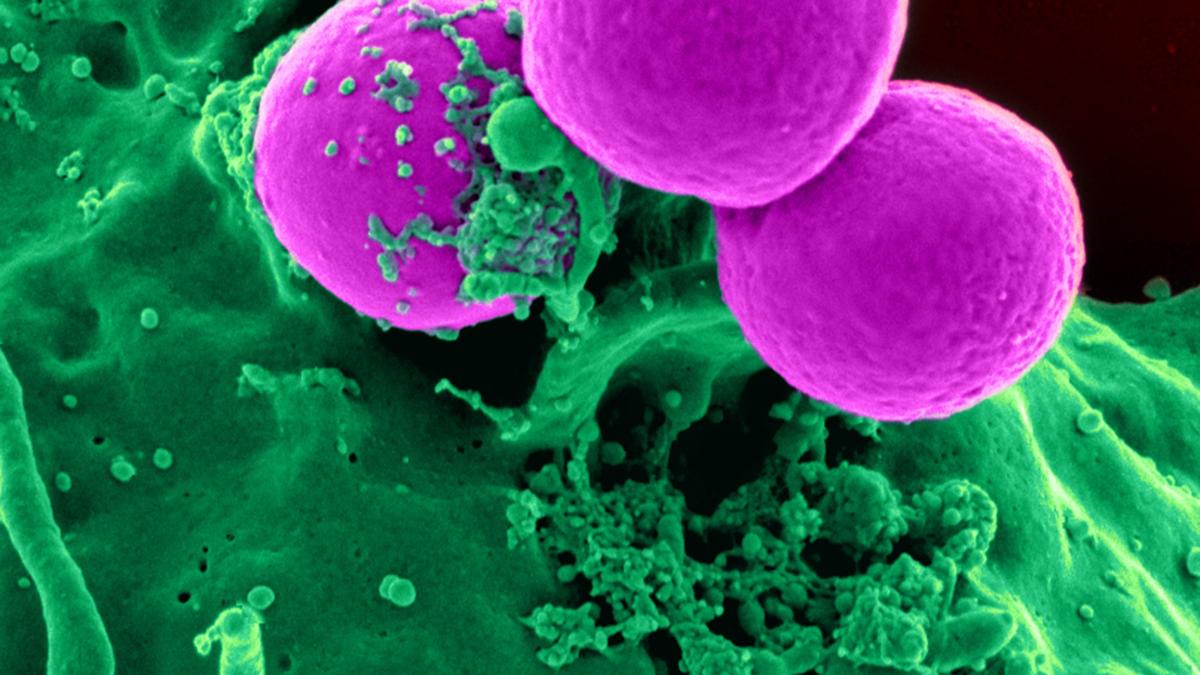
Antimicrobial resistance is one of the great crises of the 21st century, and Staphylococcus aureus is an important bacteria species leading this charge.
In 2019, for example, methicillin-resistant Staphylococcus aureus (MRSA) — a strain that can resist several antibiotics — was responsible for more than 100,000 deaths. Fortunately it is still significantly vulnerable to vancomycin, which has been doctors’ first-line treatment against MRSA infections for 40 years.
Nothing is forever
MRSA rarely resists vancomycin. Only 16 such cases have been reported in India so far. This is because when S. aureus acquires vancomycin resistance (to become VRSA), it also grows slower and is less fit.
Now, researchers have found S. aureus can adapt to vancomycin while overcoming this fitness cost. The study, published in the journal PLoS Pathogenson August 29, reported results threatening the long-term use of vancomycin in the clinic.
“Vancomycin has been reliable for treating MRSA for decades as it is very rare that S. aureus becomes resistant to vancomycin,” Eric Wright, a researcher at the University of Pittsburgh and study co-author, wrotein an email. “Our study shows that we may not be able to treat MRSA with vancomycin forever.”
A commanding presence
All documented cases of VRSA are due to the transfer of a cluster of genes, called the vanA operon, from another vancomycin-resistant bacterium to S. aureus during a simultaneous infection. The researchers isolated VRSA strains from clinical samples and grew four of them carrying the vanA operon in the presence or absence of vancomycin.
First, they grew VRSA in the presence of vancomycin in both solid and liquid culture conditions to study different fitness parameters. Most strains of VRSA cultured under both conditions grew more slowly than S. aureus that was still susceptible to vancomycin, confirming that acquiring antibiotic resistance came with a fitness cost.
Next, to check whether the strains retain vancomycin resistance in the absence of the antibiotic, the team moved the bacteria to a vancomycin-free solid medium. This resulted in a quick reversion of antibiotic resistance: the strains became susceptible to vancomycin.
The researchers let the VRSA grow and evolve in the lab for 50 life cycles and compared the growth rates of the evolved and the ancestral strains. They found most evolved lineages grew faster than the ancestral strain, indicating VRSA could overcome the initial fitness cost of vancomycin resistance when exposed to the antibiotic for a longer period.
In parallel, the researchers also grew separate lineages of VRSA in mediums lacking vancomycin for 50 cycles. VRSA grown this way didn’t grow faster than the ancestral strain, meaning the fitness changes in cells exposed to vancomycin were largely due to the presence of the antibiotic.
Help from mutations
The researchers hypothesised VRSA developed additional mutations in the presence of vancomycin that helped overcome the cost of resistance. To test this, they sequenced the genomes of vancomycin-exposed and vancomycin-unexposed lineages. The results revealed mutations in a particular gene enriched in bacteria exposed to vancomycin but didn’t occur in bacteria grown without vancomycin.
To determine if these mutations were directly responsible for surmounting the fitness costs, the researchers compared the fitness of vancomycin-exposed strains with and without the mutations. VRSA with the mutations grew faster in the presence of vancomycin while the strains sans the mutations were less fit.
Next, the researchers explored whether vancomycin-exposed VRSA lineages reverted to becoming susceptible to the antibiotic. They exposed VRSA to vancomycin for 50 cycles, followed by exposure to vancomycin-free media for 10 cycles. Unlike the original strains that lost vancomycin resistance, most of the vancomycin-exposed strains remained resistant even in the absence of vancomycin.
Finally, the researchers checked whether overcoming the fitness cost of vancomycin resistance came with lower resistance to other antibiotics. They tested the susceptibility of ancestral and evolved VRSA strains to linezolid and oxacillin. Most of the evolved lineages had much lower or no oxacillin resistance, although there were signs they could re-acquire it through other means.
Strength in number of approaches
The results show “it is important that we develop new antibiotics and treatment strategies to combat any future vancomycin-resistant S. aureus, as well as other antibiotic-resistant pathogens,” Wright wrote.
According to him, one limitation of their study is they didn’t test how the VRSA lineages that evolved in the lab would survive in a living host.
“The study adds to a body of work looking at vancomycin resistance in Staphylococcus aureus,” Laasya Samhita, an assistant professor at Ashoka University, Haryana, who studies the mechanisms of antibiotic resistance, said.

According to her, the findings underline what others have shown: about vancomycin resistance being costly and thus easily lost in the absence of the pressure to adapt imposed by the antibiotic. “Their key finding is that continued exposure of resistant strains leads to rapid cost compensation,” she said. “These evolved strains are now both recalcitrant to treatment and will spread readily in the population.”
She added that it is “nice” to see experimental evolution in both solid and liquid mediums, which she said “can make a difference to the rate of evolution and the kind of resistance that shows up.”
Other forms of resistance
But the study explores how VRSA overcomes the fitness cost imposed by only one type of resistance, she added. While the vanA operon is responsible for all known VRSA cases, other mechanisms of vancomycin resistance exist in other bacteria.
The authors also don’t elaborate on measures to prevent the bacterium from overcoming the resistance costs, Samhita added.
But according to her, the study underscores the importance of stopping vancomycin treatment the moment physicians observe VRSA in patient samples.
Sneha Khedkar is a biologist turned freelance science journalist.
Published – September 23, 2024 08:30 am IST