



The modern telescope is a window into the universe, a sophisticated paintbrush in the hands of skilled astronomers that brings the fantastical wonders of the cosmos into view. And in so doing, telescopes give us an incomparable sense of our place and remind us of the joy of curiosity and exploration.
Two types of telescopes
Celestial objects emit light in all directions. But only light rays travelling in the direction of the earth will reach us. And when these rays reach us after a lengthy journey, they are virtually parallel.
There are two ways to concentrate these rays and create an image. We can use a concave mirror to focus incoming photons at the focus point. The image produced by this reflecting telescope is real, inverted, and smaller. Most contemporary telescopes are such reflecting telescopes. Giant telescopes use parabolic mirrors because light rays reflected from the concave produce several focal points, causing the image to blur.
In a reflecting telescope, rays reflected by the primary mirror are diverted to a secondary mirror, which reflects them into an eyepiece with a small lens to enhance the image. Alternatively, a hole is drilled in the primary mirror’s centre, and the rays the primary reflects pass through this hole to the secondary, which finally reflects them upward into the eyepiece.
Some telescopes also use lenses to bend light and directly create an image instead of using lenses. This is a refracting telescope. To observe fainter cosmic objects, much bigger lenses are required, which will slump under their own weight and distort the image. The maximum practicable lens size in a refracting telescope is around 1 m. The world’s largest refracting telescope is at Yerkes Observatory in the U.S., with a 1.02-m lens.
The primary function of telescopes
It’s a common misconception that telescopes are designed to make astronomical objects appear larger. Instead their primary function is to enhance the brightness of celestial objects, measured by their light-gathering power.
Say it’s drizzling and you wish to collect rainwater. Place a cup with a small opening and a tub with a larger opening outside. Due to the larger opening, the tub will collect more water than the cup in a given time.
This is what telescopes do with light.
Let’s expand the analogy to include the human eye. The opening size that regulates how much light may pass through an optical device is called the aperture. When the eye’s pupil is fully dilated, its aperture area is around 153.9 sq. mm.
To compare, a 0.07-m reflecting telescope — available as a toy — has an aperture area of 18241.4 sq. mm. This is 118.5-times more light-collecting area than the human eye.
Features of telescopes
The brightness of celestial objects is quantified by their apparent magnitude. Its values are logarithmic, meaning each step represents 2.512-times more brightness than the earlier. For example, a star of magnitude 4.0 is 2.512-times brighter than a star of magnitude 5.0.
The lower the apparent magnitude, the brighter the object; the larger the magnitude, the dimmer it is. The sun’s apparent magnitude on this scale is –26.78, Venus’s is –4.92, and Sirius, the brightest star in the night sky, is –1.46.
The Andromeda Galaxy, which has trillions of stars and an apparent magnitude of +3.44, is the furthest object we can see with our eyes. It appears as a fuzzy patch and we can’t discern individual stars. The star V762 Cassiopeiae is 1,000,000-times brighter than the Sun. But because it is 16,000 lightyears away, it has an apparent magnitude of only +5.82. It’s the faintest star visible to the naked eye.
The limiting magnitude is the brightness of the faintest object visible to an optical instrument. Anything fainter will be lost to this instrument. The human eye’s limiting magnitude in ideal conditions is +6.5 while that of the toy telescope is +11.2. In other words, this telescope will reveal objects 100-times fainter than what a human eye can perceive.
Resolution is another essential feature. Simply put, a telescope’s resolution limit specifies the size of the smallest detail it can spot between two objects that are really close together. The greater the resolving capacity, the more details will be visible. The human eye with 20/20 vision has a resolving power of 60 arcsec. One arcsec is 1/3600th of a degree. The toy telescope’s optimal resolving power is around 1.47 arcsec, over 40-times greater.
Why are telescopes setup on mountains?
The earth’s tumultuous atmosphere interferes with the telescope’s functioning. When starlight passes through the turbulence of air, it twinkles. Even the largest telescopes have a resolution of just 0.3-0.5 arcsec. The higher we go, the less the air is disturbed, which is why most telescopes are erected atop mountains.
Space telescopes are more than 400 km above sea level, allowing them to entirely escape atmospheric disturbances. That is why the Hubble Space Telescope has a resolving power of around 0.04 arcsec, 10-times greater than the best ground-based telescopes.
In recent years, scientists have developed a method to increase the telescope’s resolution by correcting for the effects of air turbulence. They use a laser to make an artificial star in the upper atmosphere and then analyse how the guiding star fluctuates. Using this information, the deformable mirror is flexed to correct for distortions.
A more enhanced version of this technology, called tomography, examines segments of the air column and eliminates aberrations to provide a crystal clear image.
Limits to telescopes
A telescope with a higher limiting magnitude is required to look deep into the universe, which demands a larger primary mirror. However, there is a limit to the size of the primary mirror.
Grab a sheet of newspaper. Hold it only at the edges and try to keep it horizontal. Because of its weight, the sheet will sag and droop. Now reduce the size of the sheet. If the sheet is large enough, it will still droop, but when it’s small enough, it will be easy for you to hold it flat. Similarly, a mirror wider than around 8.5 m will sink under its own weight, distorting its surface.
Astronomers have found a workaround. Instead of a single primary mirror, today’s large telescopes have many segments. Each piece is small enough to remain firm without slumping. And when they are combined, the overall light-collecting area is still large.
Advanced telescopes around the world
The largest telescope to date is the Large Binocular Telescope (LBT), which has two 8.4-m-wide mirrors and an effective combined aperture of 11.9 m. It is located at the Mount Graham International Observatory in Arizona, USA.
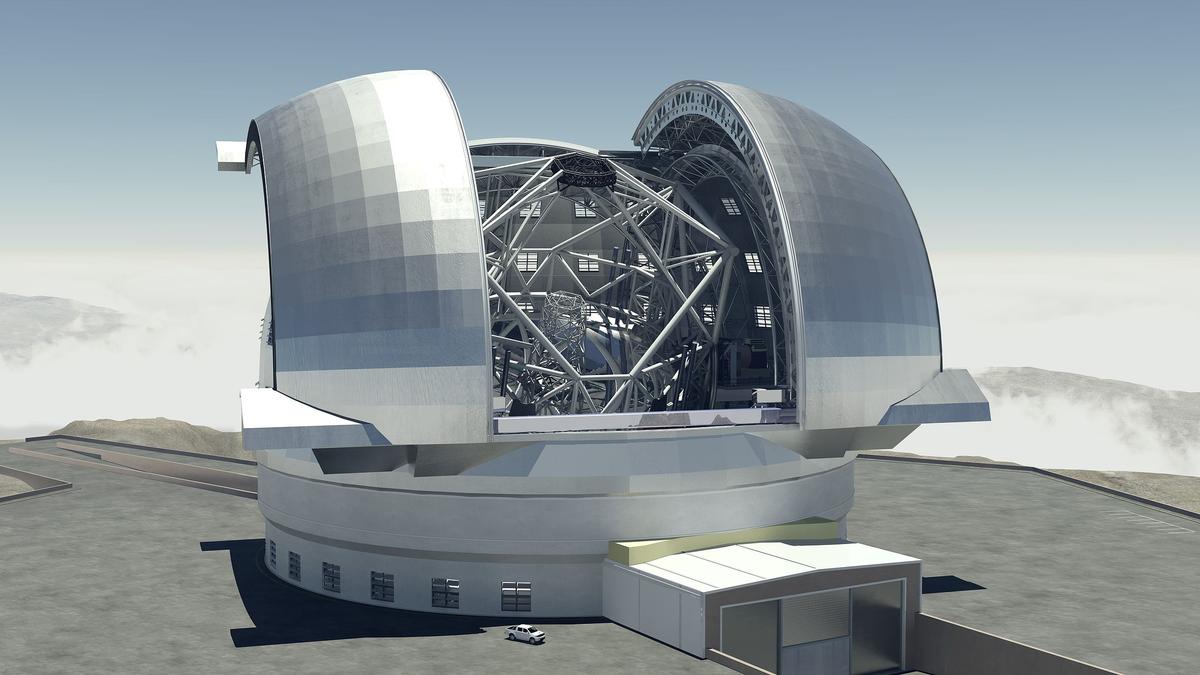
The Extremely Large Telescope (ELT) is under construction atop the Cerro Armazones in the Atacama Desert in Chile, as part of the European Southern Observatory. It has five mirrors and a combined aperture of 39.3 m. It is expected to be completed by 2028. The ELT’s light-gathering power will exceed that of any telescope to date, with a fantastic resolving power. Our eyes can discern two lights burning 30 cm apart and kept 1 km away. In perfect conditions, the ELT can distinguish two lights kept 30 cm apart from 12,000 km away.
Astronomers also increase the exposure time to better observe distant cosmic objects. Even a cup left in a drizzle for an extended duration will become full with rainwater. Similarly, by keeping the camera’s shutter mounted to the telescope open for a protracted period, we may record dimmer light sources. Telescopes expose instruments called charge-coupled devices to light from target sources for many hours before combining them to generate a composite image.
The Subaru Telescope is an 8.2-m-wide Japanese telescope located at the Mauna Kea Observatory in Hawaii. It recently used 10 hours of exposure time to capture a faint celestial object with a visual magnitude of 27.7, which is 100-million-times fainter than what any human eye can detect.
T.V. Venkateswaran is a science communicator and visiting faculty member at the Indian Institute of Science Education and Research, Mohali.
Published – September 18, 2024 08:52 am IST